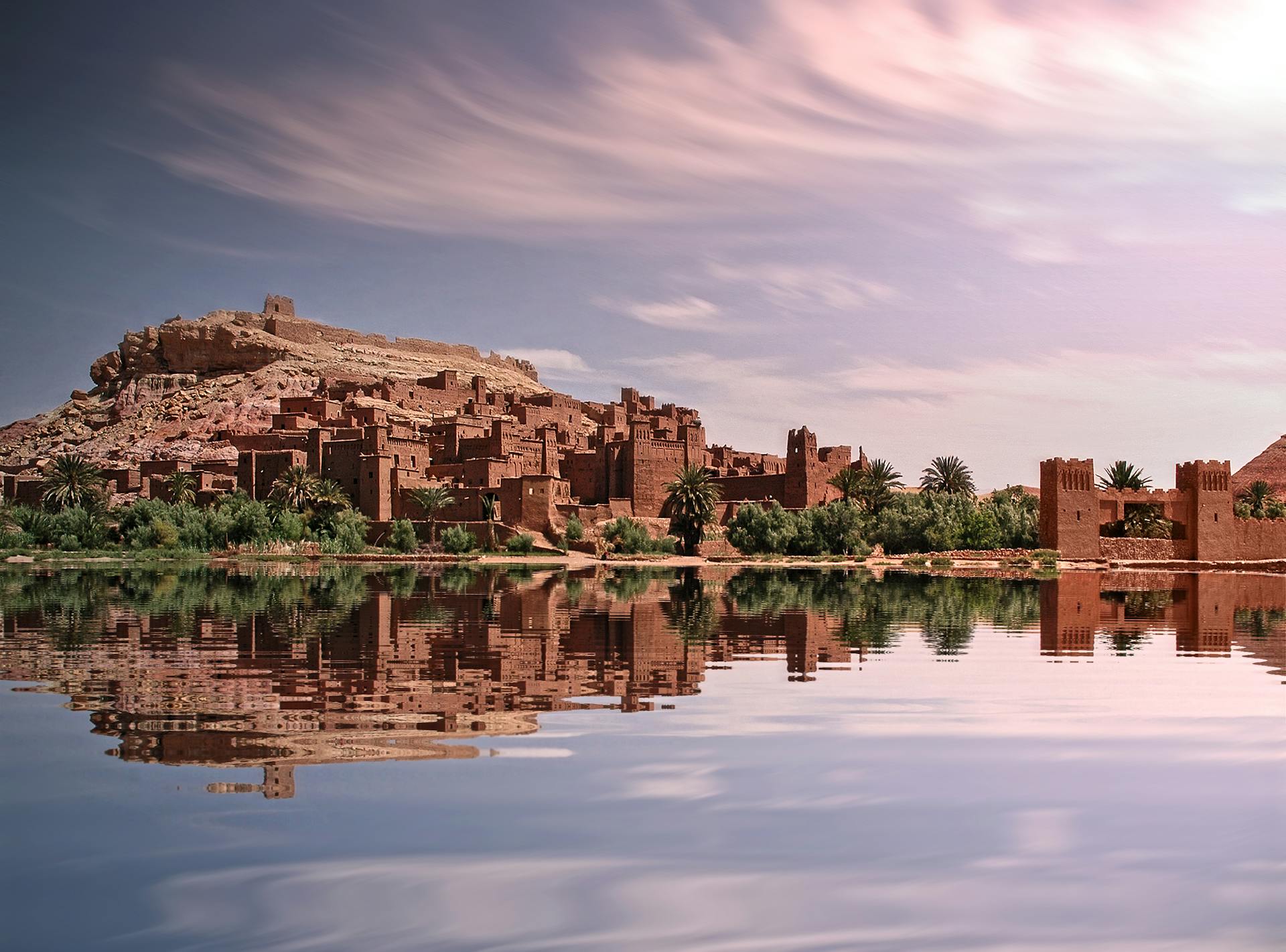
The wind arrives before the city does. Driving west from Marrakech, you feel it first as a shift in temperature — the interior heat breaking against something cooler, saltier, alive with moisture. By the time the Atlantic coast appears, the wind has taken full possession of the landscape: argan trees bent permanently eastward, sand streaming across the road in low, fast rivers, and ahead, the walled silhouette of Essaouira rising from the spray like a ship that decided, centuries ago, to stop sailing and simply stay.
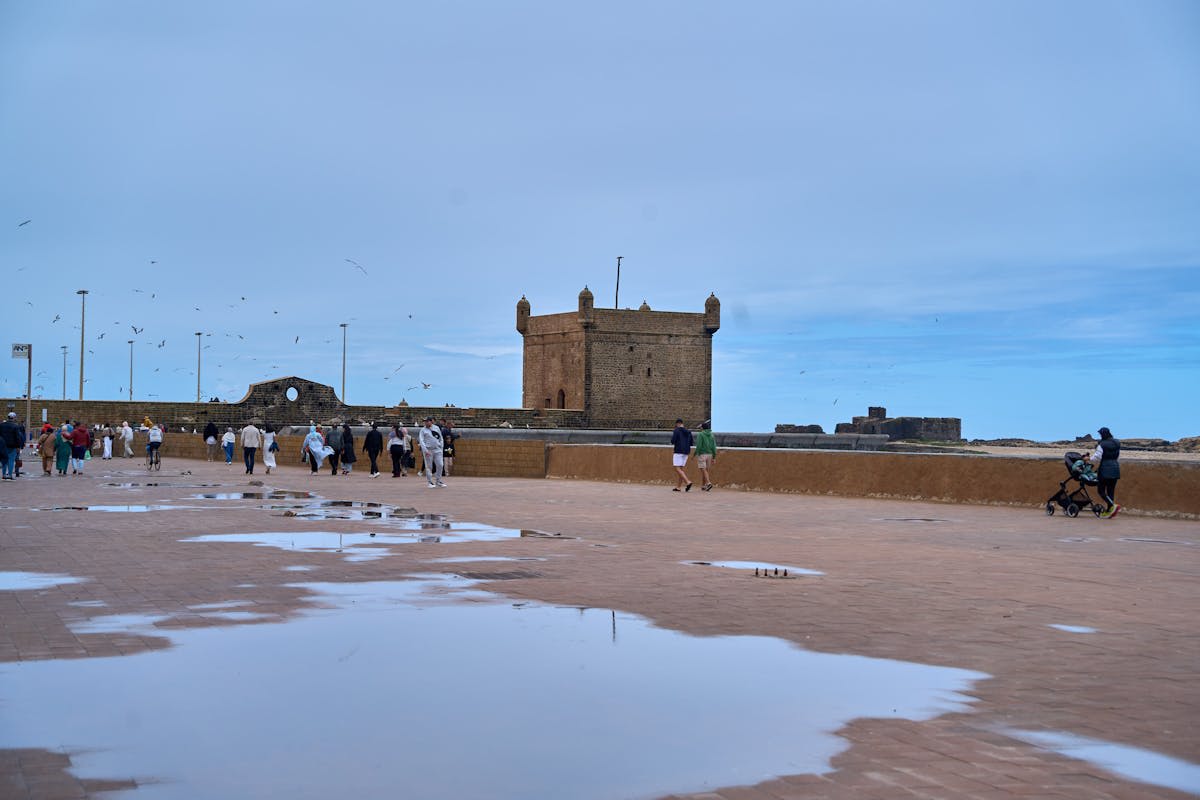
The wind here has a name — the alizee, the trade wind — and it defines everything. It keeps the summer temperatures twenty degrees cooler than Marrakech, an hour and a half inland. It sculpts the beach into a long, flat expanse of hard-packed sand that stretches south for miles. It fills the sails of kitesurfers and windsurfers who come from across Europe to ride it, treating what others might call hostile weather as a gift. And it gives the town its character: a certain roughness, a salt-cured resilience, a refusal to be precious about anything. Essaouira is not delicate. It is beautiful the way a working boat is beautiful — because it functions, because it endures, because the elements have shaped it rather than destroyed it.
The medina is a UNESCO World Heritage site, and it carries an unusual distinction: it was designed. In the eighteenth century, Sultan Mohammed III commissioned a French architect named Theodore Cornut to build a port city that could control Atlantic trade routes. The result is a medina that actually makes sense — streets laid out in a navigable grid, a rarity in Morocco that feels almost disorienting after the deliberate chaos of Fes or Marrakech. The ramparts face the ocean, their stone walls battered by spray, their cannons still pointed seaward in a gesture of defiance that time has rendered decorative. Walk the Skala de la Ville at sunset and the views alone justify the visit: the Atlantic crashing against the rocks below, the purple silhouettes of the Iles Purpuraires offshore — islands where Phoenicians once harvested murex snails to produce the imperial purple dye that was, pound for pound, more valuable than gold.
The fishing port is Essaouira’s pulsing, reeking, magnificent heart. Blue wooden boats crowd the harbor, their paint peeling, their names painted in Arabic script on the prows. Fishermen haul in the morning catch — sardines, sea bream, squid, octopus, prawns — and carry it to the stalls at the harbor’s edge, where it is grilled on the spot over charcoal and served on plastic plates with bread and harissa for a few dirhams. The smoke drifts across the harbor and into the medina. The cats, who are many and strategic, position themselves at ankle height and wait. It is the most honest meal in Morocco: fish that was in the ocean an hour ago, cooked by the people who caught it, eaten within sight of the boats that brought it in.
Essaouira’s souks trade frenzy for a quieter kind of commerce. The specialty here is thuya wood — the gnarled, aromatic root of a tree that grows in the surrounding forests — carved into boxes, chess sets, and sculptures with a craftsmanship that ranges from tourist-functional to genuinely exquisite. The art galleries that dot the medina reflect the town’s long history as a refuge for creative types. Orson Welles filmed his 1952 Othello here, using the ramparts and the port as his Venetian backdrop, and the town has traded on that association ever since — there is a square named after him, and a small plaque, and the general sense that Essaouira has always attracted people who needed a place to work in peace, far from the noise of larger cities.
The Gnawa music tradition is Essaouira’s deepest cultural current. Gnawa is a spiritual practice rooted in the experience of sub-Saharan Africans brought to Morocco as slaves centuries ago — a fusion of African rhythm, Sufi mysticism, and Berber tradition that expresses itself through trance-inducing music played on the guembri, a three-stringed bass lute, accompanied by iron qraqeb castanets and call-and-response chanting. The annual Gnaoua World Music Festival in June transforms the town into an open-air concert venue, with performances on stages set against the ramparts and in the squares, drawing hundreds of thousands of visitors. But Gnawa is not only a festival — it lives year-round in the restaurants and riads where musicians play nightly, and in the lila ceremonies that are still performed privately, where music serves not as entertainment but as a technology of the spirit.
The beach south of town is where Essaouira exhales. The sand stretches for kilometers, wide and wind-scoured, and on any given afternoon you will find surfers, horseback riders, football games, and families gathered around picnics weighted down with stones against the eternal wind. The surfing here is good — not world-class, but consistent, with breaks suited to intermediates and a vibe that is relaxed rather than competitive. Further south, the village of Sidi Kaouki offers emptier waves and a quieter version of the same Atlantic magic.
When to go: June for the Gnaoua World Music Festival and the town at its most electric. April to October for reliable wind and sun, ideal for water sports. Evenings are cool year-round, even in summer — bring a layer and expect to use it.