
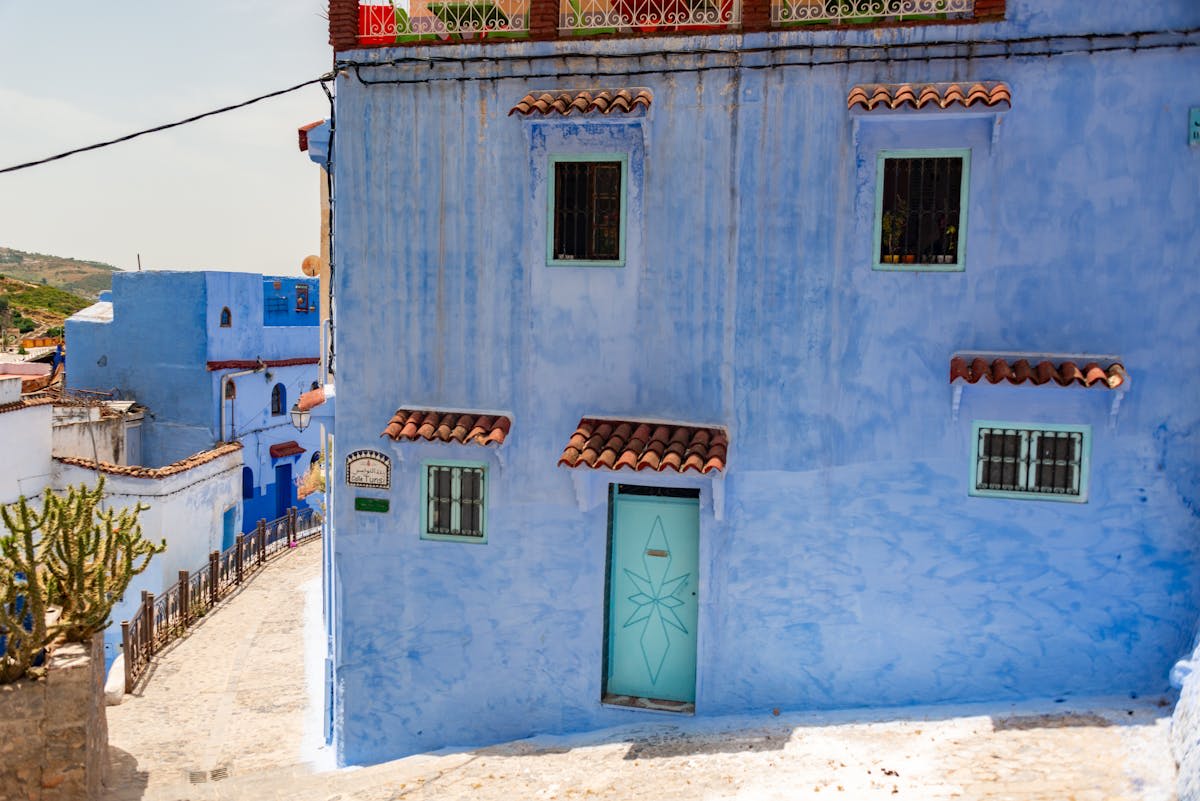
The first thing you notice is that the color is not uniform. Chefchaouen is not painted a single blue — it is painted every blue. The walls of the old medina shift from powder to cobalt to cerulean to a deep, almost violet indigo, sometimes within the span of a single staircase. Doorways are framed in ultramarine. Flowerpots sit on periwinkle ledges. Cats — and there are many cats — sleep on steps that fade from turquoise to sky. The effect is not merely pretty; it is genuinely disorienting, as though you have stepped inside a painting by someone who understood blue the way a musician understands silence, as a medium with infinite variations.
The origins of the tradition are debated and probably layered. Some say Jewish refugees who settled here in the 1930s brought the custom of painting walls blue to symbolize the sky and heaven. Others claim it keeps mosquitoes away. Still others suggest it was simply a practical choice — the lime wash mixed with blue pigment reflects heat in a mountain town where summers can bite. Whatever the truth, the result is a town that has become one of the most photographed places on earth, and that somehow survives its own fame with grace. The medina is small enough to cross in twenty minutes, yet you will not cross it in twenty minutes, because every turning reveals another composition of blue wall, green plant, and golden light that demands you stop, look, and possibly sit down with a glass of mint tea to consider what you are seeing.
Chefchaouen sits at the foot of the Rif Mountains, and the landscape announces itself in every direction you look. The twin peaks of Jebel ech-Chaouen — the “horns” that give the town its name — rise directly behind the medina, their slopes thick with pine and oak forest. Hiking trails radiate outward into a countryside of extraordinary beauty: terraced farms, hidden waterfalls, and ridgelines where the views stretch north to the Mediterranean on clear days. The trail to the Spanish Mosque, a half-ruined building on a hilltop east of town, is the essential sunset walk. From there, the entire medina spreads below in a cascade of blue rooftops against green hills, catching the last light in a way that makes even seasoned photographers fumble with their settings.
The town carries a distinctly Spanish-Moroccan character that sets it apart from the rest of the country. Founded in 1471 as a fortress against Portuguese expansion, Chefchaouen later absorbed waves of Andalusian refugees — Muslims and Jews fleeing the Spanish Reconquista — who brought with them architecture, cuisine, and cultural habits that persist today. The medina’s layout, with its small plazas and tiled fountains, feels more Andalusian village than Moroccan souk. The food reflects this blend: you find bisara and tagine alongside Spanish-inflected dishes, goat cheese from the Rif, and bread baked in communal ovens whose warmth you can feel through the walls as you pass.
The Rif is also Morocco’s cannabis heartland, and this is not a whispered secret but an observable fact. Kif — the local term for marijuana — has been cultivated in these mountains for centuries, and the fields of cannabis plants are visible on the hillsides outside town. The culture around it is complex: technically illegal but deeply woven into the local economy, tolerated in practice but risky for visitors who mistake tolerance for invitation. The subject is worth understanding rather than either romanticizing or condemning, because it is part of what makes the Rif the Rif — a region that has always operated by its own rules, at a comfortable distance from the central government in Rabat.
The Ras el-Maa waterfall at the eastern edge of the medina is where the town’s domestic life meets its wild surroundings. Women gather to wash wool in the cold mountain water. Children splash in the pools below. The sound of the falls provides a constant, gentle percussion that follows you through the nearby streets. Beyond the falls, trails lead into the hills where the blue walls end and the green world begins, and the transition is so abrupt it feels like crossing a border between two countries that happen to share a waterfall.
Evenings in Chefchaouen are quiet in a way that Marrakech and Fes cannot imagine. The medina empties after dark. Restaurants serve simple, excellent food — grilled meats, fresh salads, the local goat cheese drizzled with olive oil and herbs — on rooftop terraces where the only sounds are conversation, distant music, and the occasional protest of a cat. The sky, freed from the light pollution that plagues larger cities, fills with stars. And the blue walls, lit by the occasional streetlamp, take on a deeper, almost phosphorescent quality, as though the town is glowing from within.
When to go: March to May for wildflowers in the Rif and pleasant hiking temperatures. September to November for clear skies, cooler air, and fewer visitors in the medina’s narrow lanes.