Let us dispense with the obvious: Casablanca is not the city from the film. There is no Rick’s, no fog-shrouded airstrip, no letters of transit. The 1942 movie was shot entirely on a Warner Brothers sound stage in Burbank, California, and its version of the city — romantic, shadowy, full of desperate European refugees — bears no resemblance to the actual place. The real Casablanca is louder, bigger, more chaotic, and more interesting than anything Hollywood imagined. It is Morocco’s largest city by far, its economic capital, its port, its engine. Seven million people live in its sprawl, and they are too busy building a modern African metropolis to worry about Humphrey Bogart.
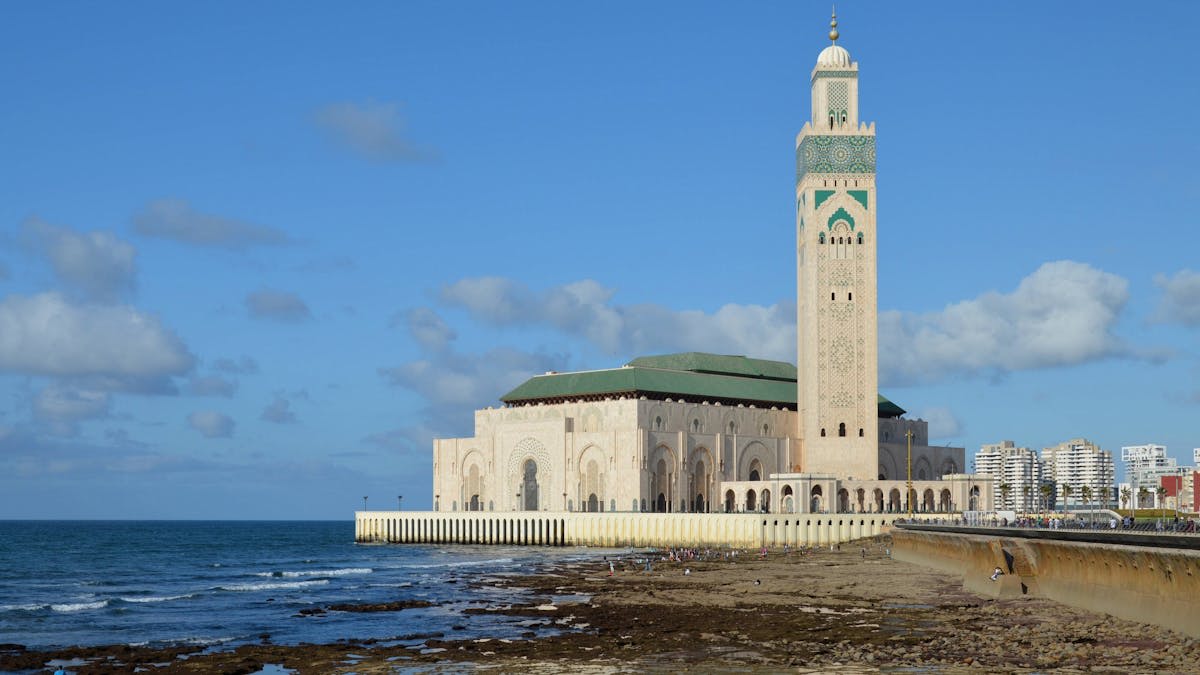
The city does have a monument worthy of cinema, though, and it stands at the edge of the Atlantic on a promontory where waves crash against a platform of stone and the salt air carries the call to prayer across the water. The Hassan II Mosque is staggering in both ambition and execution. Completed in 1993, its minaret rises 210 meters — the tallest religious structure on earth — and its prayer hall accommodates 25,000 worshippers, with space for another 80,000 on the esplanade. The floor is built partially over the ocean, with glass panels that allow worshippers to pray above the sea, a reference to the Quranic verse that God’s throne rests upon water. The interior is a cathedral of craftsmanship: hand-carved cedarwood ceilings, floors of Carrara marble and Moroccan onyx, zellij tilework in patterns so intricate they seem to pulse, and a retractable roof that opens to the sky. It is one of the few mosques in Morocco open to non-Muslims, and the guided tour — available several times daily — is essential.
Beyond the mosque, Casablanca reveals itself slowly, and it rewards those who look up. The city’s Art Deco heritage is its great hidden treasure, a legacy of the French Protectorate era when architects were given license to experiment. The downtown quarter around Boulevard Mohammed V and Place Mohammed V contains one of the finest concentrations of Art Deco and Neo-Mauresque buildings anywhere on earth. The influence is hybrid: classical Deco geometry merged with Islamic arches, zellij borders, and carved stucco, producing a style unique to Morocco. The Cinema Rialto, the Hotel Lincoln, the Central Market building — these are structures of genuine architectural distinction, though decades of neglect have given many of them a melancholy patina. Restoration efforts are underway, but part of the appeal is the imperfection: paint peeling to reveal layers of previous color, ironwork rusting into organic shapes, balconies where laundry dries among crumbling ornament. It is Deco with a heartbeat, not a museum piece.
The Quartier Habous — the New Medina — offers a different kind of architectural curiosity. Built by the French in the 1930s as a “modern” medina, it was designed to provide traditional Moroccan urban forms with improved sanitation and wider streets. The result is an uncanny space: recognizably a medina in its arched passages and tiled fountains, but with a geometric regularity that feels subtly off, like a dream of a medina rather than the thing itself. Today it houses excellent pastry shops, olive merchants, and the royal palace, and it provides a far calmer shopping experience than the old medinas of Fes or Marrakech.
Casablanca’s food scene deserves its own paragraph. This is a port city, and the seafood is superb. The stalls at the Marche Central — the old central market on Boulevard Mohammed V — serve grilled sardines, fried calamari, and sea bream so fresh the eyes are still clear, plated on paper with nothing but lemon, cumin, and bread. The city’s restaurants range from hole-in-the-wall tagine joints where lunch costs two dollars to elegant establishments in the Corniche district where French technique meets Moroccan ingredients. Casablanca is also the best city in Morocco for street food after dark: the smoke from grilled merguez sausages, the sizzle of msemen flatbread on a griddle, the sweet perfume of orange juice freshly squeezed at a cart — the night air is a menu in itself.
Yes, Rick’s Cafe exists — a reconstruction built in 2004 by a former American diplomat, designed to look like the film set, serving cocktails and live piano to tourists who want the fantasy. It is well done for what it is. But the real Casablanca sits outside its doors: a vast, imperfect, ambitious city drinking its coffee on the grand boulevards, arguing about football, building skyscrapers, and not looking back.
When to go: March to May or September to November for mild Atlantic weather and comfortable walking temperatures. Summer is warm but tempered by ocean breezes along the Corniche. Winter brings occasional rain and moody gray skies that suit the city’s Art Deco melancholy.