Pantanos de Centla
"The manatee surfaced two meters from the boat with a sound like a very large, polite breath, and then was gone. The guide had already moved on to identifying a heron."
We left Frontera before five in the morning because the guide had been emphatic: dawn or nothing. He said this the night before, when we arranged the tour, and again when he called to confirm at 9pm, and once more by text at 11pm. The message was received. By 4:45 we were outside the guesthouse in the dark, and by 5:15 we were in a small motorboat moving through channels in the blackness of a Tabasco wetland, the outboard engine kept deliberately low so as not to disturb whatever was ahead.
The Pantanos de Centla Biosphere Reserve is the largest wetland system in Mesoamerica — roughly 300,000 hectares where the Grijalva and Usumacinta rivers meet, slow, and spread across the flat Tabasco coastal plain before entering the Gulf of Mexico. It is the kind of geographic superlative that doesn’t immediately register until you’re in it, because on a map it looks like a complicated blue smear, and on the ground, from a boat, it looks like water going in all directions with no visible horizon.
The Dawn Light and the Manatee
The channels of the Pantanos are lined with water hyacinths, which grow in dense floating mats along the banks and produce a violet flower that is unfairly beautiful for something that’s also considered an invasive nuisance in other parts of the world. In the dawn light — that particular Tabasco dawn that is pink and heavy and arrives as if surprised to find itself here — the hyacinths glow. The color is impossible to photograph adequately. I’ve tried.
Our guide, whose name was Ernesto and whose method was encyclopedic silence punctuated by sudden sharp pointing, cut the engine at one point and let us drift. We’d been moving for about forty minutes. He pointed at the water off the port side. We watched. Nothing. He didn’t move his arm. We watched more. A shape in the dark water, large and slow, something moving just beneath the surface. Then: the manatee surfaced two meters from the boat.
I want to be precise about this moment because imprecision would dishonor it. The animal was approximately three meters long — a West Indian manatee, the kind that inhabits these Gulf-coast wetlands. The sound it made when it surfaced was a single exhalation, oddly gentle for something that large, a sound like a person sighing quietly in another room. It floated for perhaps eight seconds, enough to see the scarred grey skin, the paddle-shaped tail, the small eyes that registered us without apparent concern. Then it dove, and the hyacinths on the surface barely moved.
Ernesto lowered his arm, started the engine, and moved on. He had already identified a tricolored heron in the same motion.
The Birds
I grew up near the Camargue, which is the great wetland of southern France — the place where the Rhône delta spreads into a wide flat reserve of flamingos, white horses, and herons. The Camargue is extraordinary. I’ve been there many times. I thought I had a reference point for what a major wetland bird population looks like.
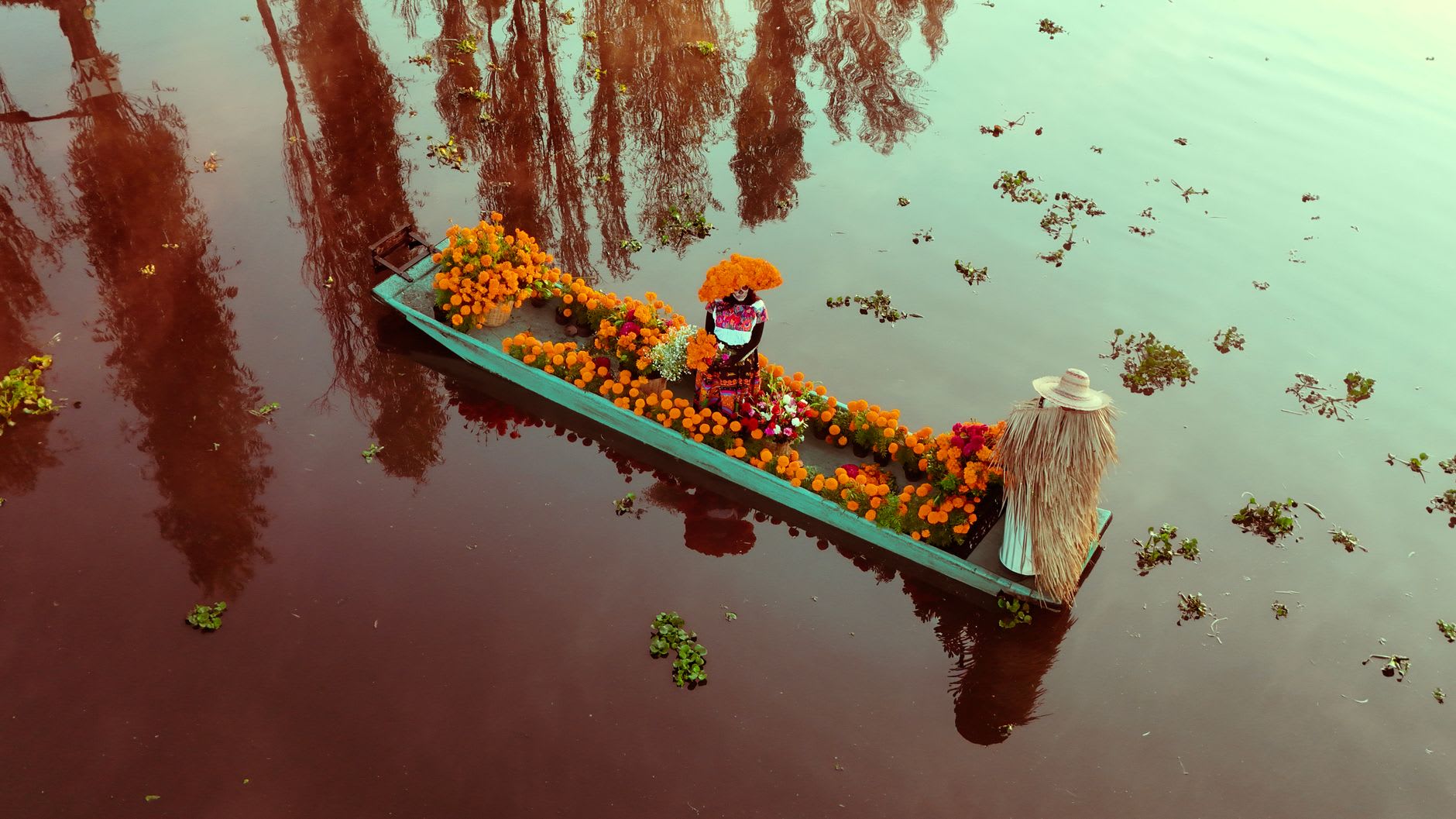
The Pantanos de Centla recalibrated this. Not because any individual species was more spectacular — a French grey heron is a magnificent animal — but because the density and variety simply don’t compare. In two hours on the water, Ernesto identified, and I independently confirmed with binoculars, sixty-three species. I am not a serious birder. I know European species well enough and that’s roughly where my expertise stops. Ernesto knew things I didn’t have vocabulary for: not just species, but individual behavioral patterns, which nesting pairs had returned to the same sites, which territories were new this season. He navigated not by channel markers but by memory of where specific animals lived.
The wood storks are extraordinary — large, hunched, prehistoric. The roseate spoonbills arrived in a group of eleven, which Lia photographed for approximately fifteen uninterrupted minutes while Ernesto and I watched in silence. There are snail kites that hunt exclusively the apple snails in the hyacinths, hovering with a precision that seems more calculation than instinct. The black-bellied whistling ducks appear in groups and make a sound that does not match their size. Along one bank, a boat-billed heron sat completely still for so long that I mistook it for a broken branch.
We saw crocodiles — Morelet’s crocodiles, which are smaller than the American crocodile and somewhat less alarming for that, though only somewhat. One was perhaps two and a half meters and was lying on a mud bank with its mouth open in the thermoregulatory posture they use to cool down. Ernesto slowed to about five meters away. The crocodile did not move. I moved slightly backward in the boat, which Ernesto noticed and found gently amusing.
The Camargue is beautiful and quieter and more accessible and has better infrastructure. The Pantanos de Centla is wetter, louder, denser, and more alive in a way that takes some adjustment. The heat by 9am was already serious. The air smells of mud and vegetation and river. There is no elegant way to experience it — you sweat, you use sunscreen aggressively, you accept that your clothes will be damp for the rest of the day. This is correct. The place is not performing for you.
Getting There and Practical Notes
The practical base for visiting Pantanos de Centla is either Frontera (the largest town in the area, on the Grijalva delta) or the village of Centla itself. Frontera is about 100 kilometers from Villahermosa — roughly 90 minutes by car, or accessible by ADO bus. From Frontera, guides run boat tours into the reserve.
Finding a guide is best done the day before rather than the morning of. The municipality tourist office in Frontera has contacts, and the local ecological cooperative — Cooperativa Ecoturística Pantanos de Centla — runs official tours. Prices are modest; the tour typically runs two to four hours depending on what’s been spotted recently and how talkative your guide is about it. Ernesto was not talkative about anything except birds, which was exactly right.
Dawn departure is not optional. The birds are most active from first light to about 8am, and the heat becomes significant after 9. By 10am the wetland has quieted to something more torpid and less spectacular. If you must do an afternoon tour, go in the dry season (November through April) when water levels drop and animals concentrate. We went in May, which is late dry season verging on wet — the hyacinths were in full bloom and the manatees were more active. That turned out to be the right call.
Bring more water than you think you need. Bring binoculars — they are worth more here than at almost any wildlife site I’ve visited. The sun on the water in the morning is specific and intense; a hat with a brim is not optional. And accept, in advance, the possibility that the most extraordinary moment of the trip will last eight seconds and then disappear into the hyacinths, and that this is entirely sufficient.