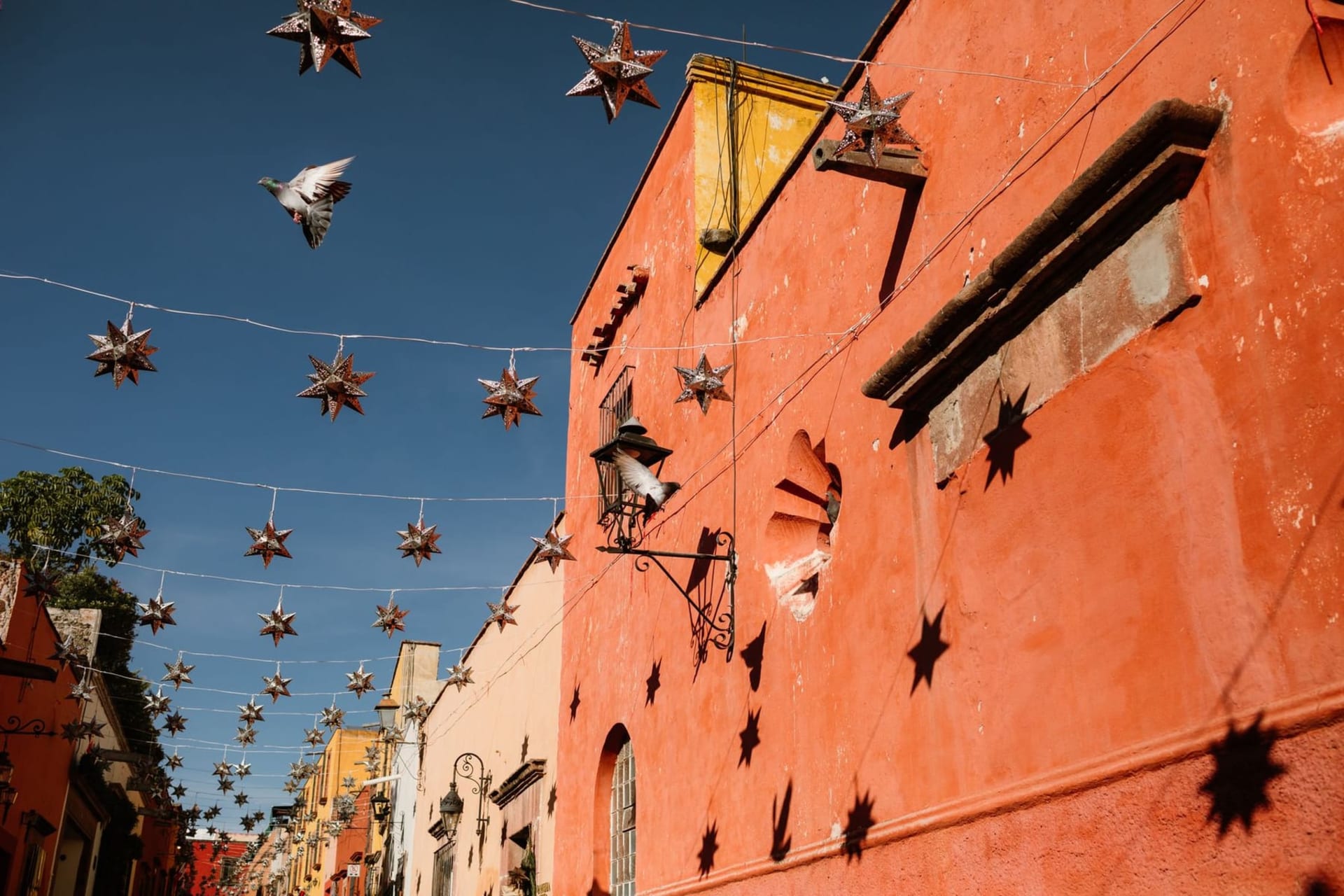
San Miguel de Allende
"Every corner of San Miguel looks like it was composed rather than built."
I live in Mexico, which means San Miguel de Allende carries a particular weight for me — it is the version of this country that the rest of the world knows best, the one that lands on magazine covers and retirement surveys, and I used to resent that a little. Then I went back in November, with Lia, and the city reminded me that popularity is not the same as being wrong.
The light here does something specific at around five in the afternoon. It comes in low and amber over the Bajío plateau and hits the pink quarrystone of La Parroquia — the neo-Gothic parish church whose fantastical towers were supposedly sketched in the 1880s by an indigenous mason named Zeferino Gutiérrez, who had learned Gothic forms from postcards of European cathedrals. It is baroque in ambition, improbable in execution, and it anchors the Jardín Principal the way a very good painting anchors a room.
The Streets Below the Jardín
Walking down Calle Umaran toward the Mercado Ignacio Ramírez in the morning, I passed stalls selling carnitas on blue plastic stools, a woman ironing tablecloths in a doorway, the smell of copal from a botanica three steps down from street level. The market’s fish section has an intensity of smell and argument that no tourist brochure prepares you for — and that is precisely the point. On the upper level, the handicraft vendors sell textiles from Oaxaca and Guerrero, and the prices are negotiable in a way that feels like conversation rather than combat.
The streets themselves — Recreo, Hernández Macías, San Francisco — are paved in rough-cut adoquín stone that turns every wheeled suitcase into a percussion instrument and every walk into something you feel in the ankles. The colonial facades are painted in ochre, terracotta, rust, and a specific blue-green that I have only seen in the Bajío. Window grilles cast long shadows by ten in the morning.
The Surprise Off Canal
What I had not expected was the Fábrica La Aurora, a converted early-20th-century textile factory on the northern edge of the centro that now houses sixty-odd art galleries, antique dealers, and design studios. We stumbled in on a Tuesday afternoon thinking it was a market and spent two hours there instead. A ceramicist from Guadalajara was firing small pieces in a kiln the size of a refrigerator. A gallery showing mid-century Mexican furniture had pieces I would have bought if we owned anything other than a rented apartment. The light inside the factory — filtered through the original iron-framed skylights — was extraordinary: the kind of light that makes everything look like it belongs in a collection.
That evening we ate enchiladas mineras — the Guanajuato-style version, stuffed with potato and carrot, bathed in red guajillo and stacked high — at a place on Calle Mesones with four tables and a handwritten menu. The agua de jamaica came in a clay pitcher and tasted like someone had distilled the colour red.
What to Carry With You
San Miguel rewards slowness. The Chorro neighborhood, downhill from the Jardín past the Parque Benito Juárez, is where the city’s water supply historically emerged and where the streets get quieter and the bougainvillea get more aggressive. The Templo del Oratorio de San Felipe Neri holds a series of oil paintings that deserve more attention than they get. And the view from El Mirador — the overlook above town on the road toward the thermal baths at La Gruta — shows you the whole arrangement at once: terracotta rooflines stepping down to the reservoir, towers rising above the canopy, the plateau stretching toward distant mountains.
When to go: October through December for dry, clear days and the cool, leather-jacket evenings the altitude provides. The Día de los Muertos celebrations in early November transform the Jardín and the surrounding streets into something that has to be experienced to be believed.