Akumal
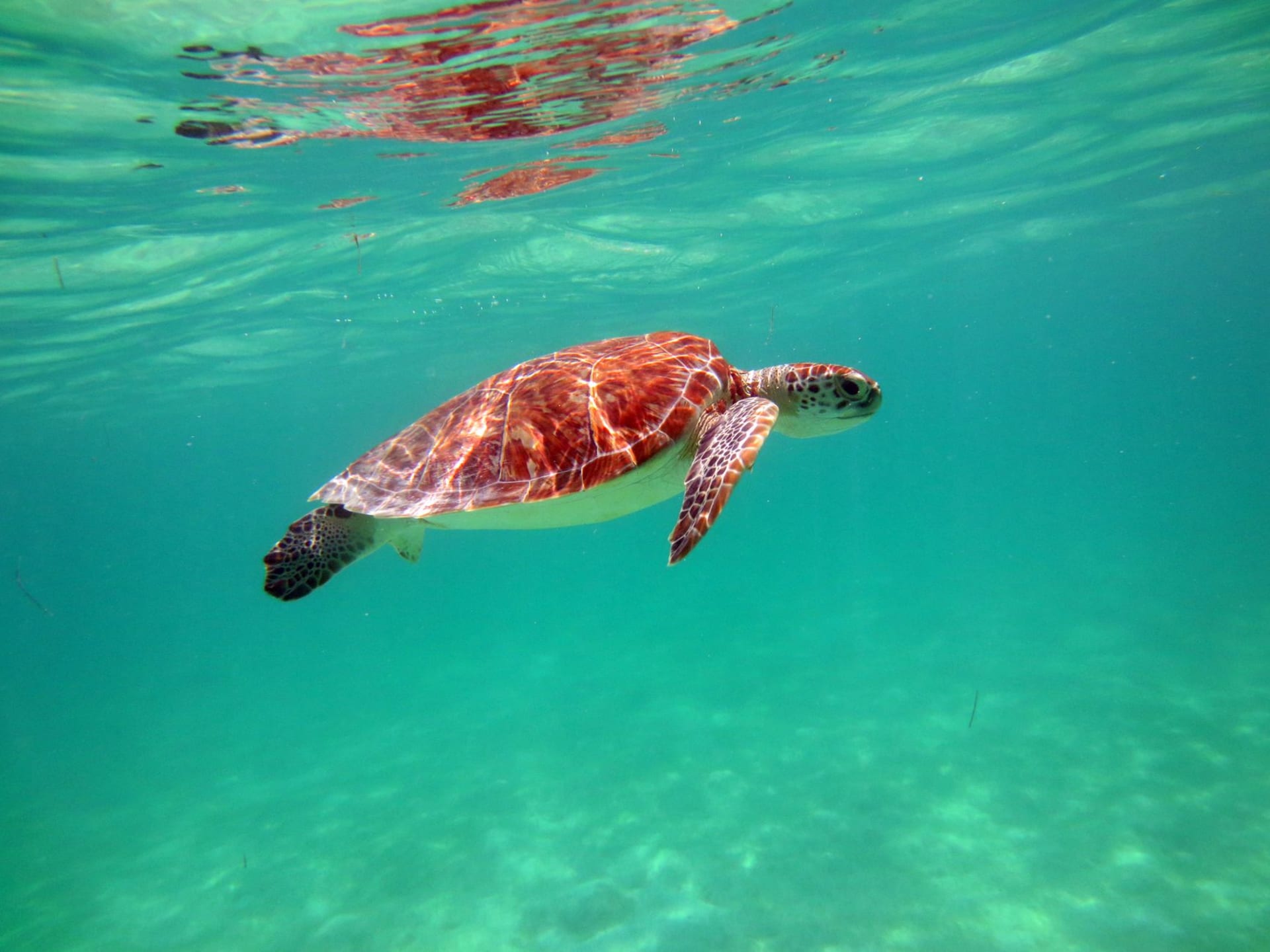
"The turtle was the size of a coffee table and three meters below me and it had not once acknowledged that I existed. This felt like exactly the right relationship."
One hundred kilometers south of Cancún, the Riviera Maya mostly does the same thing: beach resorts, all-inclusives, pools adjacent to the ocean that people use instead of the ocean. Akumal is on the same coast and looks, from the highway turnoff, like it might be the same story. It isn’t. What Akumal has that no amount of resort development can engineer is a shallow bay with a seagrass bed that green sea turtles have been grazing for longer than anyone has been counting, and the turtles have not agreed to be impressed by the infrastructure.
I came on a Tuesday in February, early. This matters: the beach fills toward midday with day-trippers from the resort strip, and the snorkel experience degrades as the water gets crowded. At seven-thirty in the morning, the beach was nearly empty. A man under a thatched palapa was already open, renting snorkel gear from a wooden rack. I paid, waded in, and within ten meters of shore I could see the seagrass beginning below me.
The Turtles
The first one appeared at a depth of maybe four meters, moving along the bottom in a slow, deliberate arc, its front flippers doing the characteristic sweeping motion that looks lazy and covers ground efficiently. Green sea turtles at rest or feeding move with a quality I can only describe as unhurried in a structural sense — not slow because they’re being slow, but operating on a timescale that simply doesn’t account for urgency. This one was large, the shell a good seventy centimeters across, the color of old olive oil and dark water combined.
I stopped swimming and floated. It continued grazing. Its beak tore at the seagrass with a slow, methodical pull. It did not look at me. I was not a relevant variable.
Over the next two hours I encountered five different turtles, ranging from one that must have been juvenile — shell maybe thirty centimeters, moving faster, less confident in its grazing — to a large loggerhead near the outer edge of the bay that surfaced for air about two meters from where I was floating, exhaled with an audible exhalation, and descended again with complete disregard. The reef at the outer edge of the bay is within swimming distance from shore and has the usual Caribbean composition: brain coral, elkhorn, sergeant majors and parrotfish and the occasional barracuda hanging in the water column. But the turtles are the reason to come, and the reason to come back.
I came back the next morning.

Yal-Ku Lagoon
About a kilometer north of the main bay is Yal-Ku, a natural tidal inlet where a freshwater spring meets the sea through a channel in the mangroves. The result is a lagoon of unusual clarity — visibility long enough that you can see the far wall of the channel from the entrance — with a mix of fresh and salt water that creates its own ecology. Bonefish cruise the shallower areas. Barracuda hang in the deeper sections with the suspended stillness that makes them unsettling until you get used to it. The salinity gradient creates a slight visual shimmer at certain depths where the water layers meet.
There is an entrance fee, which goes toward maintaining the protected area. The lagoon is enclosed and calm, which makes it excellent for less confident swimmers and for children. I spent an hour there on my second morning before going back to the main bay for the turtles. The light inside the lagoon in the morning, bouncing off the white sandy bottom and filtered through mangrove, is extraordinary and specific to that place.

Practical Notes
Akumal is quieter than Tulum, which is a deliberate understatement. It is substantially quieter than Tulum. There are a handful of small hotels and guesthouses in the village, none of them large, none of them particularly expensive relative to the Riviera Maya’s general price level. The beach itself is public and the snorkeling is technically accessible from shore at no cost beyond the rental gear. Come early. Come on a weekday if possible. The turtles are present year-round, though the peak season for larger numbers is generally June through October when the water is warmest.
The village has a few restaurants, a dive shop, and a small grocery. It is not a place for nightlife or elaborate meals. It is a place for the water, and the water is enough.