Coixtlahuaca
"The Dominican friars built for permanence in a landscape that punishes ambition — and somehow, improbably, both survived."
I came to Coixtlahuaca on a Tuesday in November, on a second-class bus from Tehuacán that dropped me at the edge of town with a handful of other passengers who all seemed to have somewhere specific to be. At 2,100 meters the air was cold and dry and the light had that high-plateau quality — thin, hard-edged, unflattering to nothing. The plaza was quiet. A woman was selling tlayudas from a cart near the corner of the market. I bought one and ate it standing, looking at the ex-convent across the square, trying to process why something that enormous existed here at all.
The Ex-Convent of San Juan Bautista
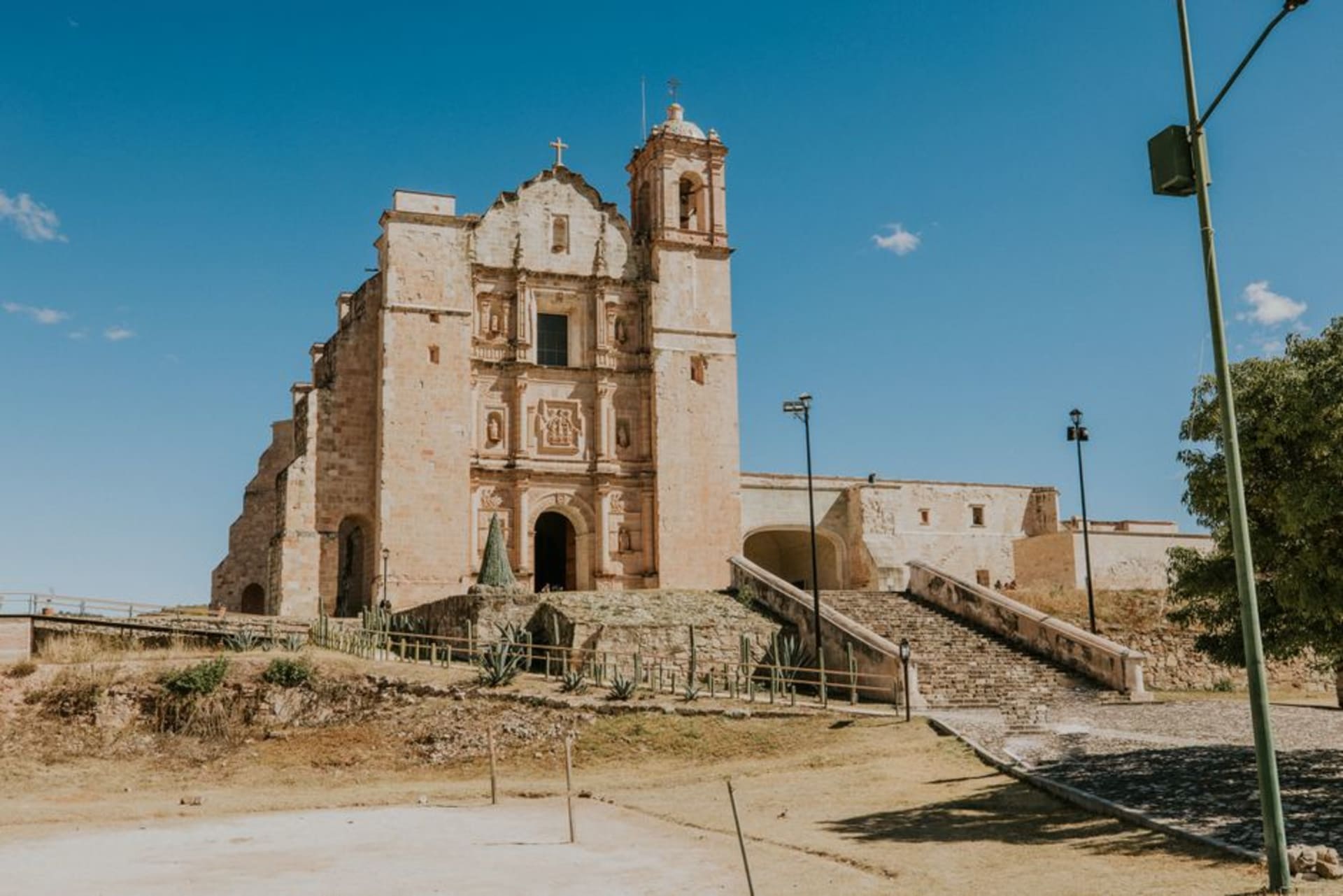
The facade stops you. Not because it is pretty — though it is — but because it makes no sense at this scale in this place. The Dominicans broke ground in 1546 on what would become one of the most ambitious religious building projects in Nueva España, constructing an open chapel — a capilla abierta — with a vaulted arch wide enough to shelter several hundred people for outdoor Mass. The logic was missionary: the indigenous population was too large for any enclosed church. The result, five centuries later, is a ruin that is not quite ruined, maintained just enough to make clear what it once was. Stone medallions cover the facade in patterns that mix Mixtec cosmological symbols with Spanish heraldic motifs — nobody asked one culture to disappear before borrowing its visual vocabulary. I spent a long time on that facade before going inside, where the cloister is still largely intact and the silence is the kind that accumulates over centuries.

The Mixteca Alta Landscape
Coixtlahuaca sits at the center of a region that geography and history have conspired to make difficult. The Mixteca Alta was a major pre-Hispanic commercial corridor — merchants from here traded as far as Tenochtitlan — but the land itself is relentlessly demanding. Walking out from the town toward the barrancas in the afternoon, I could see why the Spanish chose this spot: it commanded the valley the way a watchtower commands a road. The ridges are eroded to something almost lunar, the agave growing in formations that look deliberate, like someone planted them that way to prove a point about persistence. There is a quietness to this landscape that is not peaceful exactly — it is more like the quietness of something that has outlasted everything that tried to break it. A few kilometers from town, the remains of the pre-Hispanic site of Coixtlahuaca itself, Yodzo Coo in Mixtec, are scattered across a hillside that almost nobody visits.

Eating and Staying
The market off the main plaza runs in the mornings and closes by early afternoon. I found a woman there making memelas — thick oval masa cakes — topped with black beans and fresh cheese, eaten with a salsa verde that was the hottest thing I had eaten in weeks and I live in Oaxaca. There is one small hospedaje in town; the rooms are clean and cost almost nothing and the owner will tell you everything about the convent if you ask. She has opinions about which art historian got it wrong. She is probably right.

Getting There
From Oaxaca City, the most direct route goes through Tehuacán — take an ADO or second-class bus north, then transfer toward Coixtlahuaca. Total travel time runs four to five hours depending on connections. Alternatively, some colectivos operate from Nochixtlán on market days. There is no direct tourist service. That is, as far as I am concerned, a feature.