Tlayacapan
"I arrived on a Tuesday and found a market setting up in the shadow of a convent that had been there since 1554. The market was clearly not concerned with the convent. The convent was clearly not concerned with the market."
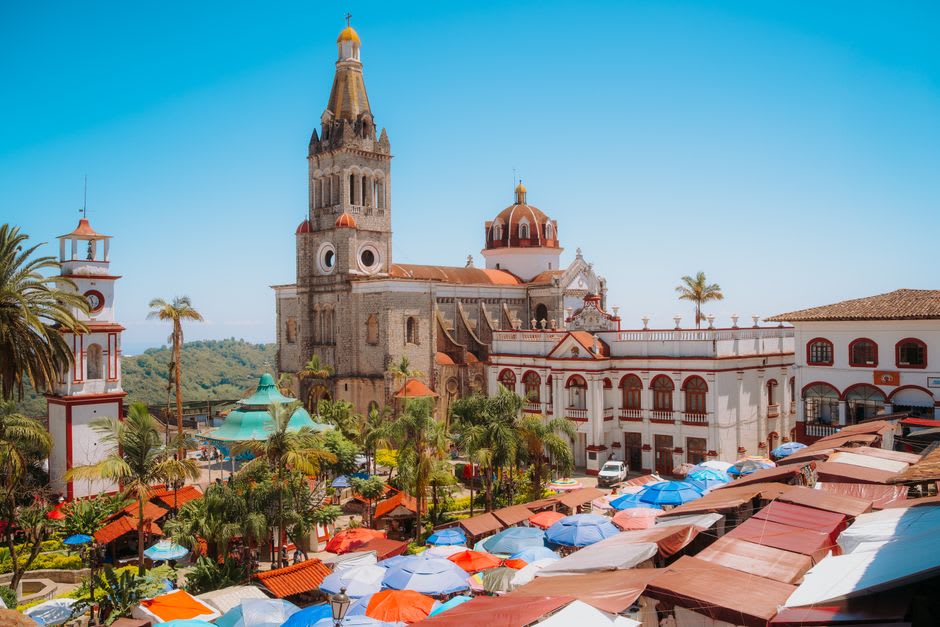
I drove to Tlayacapan on a Tuesday in March, which turned out to be market day, though I only discovered this by arriving and finding the atrium of the Augustinian convent filling with folding tables and tarps and vendors arranging piles of chiles and plastic containers and secondhand clothing. The convent — which has been standing since roughly 1554 — occupied one side of this operation with complete indifference. A woman sold tomatoes in the corner of the atrium where a capilla posa, one of the small corner chapels used for outdoor processions, stood in various states of continued existence. Nobody seemed to find this combination strange. I found it completely wonderful.
Tlayacapan is twenty minutes from Tepoztlán by a road that winds through dry hills planted with maguey. It gets far fewer visitors than its more famous neighbor, which is either a problem or the point depending on what you’re looking for. When I arrived on that Tuesday I counted perhaps four other non-local people in the entire town. By the time I left in the early afternoon I had not revised that number upward significantly.
The Convent
The Augustinian convent of Tlayacapan is one of the better-preserved examples of sixteenth-century religious architecture in central Mexico, which is a sentence that doesn’t quite capture what it feels like to stand in the atrium looking at it. What the Spanish built in Morelos in the 1500s was not modest.
The open chapel — an unusual feature where Mass was said outdoors for large indigenous congregations who could not or would not enter the enclosed church — is intact here in a way it isn’t at many similar complexes. The atrium is large enough to hold a substantial market, as I discovered. The capilla posa in the corner is the kind of thing you walk past thinking it’s a minor architectural detail and then stop and look at properly for fifteen minutes.
I was there on a weekday morning and the church itself was unlocked. Inside, the frescoes on the side chapel walls are faded but legible — figures in the flat, bold style of sixteenth-century religious painting, the kind of thing that France has in abundance in its medieval churches but that feels different here, more recent in some ways, the conversion still recent enough to feel unfinished. I stood in there alone for a while before the sound of the market outside pulled me back.
Pulque Country
Tlayacapan sits in the maguey belt of Morelos, and the pulquerías in town are not tourist operations. I walked past the first one at ten in the morning and it already had regulars. The man at the door had the patient, settled look of someone whose Tuesday morning plans had been made and confirmed some time ago.
I had a cup. Pulque is one of those things that takes getting used to — it’s slightly viscous, mildly fermented, with a sourness that isn’t quite like anything else. In France we have a concept of terroir that we apply mainly to wine and cheese, the idea that what a thing tastes like is inseparable from where it comes from. Pulque is the most terroir-specific drink I’ve encountered in Mexico: what you drink here, made from magueys growing on these specific hills, tastes like this specific valley. Transport it to a bar in Mexico City and it would become something else. It’s meant to be drunk here, in this pulquería, with these particular regulars.
The maguey plants themselves line the road into town — blue-grey and spiky, enormous rosettes of thick leaves that take years to mature before they’re harvested. Some of the plants were flowering, sending up tall stalks that stood three or four meters above the road.
Getting There and the Thermal Baths
From Cuernavaca, Tlayacapan is about forty minutes by car through Yautepec. From Tepoztlán it’s twenty minutes on a road that winds enough to remind you that the Morelos highlands are actual highlands. There’s no easy bus connection, which is part of why it stays quiet.
The thermal baths of the region — Oaxtepec is the most famous, an enormous IMSS-run complex with multiple pools — are close enough to combine with a day in Tlayacapan. I went to Oaxtepec on the same afternoon and found it full of families from Mexico City on a school holiday, which is the correct use of Oaxtepec. The water is warm and sulfurous and the chaos is cheerful.
If you time it right, the Carnival in February is apparently one of the most elaborate in central Mexico. The chinelo dancers — dancers in elaborate costumes and feather headdresses who perform for days during the festival — are a Morelos tradition, and Tlayacapan is considered one of the best places to see it. I have not been in February. I am making a plan to rectify this.
