Tepalcingo
"For fifty weeks it is a quiet town. For one, it is the center of the world for a hundred thousand people."
I first came to Tepalcingo on an ordinary Tuesday and nearly turned around. It is a warm, low, dusty town out on the dry southeastern plains of Morelos, where the sugarcane gives way to scrubbier country and the heat sits heavy on the streets, and on a normal day there is not obviously a great deal to do. Then I walked to the sanctuary, looked up at the façade, and understood that I had come at the wrong time. Because the church I was standing in front of exists at the scale it does for one reason: once a year, this quiet town becomes the destination for one of the largest religious fairs in central Mexico.
The Sanctuary
The Santuario de Jesús Nazareno is the whole point of Tepalcingo, and its façade is one of the more extraordinary things I have seen on a country church in Mexico. It is worked in dense, exuberant sculpted relief — a crowded stone composition of figures, animals, plants, and saints, a kind of eighteenth-century indigenous baroque where the Nahua hands that carved it filled every available surface with detail. You can stand in front of it for a long time picking out shapes: creatures that belong to no European bestiary, faces looking back down at you, a horror vacui that feels older than the Christianity it depicts.
Inside, the object of devotion is a revered image of Jesús Nazareno, and it is to this image that the pilgrims come. On a quiet day you have the whole cool interior more or less to yourself, and the silence makes the frenzy the building was built for hard to imagine.
The Third-Friday Fair
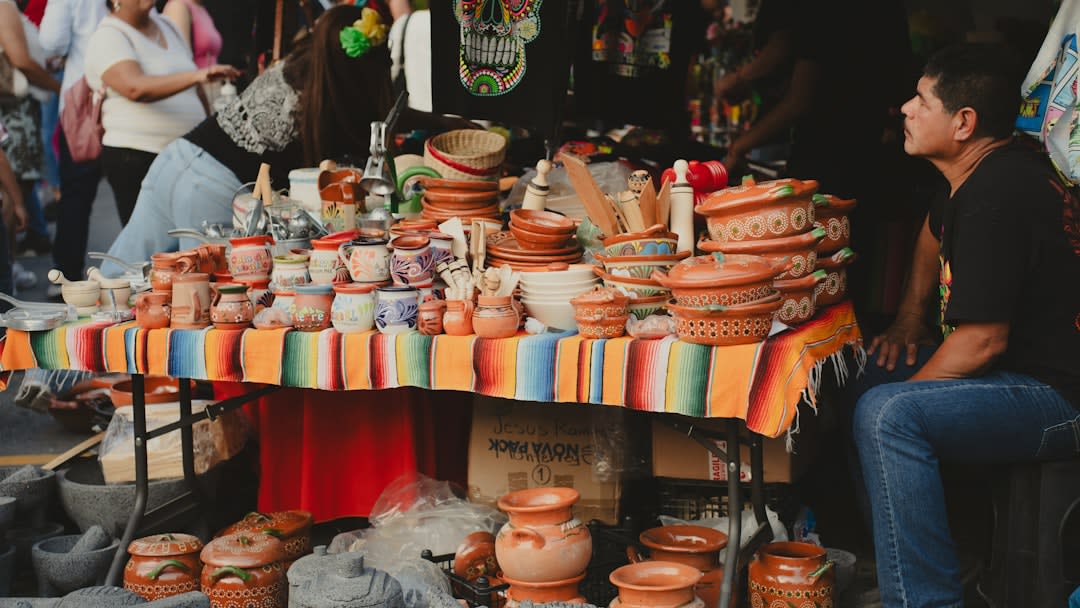
Everything changes on the third Friday of Lent. The Feria de Tepalcingo is a genuine pilgrimage fair, one that has run for centuries and draws people from across Morelos, Puebla, Guerrero, and the State of Mexico — traders, worshippers, and families, tens of thousands of them, converging on this small town all at once. The streets around the sanctuary fill with stalls selling everything a fair in central Mexico sells: pottery, herbs, leather, tools, sweets, cheap toys, prepared food, and the devotional objects that are the fair’s original purpose.
I went once at fair time and the transformation was total. The town I had found half-asleep was a churning current of people; the smell of copal and frying and dust hung over everything; the sanctuary that had been silent was a slow river of pilgrims moving toward the image. It is one of those Mexican events where the commercial, the festive, and the sacred are not separate things but all the same thing, braided together in a way that resists the tidy categories a visitor arrives with.
The Town on an Ordinary Day
The rest of the year, Tepalcingo returns to itself: a warm agricultural town on the dry plains, moving slowly through the heat. There is a market, there are comedores serving the food of warm-country Morelos, and there is the particular quiet of a place that spends fifty-one weeks recovering from and preparing for its one great week.
I have come to like it in this ordinary state as much as the crowded one. You can sit in the shade near the plaza with a cold agua fresca, watch the town go unhurriedly about its business, and feel the strangeness of knowing that this same dusty square will, on one predictable Friday, hold more people than it seems physically able to. Both versions are true. The town holds them both.
Getting There
Tepalcingo lies on the dry plains of southeastern Morelos, reached most easily by car or bus from Cuautla, the nearest hub, in under an hour; from Cuernavaca or Mexico City, route through Cuautla first. Buses and colectivos run the Cuautla road regularly, so a car is convenient but not essential.
Timing is everything here. To see the fair, come for the third Friday of Lent — but know that lodging fills far in advance, prices climb, and the crowds are enormous, so many visitors treat it as a long day trip from Cuautla rather than an overnight. To see the sanctuary itself in peace, come any other week and have that astonishing façade nearly to yourself. It is warm-country year-round, so bring sun protection and water whenever you go.