Pachuca Murals
"From the road below, the whole hillside looks like someone spilled a paint factory. Up close, each facade tells a different story."
I came to Pachuca for a day and stayed well into the evening. I had seen photographs of the murals before — the kind that flatten everything into a single dazzling image — but nothing prepares you for the moment you turn a corner on the Carretera México-Pachuca and the cerro just appears above the rooftops, every surface on it alive with color. I stood there longer than I should have, blocking foot traffic outside a taquería called Los Compadres, eating a taco de barbacoa I had not yet paid for, staring uphill.
The Hillside Gallery
The project spans the Barrios Huapalcalco, Cubitos, and a stretch of colonia after colonia climbing toward Cerro de la Magdalena. What reads as chaotic from a distance resolves, as you climb the steep callejones, into something deliberate. Geometric patterns lock adjacent facades into single compositions. A turquoise triangle on one house continues as an orange rhombus on the next, then bleeds into a deep magenta across the street. The work was organized by the nonprofit Germen Crew beginning around 2015, recruiting local families to participate — some of them actually painted their own walls, which you can tell from certain sections where the lines wobble slightly and the colors feel more personal. Those are often the ones I found most interesting. There are faces, landscapes, abstracted figures, pure geometry. The higher you climb, the less tourist foot traffic, and the more the murals feel like they belong to the neighborhood rather than to anyone’s camera roll.
Walking It
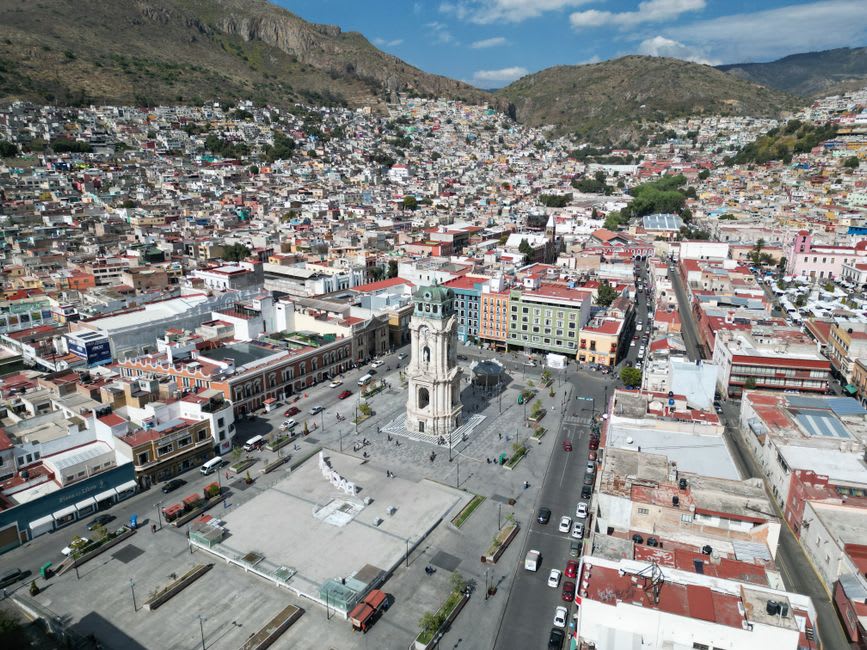
The practical thing nobody mentions: wear shoes with grip. The callejones are steep, often cobbled, and after any rain they turn slick. I went up through Cubitos starting from Calle Morelos, mid-morning when the light was still raking across the facades rather than washing them out. The ascent takes forty minutes if you walk it straight, which you will not, because you will stop constantly. There is no official route. That is actually the point — you get lost in it, double back, find a section you missed, emerge unexpectedly onto a mirador with Pachuca’s colonial centro spread below you and the clock tower of the Reloj Monumental visible through the haze. I bought a tejocote en almíbar from a woman selling from a plastic bucket near the top and ate it looking out over all that improbable color against the gray-blue mountain sky.
The Light Question
Photography here is a lesson in patience. Morning and late afternoon are the only honest times. At noon the light flattens everything and the colors lose their depth — they look like screencaps of a video game rather than pigment on concrete. I came back around five o’clock and the facades on the western slope were glowing amber. By six the shadows were long and the whole hillside had gone quiet. The paint, up close, is peeling in places. That does not bother me. A mural that looks lived-in is more interesting than one that looks preserved.
Getting There
Pachuca sits about 90 kilometers northeast of Mexico City. Direct buses run from TAPO (Terminal de Oriente) roughly every thirty minutes with Autobuses Teziutlán or ADO; the ride takes around ninety minutes. The murals are a twenty-minute walk uphill from the Reloj Monumental, or a short taxi to the base of the barrios altos.