Chiapa de Corzo
"At seven in the morning the river is the color of pewter and the canyon walls above it are turning gold, and you have it entirely to yourself."
I almost didn’t stop. Chiapa de Corzo sits fifteen minutes outside Tuxtla Gutiérrez and nearly every visitor to the Cañón del Sumidero passes through it without slowing down — board the lancha, go through the canyon, come back, get on the bus. I had the same plan until the colectivo dropped me at the zócalo at 6:45 in the morning and I looked up at the fountain and the light coming through the ceiba trees and thought: I have nowhere to be.
The fountain is called La Pila, built in 1562, and it is one of the stranger things in Mexico — a Moorish-style brick structure in the shape of a Gothic crown, here in the middle of Chiapas. It doesn’t belong and it belongs completely. I sat on the edge of it for a few minutes with a coffee I’d bought from a woman with a thermos and a folding table, and watched a man feed bread to pigeons with the methodical dedication of someone who does this every day, and felt the pleasure of a place that hasn’t yet noticed I was there.
The Canyon
The lanchas — open motorboats with a canopy and bench seats — leave from the embarcadero from around 7am onwards. By 9am the queues are long and you’re sharing the boat with forty strangers. At 7:15 I was on a boat with eight other people and a guide named Rodrigo who narrated in rapid Spanish I half-followed and occasionally pointed at things without saying anything, which was better.
The Cañón del Sumidero is one of those places where every frame looks composed. The walls rise 1,000 meters on either side, straight up, and the river below is narrow and green and perfectly still in places, choppy in others. I’ve been to the Gorges du Verdon and the Ardèche in France, where the cliffs are dramatic enough. This is different — the walls here are covered in vegetation, ferns and bromeliads growing out of cracks in the stone, and the scale is vertical in a way that French gorges aren’t. You feel it in your neck. You keep tilting your head back and still can’t see the rim.
There’s a waterfall that comes straight off the cliff face — it was full when I went, in October — and crashes into the river in a curtain of white. The Christmas Tree formation, a mineral deposit on the wall that’s grown into a shape covered in algae, which at certain angles and in certain light actually does look festive. Rodrigo had seen all of this ten thousand times and still said the word impresionante with what seemed like genuine feeling.
The crocodiles are real and numerous. They lie on the banks with their mouths open, motionless, looking like items someone has left behind. Rodrigo slowed the engine each time and let us take photos. One of them was enormous, three meters at least, and absolutely indifferent to us.
The moment I keep returning to: when the walls narrow and you look straight up and the sky is just a strip of blue, twenty meters wide, three hundred meters above. The sound of the water changes. The temperature drops. It lasts about four minutes and then the canyon opens again into a wider basin. I didn’t say anything. Nobody did.

Sopa de Pan and the Town Itself
Back on shore by 10am, which left me the rest of the morning. I walked the zócalo, which is quieter and more lived-in than Tuxtla’s — old men on benches, a pharmacy, a pharmacy cat asleep on a scale. The ex-convent of Santo Domingo is from the 16th century and has the particular empty grandeur of buildings that once housed hundreds of people and now house a small craft market and an occasional tourist.
I found the comedor through my nose. Something sweet and spiced coming through an open doorway on a side street, not quite like anything I knew — a caramel note but also something vegetal, something fruity. I went in and asked the woman what it was. She said sopa de pan and went back to the kitchen. It arrived in an earthenware bowl, deep brown, and it looked from the top like a bread pudding. Underneath: layers of toasted bread soaked in a tomato-chile broth, plantain, raisins, capers, olives, dried chiles (guajillo, I think, and mulato), hard-boiled egg, and something I couldn’t identify that turned out to be plantain in a different state of ripeness. It is the signature dish of Chiapa de Corzo and you cannot eat it anywhere else in quite the same way.
I don’t have a comparison that works. It’s sweet and sour and savory simultaneously. It’s Christmas spices in a hot bowl of something wet. I ate the whole thing, which was a mistake, and then sat very still for fifteen minutes.
The lacquerwork market is near the municipal building. Chiapa de Corzo has been producing lacquered gourds and boxes since before the Spanish arrived — the technique is pre-Columbian, using mineral pigments and plant oils on the surface of dried gourds, painted in black and red and gold with geometric patterns that haven’t changed much in five hundred years. Most of what’s sold today is for tourists and is fine without being extraordinary. But in the corner of the market there was an old woman at a small table with a set of paints and a brush that appeared to be made of a single human hair — she held it with two fingers and worked in strokes I could barely see. The bowl she was painting was priced at 800 pesos. I bought it. It took her forty-five minutes to finish. I waited.

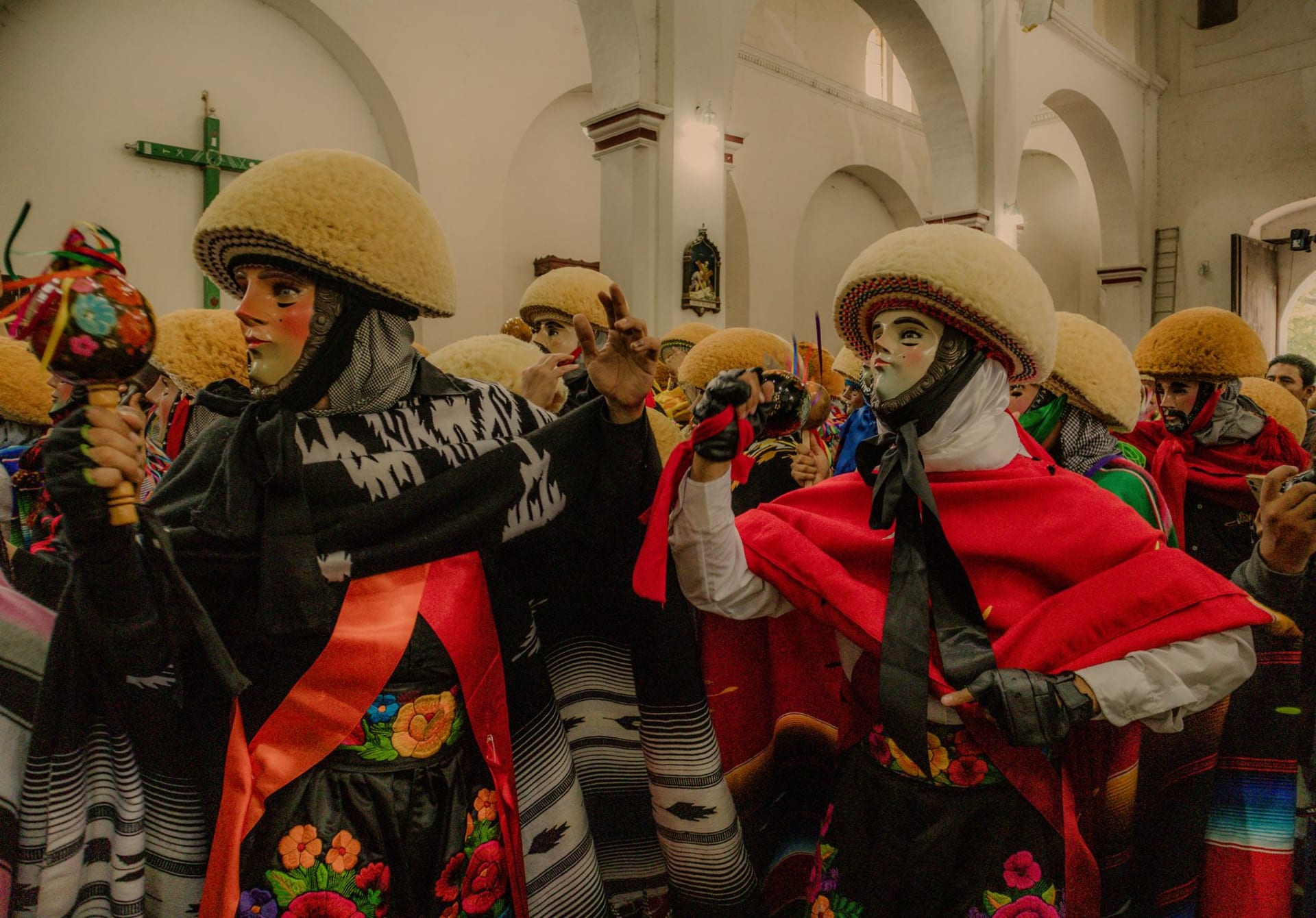
I didn’t make it to the Parachicos festival — that’s in January, and I was there in October — but I’ve seen video of it, and I’ve heard the chirimía from around a corner once, on a different trip, passing through during a regional celebration. The chirimía is a Chiapan instrument, a kind of double-reed oboe, nasal and penetrating and unlike anything in European musical tradition. You hear it before you see it. It’s the sound of something very old.
Getting There, Where to Stay, When to Go
Chiapa de Corzo is 15 minutes from Tuxtla Gutiérrez by colectivo from the CAMET bus terminal — 12 pesos, leaves when full. There is no reason to take a taxi.
The lanchas leave from the Embarcadero Turístico on the riverfront and run throughout the morning. Arrive before 8am if you want a boat to yourself or nearly so. The tour takes 1.5 to 2 hours depending on stops. Buy tickets at the dock rather than through hotels, which charge a commission. Cost is around 200 pesos per person.
You can stay in Chiapa de Corzo itself — there are a handful of small hotels and guesthouses near the zócalo — or use it as a morning excursion from Tuxtla. I’d stay in Chiapa if I came back. The town is calmer after the day-trippers leave, and the light on the river at dusk is reportedly as good as at dawn.
The best time is the dry season (November through April) when the water is clearer and the canyon walls show better in the light. I went in October, at the tail end of the rains, and the falls were full and the vegetation impossibly green — a different but entirely valid experience. Avoid weekends if you want the canyon to yourself.
Bring water and sunscreen on the lancha. The boat doesn’t stop in the shade. Bring cash; the dock ticket booth doesn’t always take cards.