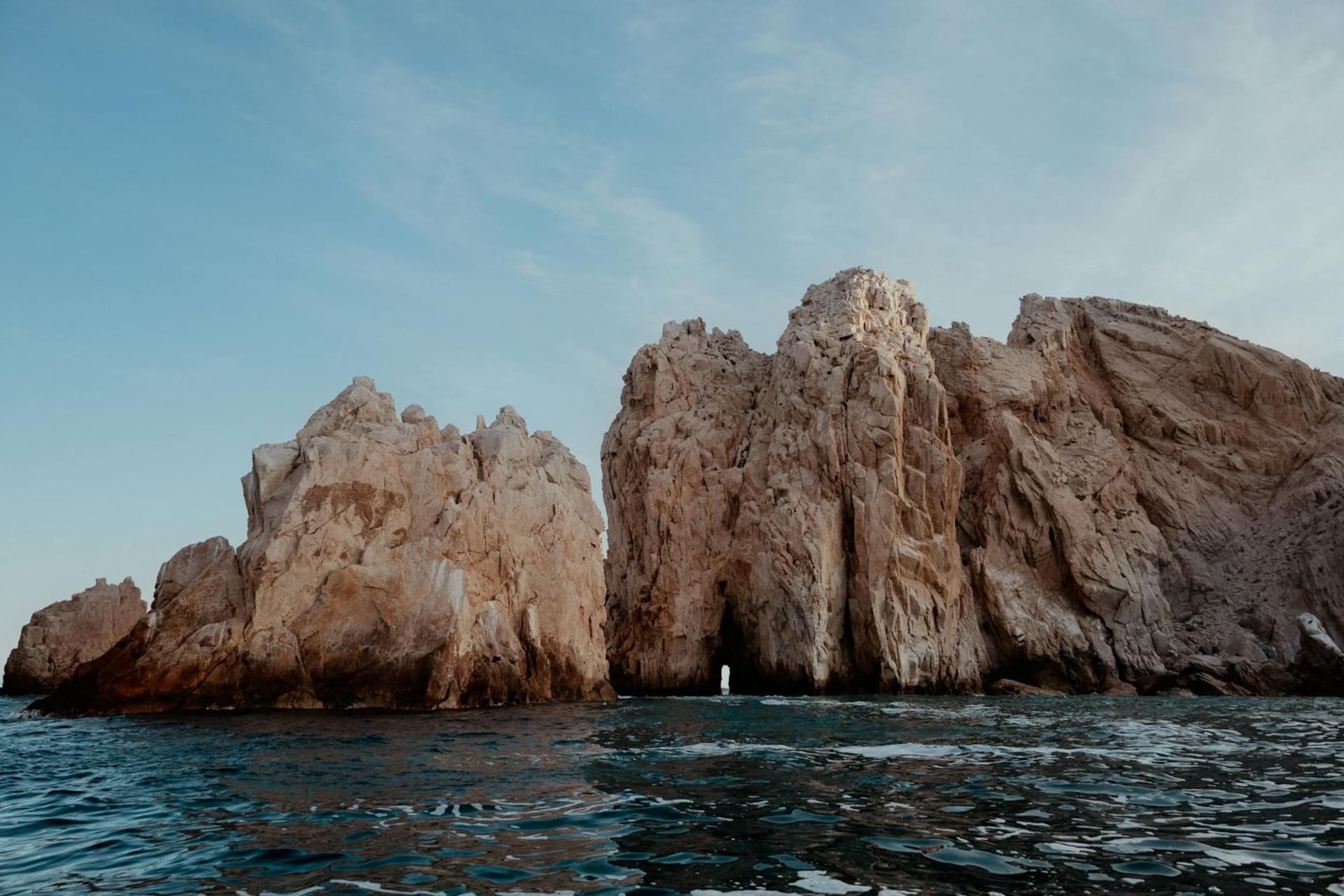
I had resisted Cabo for years. The reputation preceded it — spring-breakers, tequila shots at noon, a marina full of sport-fishing boats and duty-free watches. Then Lia booked a water taxi to Land’s End on our first morning, and everything I thought I knew about this place dissolved the moment El Arco came into view.
The Arch and What Lives Around It
Up close, the granite is almost rust-colored, streaked with salt and oxidation, and far larger than any photograph suggests. The boat bobbed beneath it while a dozen sea lions draped themselves over a shelf of rock called Playa del Amor — Lovers Beach — where the Pacific crashes white and rough on one side and the Cortez lies flat and green on the other. The water color changes so sharply at the dividing line that it looks painted. I’ve seen a lot of coastlines. That seam between two oceans still stopped me cold.
The unexpected thing was the silence. Even in high season, once you’re out past the marina noise and the hawkers on the dock, the desert headlands absorb sound. You hear the birds — frigatebirds mostly, riding thermals above the arch — and the particular crack of Pacific swells against the base of the rock. Nothing else.
Downtown and the Mercado
Back in town, I skipped the tourist strip on Boulevard Marina and walked up Calle Guerrero into the older neighborhood above it. The street smells of diesel and warm tortillas and something floral I never identified — bougainvillea probably, erupting orange over every concrete wall. I found a plastic-chaired taquería with no name on the sign serving machaca con huevo and a horchata so thick it needed to be stirred. The woman running it was watching a telenovela on a wall-mounted TV and barely looked up when I ordered.
At the Mercado Municipal on Calle Ignacio Zaragoza I bought dried chiles and a bag of dried shrimp, mostly just to carry something around while I looked at everything. The stalls here sell to actual residents — cleaning supplies, bulk grains, cuts of meat I couldn’t name. It felt like the anti-marina.
The Light at Either End of the Day
The Baja desert light in late afternoon is something I haven’t found anywhere else in Mexico. It turns the cacti silver and the sand the color of old bone. Sunrise over the Cortez side comes fast and fierce, and the fishing pangas are already out by the time the sky goes fully blue. Lia watched them from the terrace of our hotel on Paseo de la Marina while I drank the first of too many coffees and felt, briefly, like I understood why people keep coming back.
When to go: November through April offers dry, mild weather with water calm enough for snorkeling at the Arch. July and August are hot and occasionally interrupted by late-summer hurricanes — dramatic, but not ideal for planning around.