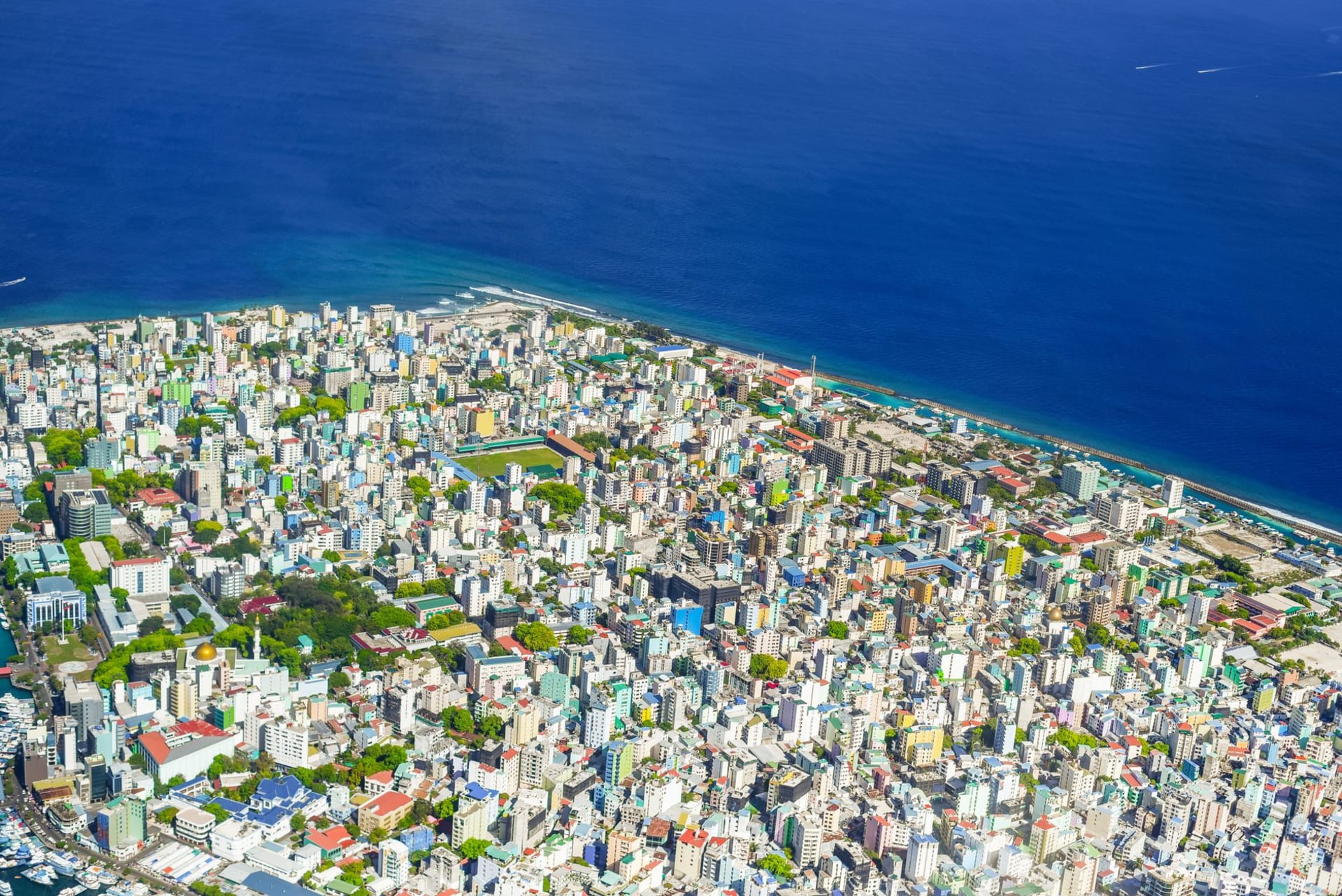
Fuvahmulah
"Fuvahmulah felt like a Maldives that had been left alone long enough to become something entirely its own."
It takes effort to get to Fuvahmulah, which is probably why it still feels like itself. There are domestic flights from Malé — a short hop south into the lower Indian Ocean — and the island appears below the window as something unusual: larger than most Maldivian islands, greener, with what appears to be a lake sitting in the middle of all that dense palm canopy. Two lakes, in fact: Bandaara Kilhi and Dhadimagi Kilhi, freshwater bodies that exist nowhere else in the Maldives, formed in a geological configuration that makes this single island its own complete atoll. No lagoon surrounds it. The ocean strikes the shore directly, and the waves here — crashing against exposed reef — sound nothing like the quiet lap of the resort atolls to the north.
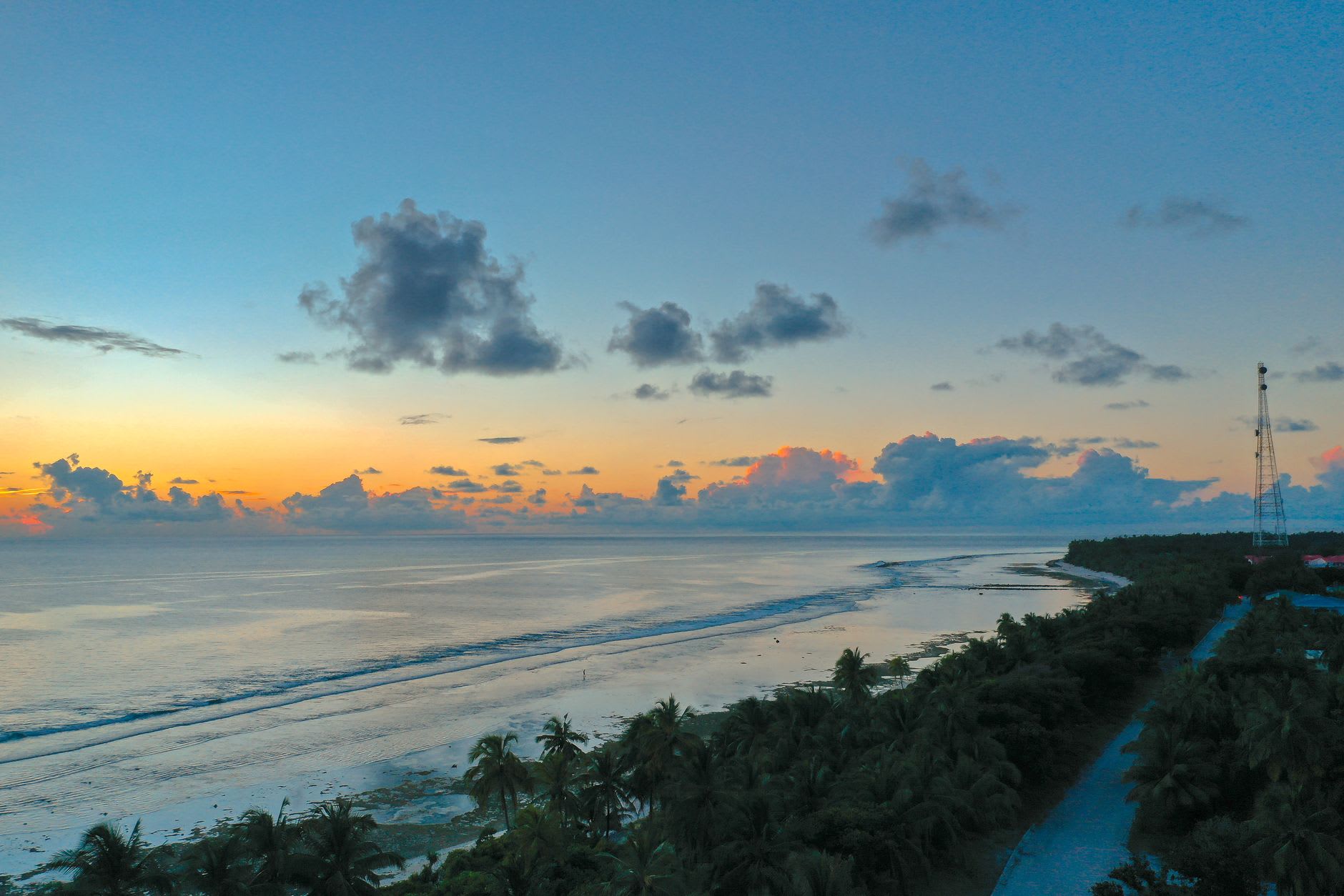
I spent a morning walking the interior, which surprised me every few steps. The vegetation is denser than anything I’d seen elsewhere in the Maldives — breadfruit trees, giant taro, citrus, the kind of undergrowth that demands a path be cut rather than found. The lakes are calm and slightly eerie in their stillness, ringed by birds that rest on low branches at the water’s edge. Fuvahmulah grows its own food in a way that most Maldivian islands can’t, and the market near the centre of the island reflects this: taro and breadfruit and bananas and citrus piled up alongside the inevitable yellowfin tuna that comes in daily from the boats. The smell of the place is different — earth and leaf rather than salt and sand — and it reorients you after days in the resort circuit.
But Fuvahmulah’s reputation among serious divers is entirely underwater. The island sits at the intersection of deep oceanic currents that carry nutrient-rich cold water upward along its flanks, and the concentration of marine life at these dive sites is extraordinary. Tiger sharks patrol the outer reef in numbers that would seem implausible if you hadn’t seen the photographs. Oceanic manta rays come in from the deep water. Thresher sharks, hammerheads, whale sharks — the pelagic life list reads like something assembled specifically to impress. I dove with a local dive school whose instructor, a young man named Ismail who’d grown up on the island, spoke about the tiger sharks with a familiarity that felt almost domestic. They’ve been here his whole life. They’re as fixed to this place as the lake.

The people of Fuvahmulah speak a dialect of Dhivehi that is distinct enough from the Malé dialect that mainlanders sometimes struggle to follow it — a consequence of centuries of geographic isolation in the southern ocean. There is a pride in this distinctiveness that you notice in small ways: the way islanders describe their vegetables and their fishing methods, the particular way the older men sit outside the tea shops in the evening, the sense that this community has been largely managing itself for a very long time and sees no reason to change that arrangement.
The guesthouses are simple — this is not a resort island and the infrastructure reflects that — but the diving alone justifies the journey, and the experience of an island that genuinely doesn’t run on tourism makes it one of the most interesting places I found in the entire country.
When to go: October through May offers calmer diving conditions on Fuvahmulah’s exposed outer reef. Tiger sharks are present year-round, but large aggregations are most reliably reported October through December. Domestic flights from Malé operate regularly and the journey takes around forty-five minutes.