Pemaquid Peninsula
"The rock here does something strange — it swirls, like the Atlantic has been slowly turning it in a bowl for ten thousand years."
The Pemaquid Peninsula runs south from Route 1 for about twenty miles, narrowing as it goes, the road threading between inlets and coves and the occasional white church steeple, until it ends at the water. I drove it on a Tuesday in late June with no particular plan, which is the right approach. The small towns along the way — Bristol, New Harbor, Round Pond — are the kind of places that appear and disappear before you quite register them: a general store, a post office, a few boats pulled onto a gravel shore. New Harbor has a harbor that functions more or less the way harbors have functioned here for three hundred years. You can buy a lobster roll at a shack on the waterfront and eat it on a picnic bench watching the lobster boats idle in and tie up. The roll I had was plain — fresh meat, a little butter, a roll that had been given exactly as much attention as it needed and no more. I preferred it to versions that cost twice as much and tried harder.
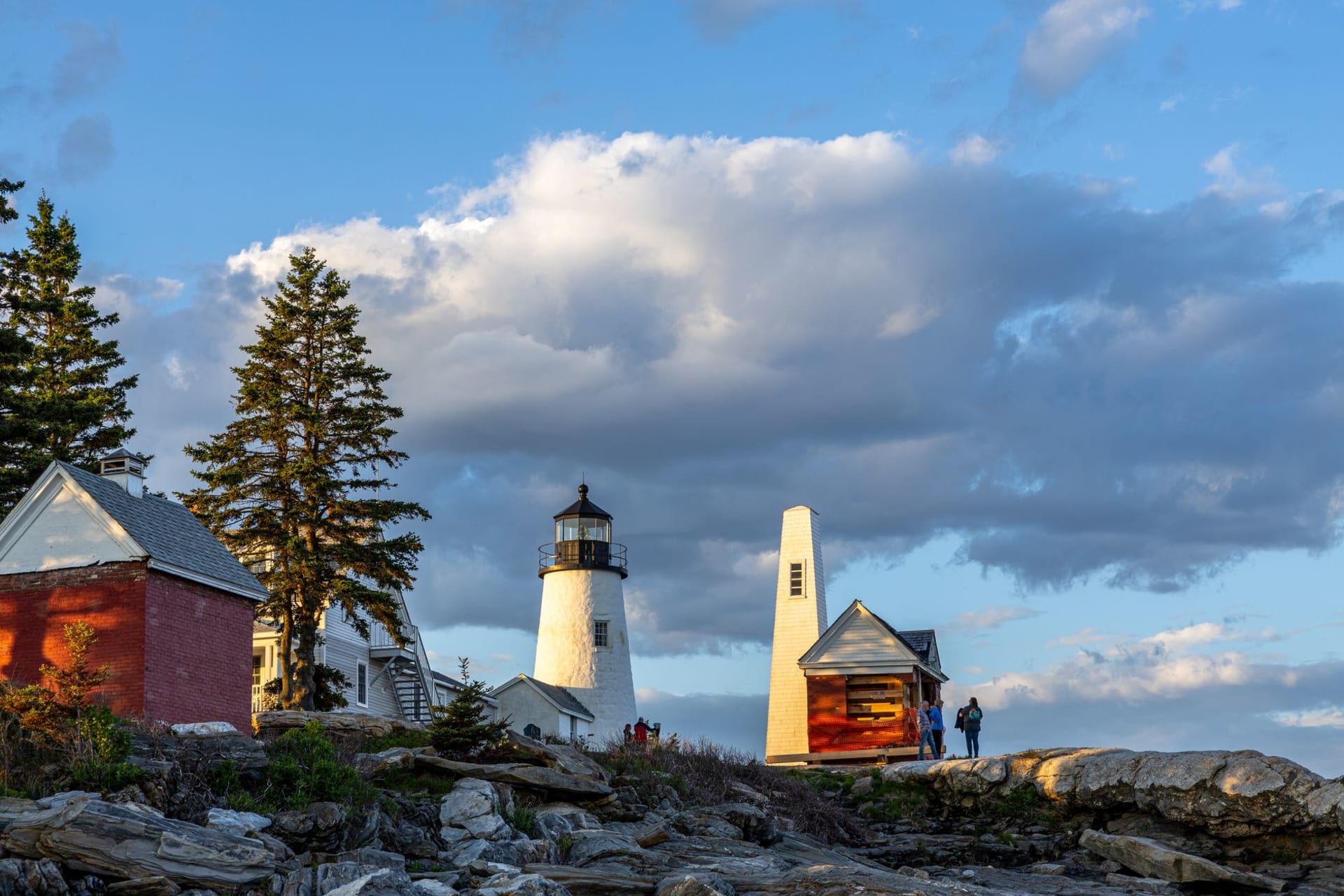
Pemaquid Point Lighthouse sits at the absolute southern tip of the peninsula, and what distinguishes it from other Maine lighthouses is not the lighthouse itself — though the 1835 tower is handsome enough — but the rock beneath it. The granite ledges here have been folded and swirled by geological forces into forms that resemble nothing so much as a frozen fluid, smooth curves and tilted planes running down into the water in broad steps and undulations. The rock is pink and gray and white, shot through with dark veins of something older, and at low tide the shapes it makes as it meets the sea are extraordinary: pools of remarkably clear water, channels where the waves run fast and shallow, platforms where the rock has been polished to a near-mirror smoothness by ten thousand years of surf. I spent most of an afternoon just sitting on the ledges, moving from pool to pool, looking at the things living in them.

Above the lighthouse, the Fishermen’s Museum occupies the old keepers’ dwelling and does what small local museums often do: preserve things that would otherwise be lost through a combination of earnest effort and imperfect curation. There are photographs of the life-saving crews who worked this coast in the nineteenth century, before the lighthouse’s light was bright enough to prevent all disasters. There are tools I could not identify and records of ships that went down on these ledges anyway, despite the light. The sea here is not malicious. It is simply indifferent, and the indifference is absolute.
A short drive north, the Colonial Pemaquid State Historic Site marks the location of one of the earliest English settlements in North America — established in the early seventeenth century and destroyed and rebuilt several times in various wars. The archaeology is ongoing, and the site has that particular quality of places where the ground has been opened and examined: a sense of depth, of time compressed into the earth, of all the things that happened here that left no record anyone can easily read. The fort reconstruction is modest and honestly labeled as reconstruction. I appreciated the honesty.

The round pond at Round Pond village is, in fact, round, and the lobster pounds clustered around it on warm evenings are reliably full of people who drove here specifically because this is where the lobster is good and the price of doing business in a location nobody has inflated yet.
When to go: June through mid-July offers the point nearly to yourself on weekday mornings — the light is extraordinary at low tide just after dawn. Late August brings the most visitors. The peninsula is accessible year-round, and the point in winter, when the waves are heavy and the rock is wet and there are no other people, is a different and more demanding kind of beautiful.