
Montagne d'Ambre National Park
"Twenty minutes out of the dry heat of Diego and suddenly I needed a jacket. Madagascar keeps doing that to you."
A cool, mist-fed volcanic massif above Diego Suarez where waterfalls drop into crater lakes and chameleons the size of a thumbnail cling to fern fronds.
The drive up from Diego Suarez takes under an hour, but the change in climate makes it feel like crossing a border. The dry scrubland around the port city gives way, almost abruptly, to dense montane rainforest as the road climbs the flanks of an extinct volcano, and by the time I stepped out of the taxi-brousse at the park entrance the air had a damp coolness I hadn’t felt anywhere else in northern Madagascar. I actually put on a long-sleeve shirt, which after weeks of sweating through cotton felt like a strange kind of luxury.
Waterfalls in Tiers
Montagne d’Ambre is built around a series of crater lakes and waterfalls fed by the near-constant mist that collects on the upper slopes, and the most visited trail loops past two of them — the Petite Cascade and the Grande Cascade — each dropping into a dark, cold pool ringed by tree ferns and epiphyte-choked branches. My guide, Nirina, encouraged me to swim at the smaller one, and I did, briefly, before the cold reasserted itself as a genuinely bad idea. The Grande Cascade is more of a spectacle than a swimming hole — a sheer drop into a plunge pool walled in by rock draped so thickly in moss it looks upholstered.
The Smallest Chameleons on Earth
The park’s real headline act, though, is scaled to almost nothing. Montagne d’Ambre is one of the best places in the world to find Brookesia, the leaf chameleons — several species here max out at under three centimeters, small enough to sit on a fingernail, camouflaged to look like a curled dead leaf until it blinks. Nirina spotted the first one by torchlight on a night walk, crouched at the base of a fern, and I had to be shown twice before my eyes adjusted to what I was looking at. We also found a much larger Parson’s chameleon draped over a low branch, moving with that deliberate, rocking gait that always looks like it’s second-guessing itself.
Crater Lakes and Cold Mornings
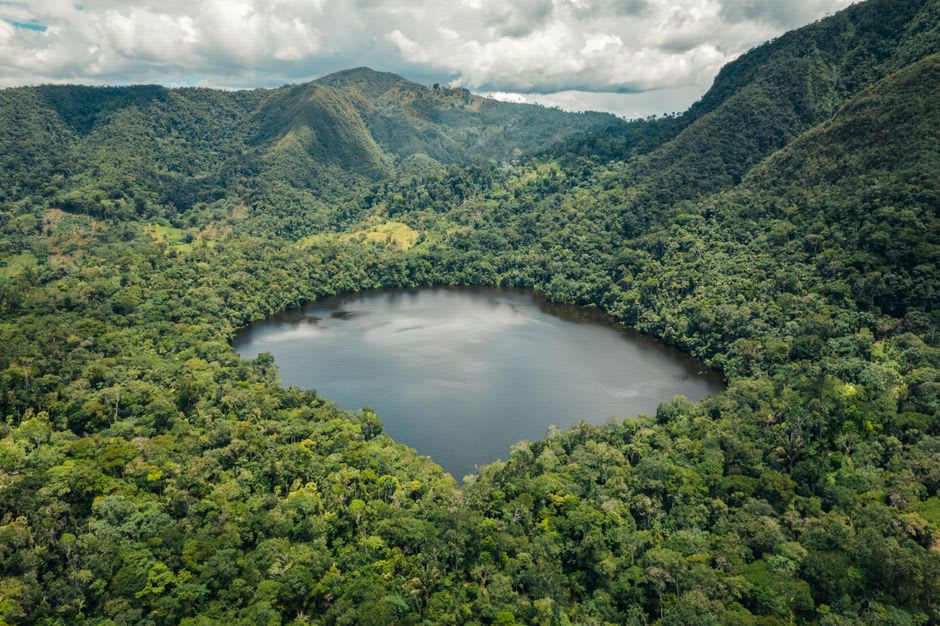
At the higher elevations, two crater lakes — Lac Grand and Lac Maudit, the latter named for local legends about spirits inhabiting its still water — sit in near-permanent mist, ringed by forest that never quite dries out. I reached Lac Grand in the early morning, before the day’s tour groups, and had it entirely to myself: black water, absolute quiet, the occasional call of a coua somewhere in the canopy.

Coming back down to Diego that evening, the heat returned in stages, the humidity dropping off the mountain like a coat being removed layer by layer. It’s a strange, compact microclimate, this mountain — a cool green island stitched into the middle of the dry north — and it’s easy to see why so much life on it exists nowhere else.
When to go: Year-round, though April through November brings drier trails. Bring a layer regardless of season — the upper slopes stay noticeably cooler than the coast below.