
Guia Fortress and Lighthouse
"Built to guide sailors in. Now it watches the casino towers that guided them somewhere else entirely."
Guia Hill rises from the middle of the Macau peninsula, forested and slightly apart from everything, and the way to reach the fortress at its summit is either a cable car through the tree canopy or a walk up through the Guia Garden — a city park that manages to feel like a proper forest in a territory with almost no natural space to spare. I walked up, because the path through the garden is one of the better pieces of incidental city walking I did in Macau: stone steps cutting upward through dense green, occasional stone benches where elderly locals rest, the sound of the city gradually fading as the trees thickened.
The fortress at the top is the oldest intact military installation in Macau, built by the Portuguese between 1622 and 1638. It is smaller and less dramatic than Monte Fort — a low stone perimeter wall, a series of small underground chambers that served as ammunition stores, a well in the center that never ran dry during any siege. What makes Guia distinct is the chapel and the lighthouse that were built inside the fortress walls in 1865. The Chapel of Our Lady of Guia is tiny — perhaps forty people at capacity — and its interior contains something extraordinary: a series of frescoes that blend Christian iconography with Chinese decorative motifs. Angels with slightly Chinese faces. A Madonna whose robes are painted in colors and patterns borrowed from Tang-dynasty silk traditions. The syncretic art was created by painters who lived at the cultural intersection of two worlds and made something that belonged fully to neither.

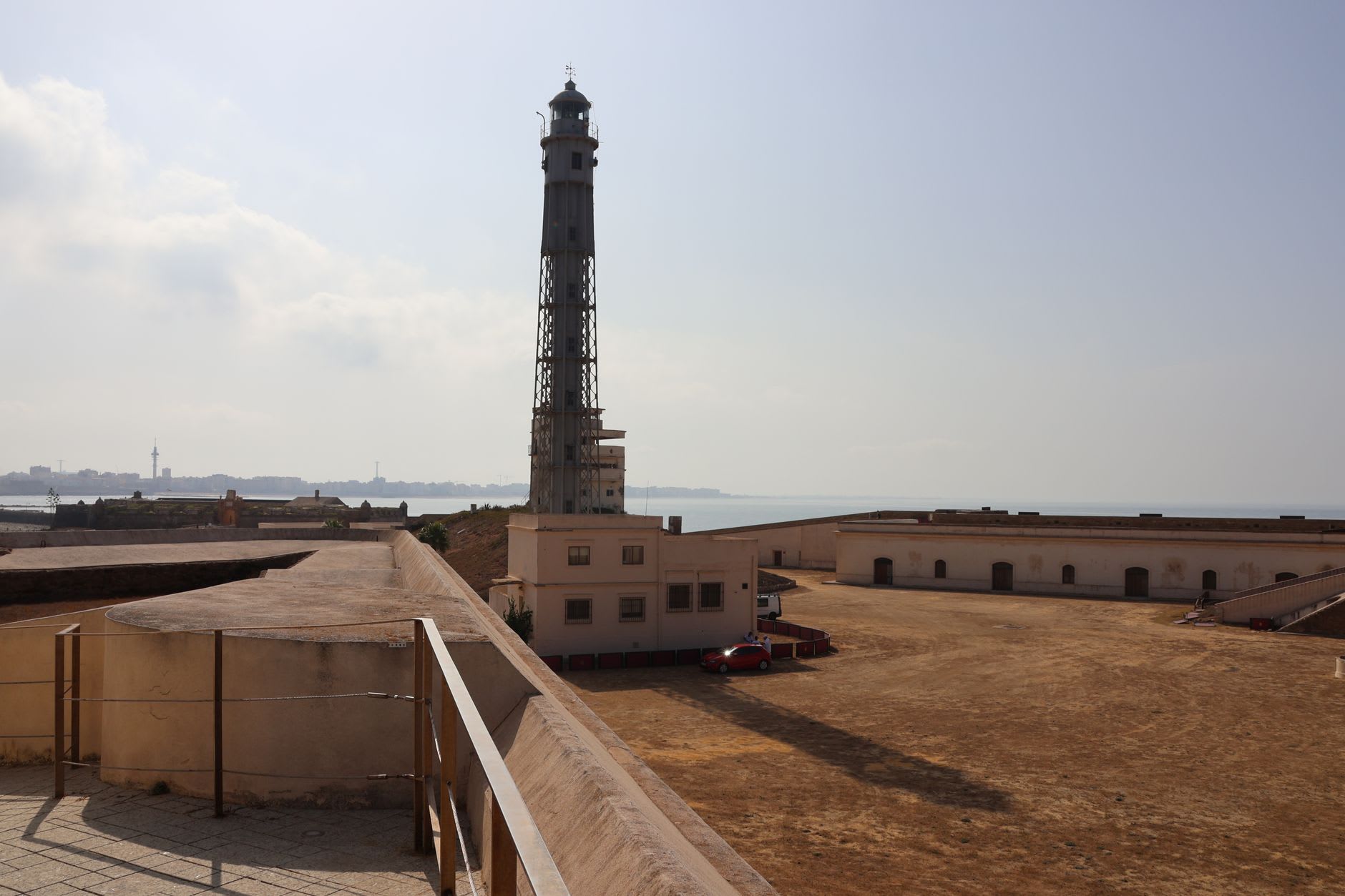
The lighthouse is the main reason the complex made it onto the UNESCO World Heritage list. Built in 1865, it is the oldest Western-style lighthouse still in operation on the Chinese coast. It is white, cylindrical, maybe fifteen meters tall, and it sits above the chapel with a studied simplicity — a pure form against the sky that makes everything around it look more complicated than it needs to be. The lamp was converted from oil to electricity in the 1910s and has been guiding ships through the Pearl River delta ever since. On the day I visited, it was surrounded by a low fence and not open to climb, which was fine. The lighthouse is best as object, as presence: the thing itself.
From the fortress walls, the view extends over the full peninsula — a grid of streets and rooftops and highways, the Inner and Outer Harbours both visible, the bridges to Taipa and Coloane, the casino towers of the Cotai Strip on the horizon. It is the highest vantage point on the peninsula and the view is correspondingly broad, though not as dramatically staged as Monte Fort’s. What it gives you instead is a sense of the territory’s true scale: tiny, impossibly dense, surrounded on three sides by water.
The cable car down is worth taking for the perspective — the treetops of Guia Garden from above, the city emerging below as the car descends, a two-minute journey that somehow makes Macau feel briefly like a forested mountain city before it reasserts its true nature at the bottom.
When to go: Morning for the chapel frescoes in the best light, and before the midday heat in summer. The cable car runs from roughly 8am to 6pm. The garden and fortress walls are accessible earlier. The complex is closed on Mondays.