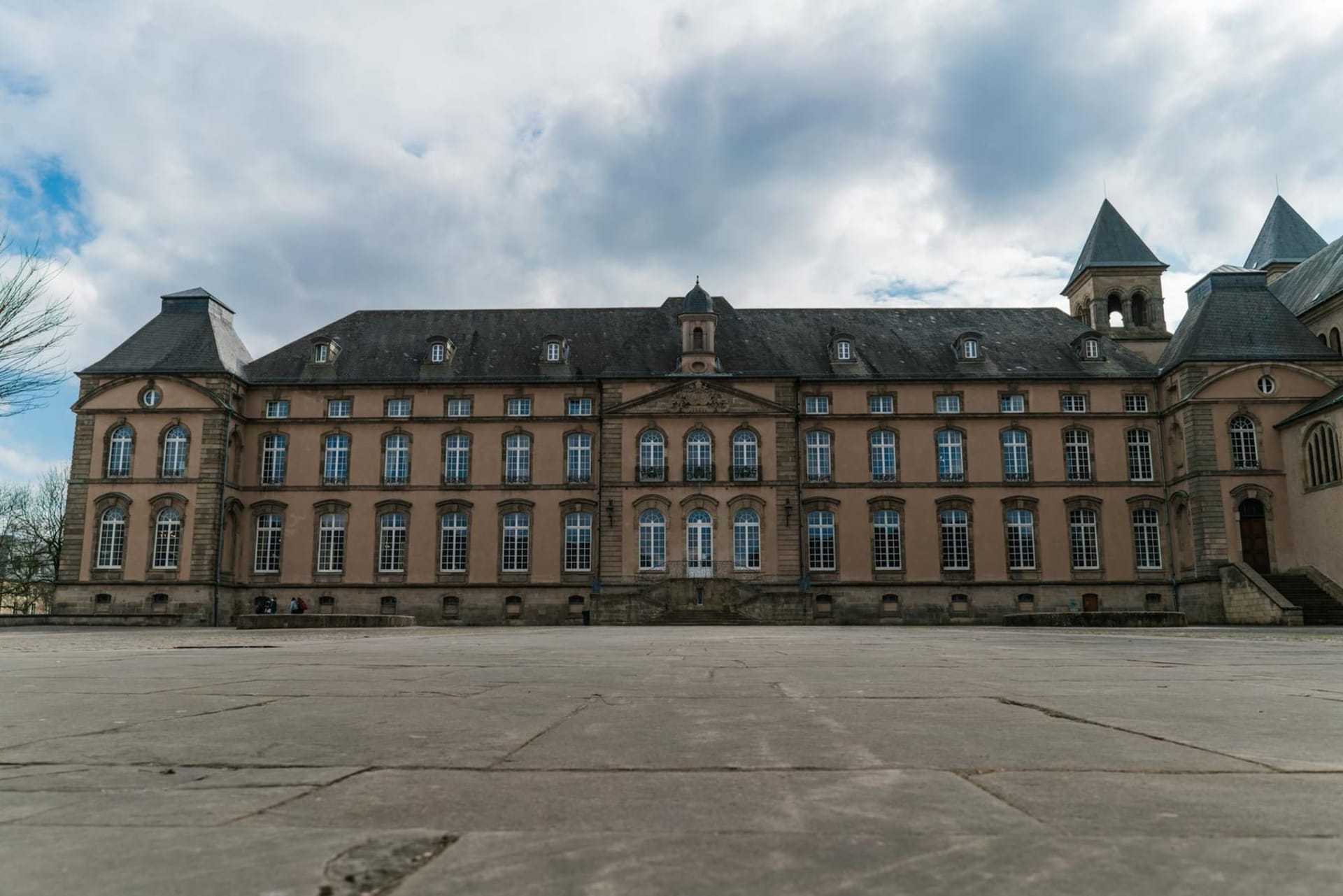
Echternach
"Echternach reminds you that 'oldest' and 'smallest' are not insults but titles of honor."
Luxembourg's oldest town sits beside the Sûre river in the Little Switzerland region, its Benedictine basilica anchoring eight centuries of pilgrimage.
We arrived on a Tuesday, which turned out to matter. The market stalls on the Place du Marché were being dismantled — just the last vendors folding their canvas, a smell of wet stone and cut herbs hanging over the cobblestones — and Echternach had that particular quietness a small town only reveals when the performance is over. Lia said it felt like arriving after a party, but I thought it felt more like arriving in time for the real thing.
The Basilica and Its Weight
The Basilica of Saint Willibrord sits at the top of the old town with the certainty of something that has already outlasted most arguments about its importance. Willibrord, the Northumbrian monk who founded the abbey in 698, is buried in the crypt beneath it. I stood down there for longer than I expected, not from piety but from the specific gravity of a place that has absorbed eight centuries of footsteps — pilgrims arrive every Whit Tuesday for the famous dancing procession, the Springprozession, hopping in three-step rhythm through the streets. I tried to imagine ten thousand people moving that way through the narrow Rue de la Gare and found it genuinely impossible. The crypt smelled of cold limestone and something faintly sweet, beeswax from the candles, a scent that clings to old churches the way memory clings to childhood rooms.
Along the Sûre
The Promenade de la Sûre follows the river east from the old bridge, and this is where Echternach loosens its formal posture. The water runs green and fast over flat stones, and the German bank — Echternach sits right on the border — faces back at Luxembourg with an almost theatrical symmetry. I ate a slice of Quetschentaart at a small café near the waterfront, the damson plum tart that appears in every Luxembourgish bakery window in late summer, its pastry short and faintly salty against the dark fruit. It was better than it needed to be.
The unexpected thing: I had not anticipated the Roman past. Just outside town, the remains of a Roman villa, the Villa Romaine, sit behind low barriers in a field off the Route de Trèves. Mosaic floors, exposed to the sky. I crouched beside a geometric border pattern — red, cream, terracotta — and felt the usual vertigo of deep time arriving without warning.
When to go: Late spring through early summer for the Springprozession crowds and long riverside evenings; September for damson season and cooler hiking temperatures through the surrounding Müllerthal trails.