Alchi
"I stood in front of those carvings for an hour and still felt I had barely started."
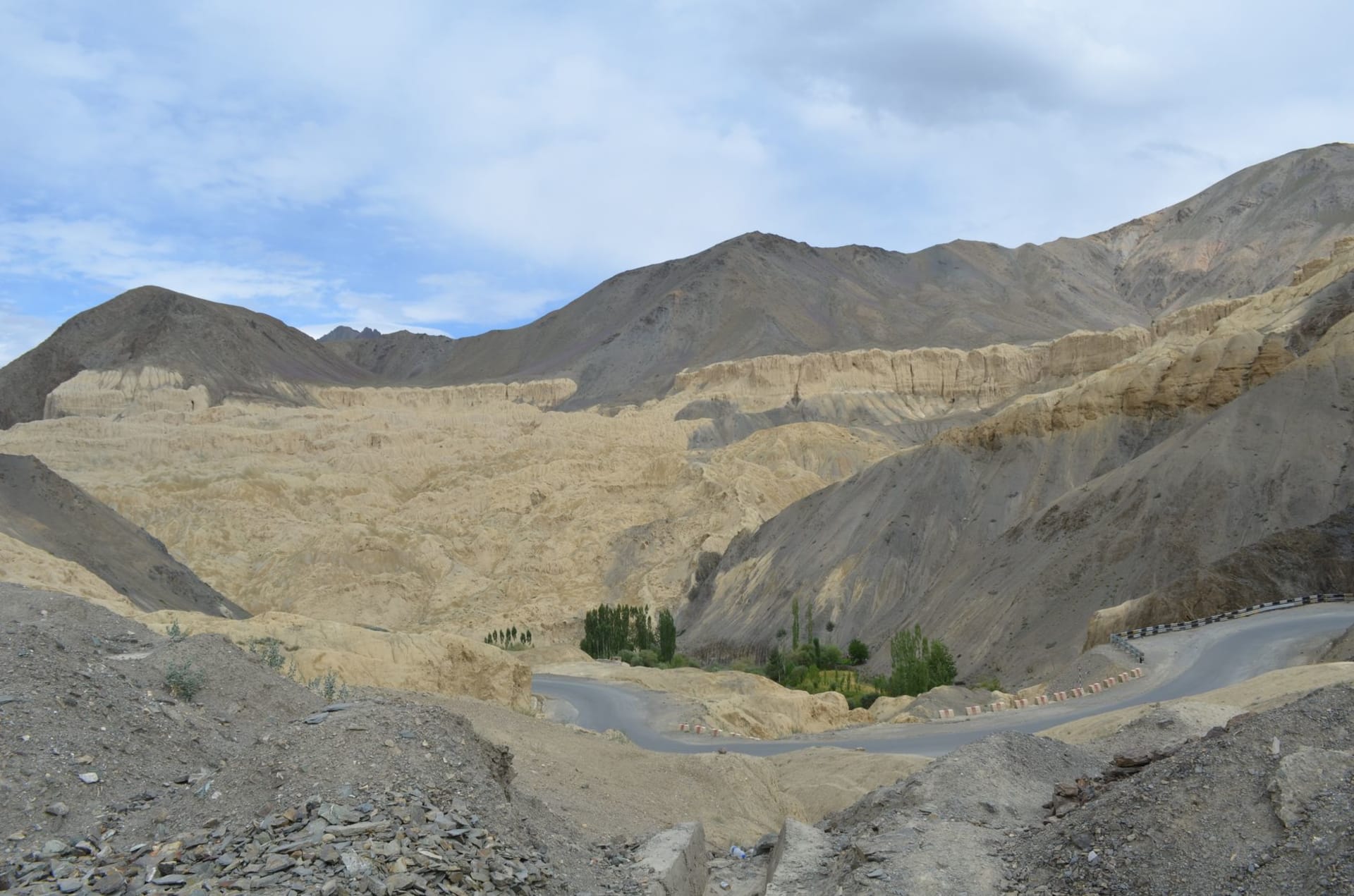
Nobody warns you how small Alchi is. After the drive along the south bank of the Indus — dust, barren ridges, the occasional truck kicking gravel — the monastery appears around a bend as a cluster of low whitewashed walls almost invisible against the pale hillside. There is no hilltop drama here, no tiered facade rising into the sky. Alchi is ground-level, tucked into a loop of the river, shaded by poplars and concealed from the road until you are almost upon it. I nearly missed it entirely and only found the gate because of a hand-painted sign nailed to a poplar tree that said, with admirable understatement: “Alchi Monastery. 1000 years old.”
That number sits differently once you are inside. The Alchi Choskhor complex was founded in the 11th century by Rinchen Zangpo, a Buddhist scholar who brought craftsmen from Kashmir to build and decorate the temples, and those craftsmen left something that has not aged cleanly so much as deepened. The wooden doorframes and lintels are carved with figures — Buddhas, bodhisattvas, celestial musicians, intertwined foliage — at a density and precision that requires time to see properly. Not a glance. Not a photograph. Time. The kind of looking where you stand still and let your eyes move slowly across the surface and find new detail every few seconds for as long as you choose to stand there.

Inside the Sumtsek temple — three storeys, accessed via a narrow staircase — three giant bodhisattva figures stand in wooden niches, their lower robes painted with scenes from the life of the Buddha in a Kashmir style that predates the Mughal empire. The painting is faded and in places damaged, but the fading has its own beauty: colours softened to terracotta, ochre, and a grey-green that reads as almost contemporary. A monk sits in the corner of the lowest level, cross-legged, turning prayer beads with one hand and watching visitors with the expression of someone accustomed to witnessing people encounter something they had not expected.
The village around the monastery is one of those places that has organised itself quietly around the presence of something old and significant without ever seeming to make too much of it. There is a row of small restaurants along the path to the gate — I ate at one, a dal and rice and a glass of salty butter tea that I did not order and did not mind — and a few guesthouses, and a shop selling postcards of the very carvings you have just seen. Families move through the lanes between gardens and apricot trees that are probably older than anyone currently alive to tend them. Children play on the monastery wall with the freedom of people who grew up in the shadow of a thing and never needed to be impressed by it.

What I had not anticipated about Alchi was the quality of its stillness. The more famous Ladakhi monasteries — Thiksey, Hemis, Lamayuru — earn their drama through height, scale, ceremony. Alchi earns its authority through age and restraint. It does not announce itself. It simply continues to be there, as it has been for a thousand years, doing what it was built to do.
When to go: Alchi is accessible year-round since it sits in the lower Indus Valley and the road from Leh stays open most of the year. The monastery is quietest on weekday mornings before the day-trip jeeps arrive from Leh around eleven. Allow two to three hours to do the complex any justice — less than that and you are only skimming it.