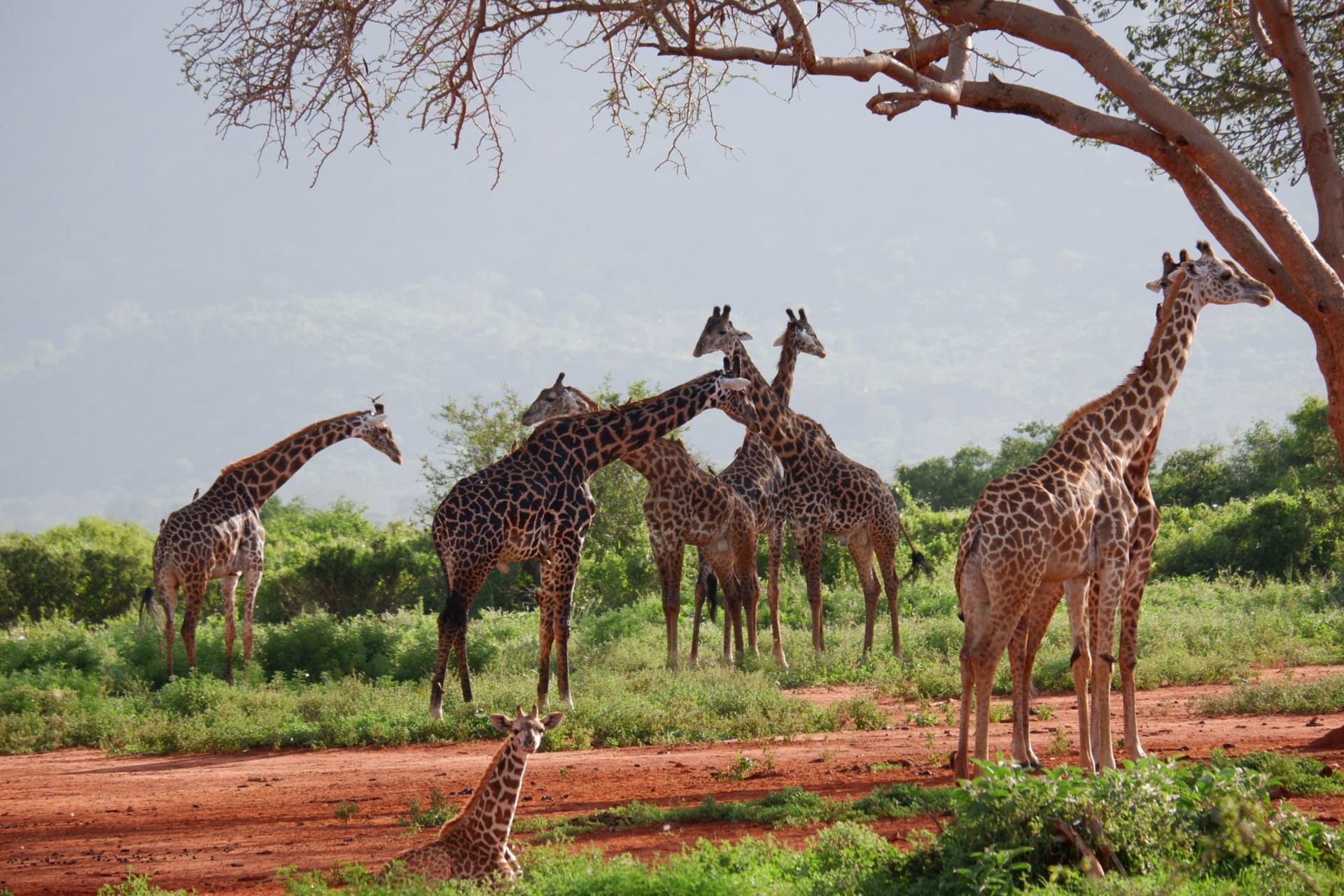
Tsavo is Kenya’s largest national park — larger than Wales, the guides like to say, which I find useful mainly because it gives you a sense of how impossible it is to see all of it. Split into East and West by the Nairobi-Mombasa highway, the two halves have different personalities: East is flat, arid, and big in the way that makes you feel appropriately small; West is hillier, wetter, stranger, with volcanic geology poking through the grass. I spent four days across both and came away with the impression of something essentially unmanageable, which I mean as a compliment.
The Red Elephants
You hear about Tsavo’s elephants before you go, and they still exceed expectations. The laterite soil here is rust-red, and the elephants bathe and dust themselves in it until they’re the color of old brick. Seeing a herd of two hundred rust-red elephants crossing the Galana River in the afternoon light is one of those experiences that doesn’t fit neatly into any category. I kept trying to make it into a metaphor and failing. Eventually I put my notebook down and just watched. The matriarch of the group we followed longest was massive, one tusk shorter than the other, and she moved through the scrubland with a focused indifference to everything that wasn’t grass or water. I admired this quality.
Mzima Springs
In Tsavo West, fed by rainwater that seeps through the volcanic Chyulu Hills and travels underground for forty kilometers, Mzima Springs produce thirty million gallons of fresh water per day into the middle of near-desert. It feels cosmically improbable. Hippos spend their days in the deeper pools; fish eagles sit above; the water is clear enough that you can see the hippos from an underwater observation chamber, which the park maintains, which sounds gimmicky and turns out to be extraordinary. I watched a hippo drift past the viewing window in slow motion, enormous and entirely unbothered, and felt the specific uncanniness of observing a large animal through glass that it does not know is there.
The Lugard Falls
The Galana River drops through a series of narrow gorges at Lugard Falls — “falls” is generous, since it’s more a sequence of chutes carved into the rock over millennia — and the water runs so fast and clear that you can watch it for a long time without deciding what to think. The gorge walls are polished smooth by centuries of flow. There are crocodiles on the downstream rocks. Nobody swims. I ate lunch sitting on a flat rock above the drop with the sound of moving water drowning out everything else, and it was one of the better lunches I’ve had in Kenya.
Scale as the Point
Tsavo rewards patience and defeats efficiency. The distances between areas are real; game drives cover ground rather than stacking sightings. On one afternoon in East Tsavo I drove for three hours and saw two lions sleeping under a tree, one hyena trotting purposefully toward nothing visible, and more dry sky than I knew what to do with. I didn’t feel cheated. Tsavo’s size is the point — it’s what allows it to function as an actual ecosystem rather than a curated animal experience. If you want volume of sightings per hour, go to the Mara. If you want to feel like you’re somewhere genuinely large and genuinely wild, come here.
When to go: June to October is peak dry season — animals concentrate around rivers and visibility through the thinning scrub improves. January to February is also good. Avoid April and May when long rains make dirt tracks in East Tsavo nearly impassable. October offers a brief green flush after short rains that photographers prefer, if you don’t mind occasional afternoon showers.