
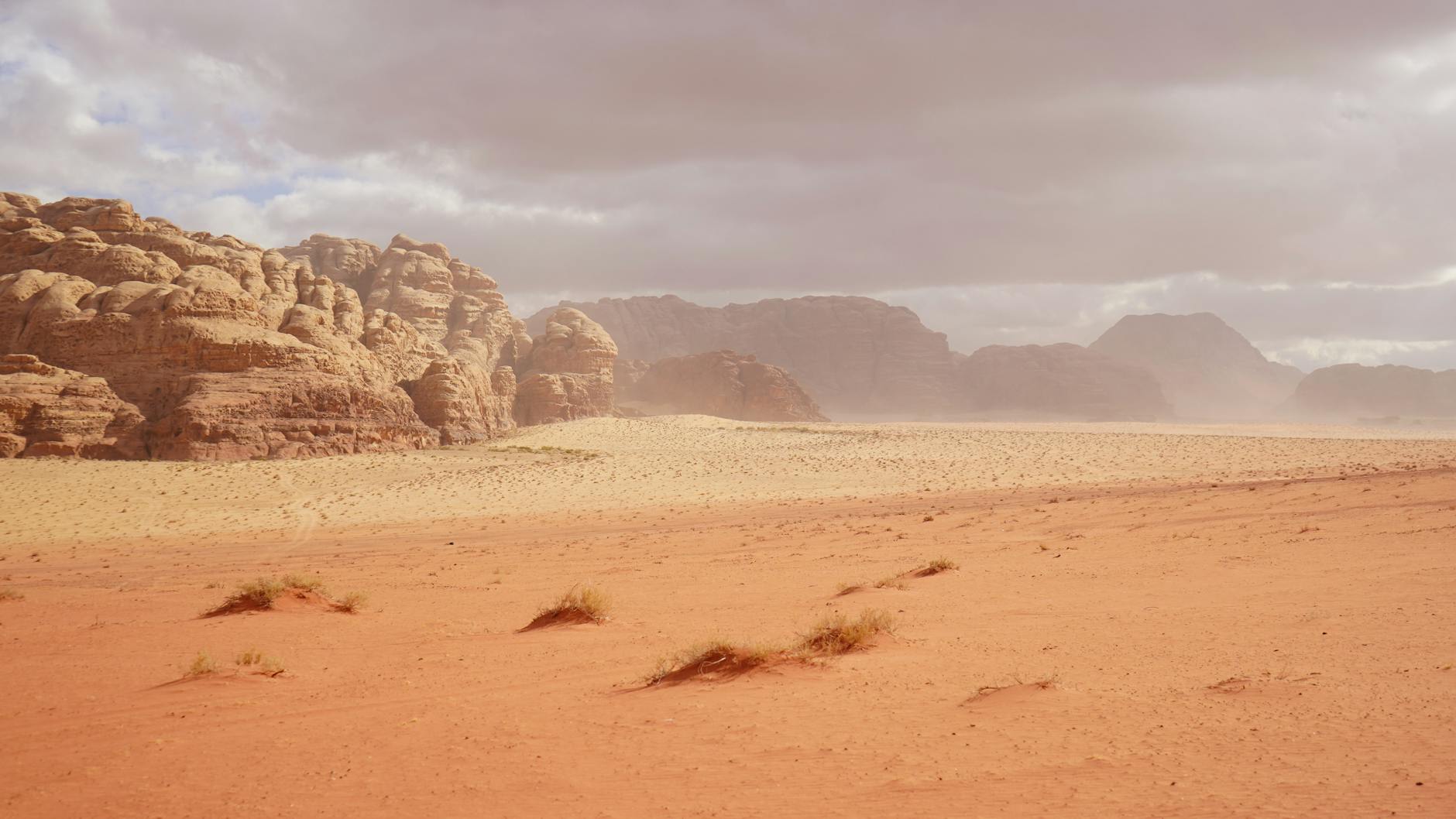
Wadi Rum looks like another planet, and Lawrence of Arabia thought so too. He called it “vast, echoing, and godlike,” and for once a literary description undersells reality. The desert spreads in red sand valleys between sandstone and granite mountains that rise 1,750 metres from the valley floor, their surfaces carved by wind into arches, bridges, mushroom formations, and shapes that no architect would dare propose. The sand itself shifts from orange to deep crimson depending on the hour, and the scale is so disorienting that a rock formation you think is ten minutes away turns out to be an hour’s drive. This is not a landscape. It is a recalibration.
Into the Desert
Our Bedouin guide drove us through the desert in a pickup truck with the casual confidence of someone who has been navigating without roads since childhood. We stopped at the Seven Pillars of Wisdom — the rock formation that supposedly inspired Lawrence’s book title — and at ancient Thamudic inscriptions scratched into the rock by the Nabataeans’ predecessors, people who lived here when the concept of “civilization” was still being invented. We scrambled up a natural rock bridge — the guide went first, barefoot, and waited at the top with an expression that said he had done this a thousand times and would do it a thousand more. The view from the bridge stretched to Saudi Arabia, a horizon so flat and so red it looked like the edge of Mars.
The Lawrence Spring — where Lawrence reportedly stopped during his desert campaign — sits partway up a cliff face, reached by a scramble that rewards you with a trickle of water and a view that makes the effort feel modest. There are Nabataean temples hidden in the desert, their inscriptions still legible after two thousand years, visited by almost no one. Our guide knew them all. He pointed to a rock face and I saw nothing; he traced the outline with his finger and suddenly there it was — a camel caravan, carved into the sandstone by someone who stood on this exact spot when Rome was still a republic.
The Night
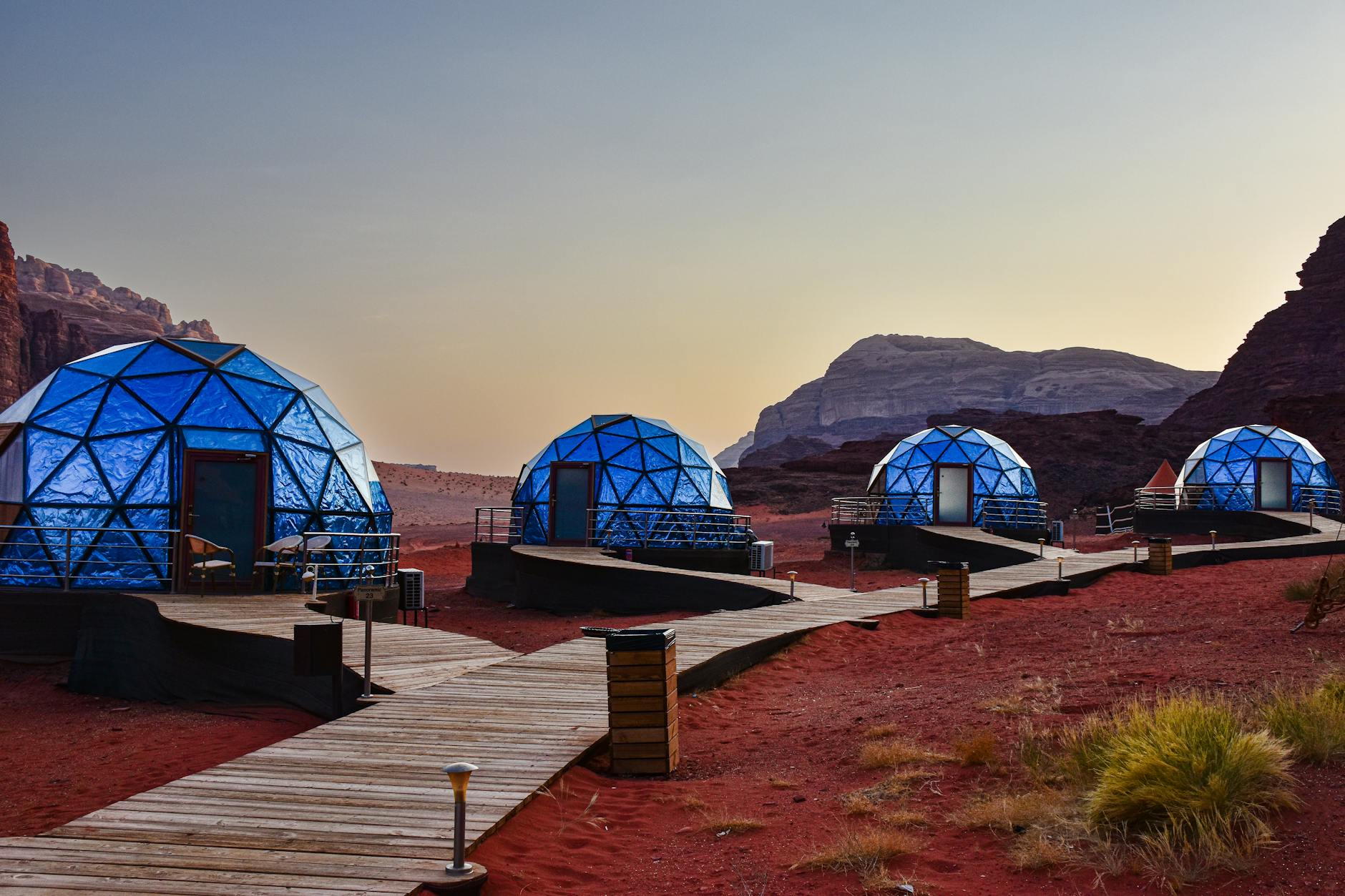
The camp was goat-hair tents and woven rugs, a fire pit, and a zarb — the traditional Bedouin oven dug into the sand. Lamb, chicken, and vegetables were placed in a metal container, buried under coals and sand, and left for hours. When the zarb was unearthed — a theatrical moment, sand brushed away, lid lifted, steam rising into the cold desert air — the meat fell apart at the touch of a fork and tasted like smoke and patience. We ate with our hands, drank sweet tea from small glasses, and the conversation moved between Arabic, English, and French with the ease of people who have been welcoming strangers for generations.
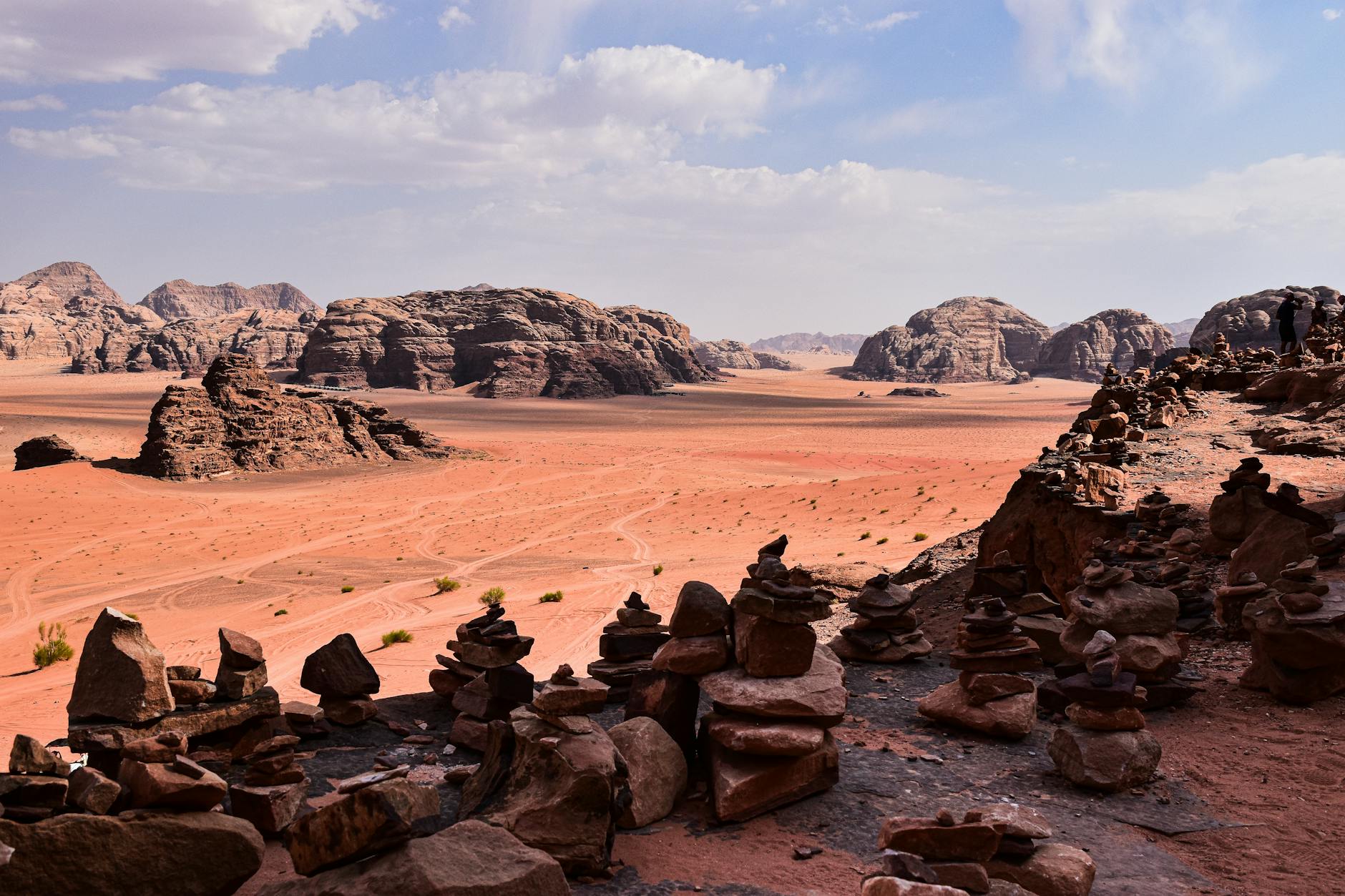
And then the stars. I have seen dark skies before — in the Sahara, in Patagonia, in rural Mexico — but Wadi Rum’s sky is different. The mountains create a natural amphitheatre, and the absence of humidity means the stars do not twinkle so much as burn. The Milky Way was not a smudge but a river — dense, structured, so bright it cast faint shadows on the sand. We lay on our backs on the still-warm dunes and watched a satellite cross the sky in absolute silence, and I understood why the Bedouins have a name for every star and why they trust the desert the way city-dwellers trust their GPS. The desert is not empty. It is full of information if you know how to read it.
We woke before dawn, climbed a dune, and watched the desert turn from grey to pink to red as the sun cleared the mountains. A Bedouin on a camel crossed the valley floor a kilometre away, a silhouette so perfectly composed it looked staged. It was not. Wadi Rum does not need to try. It simply exists, and that is enough.
When to go: March to May and September to November are ideal. Winter nights drop below freezing — bring layers. Summer exceeds 40 degrees. A minimum one-night camp stay is essential for the full experience.