Nara
"In Nara, a deer bows its head to eat from your palm and you briefly forget which century you're in."
There is a moment, somewhere between the Kintetsu station exit and the first stone lantern of Nara Park, when a deer simply walks up to you. Not to beg, not to perform — it just appears beside you like a colleague who happens to be going the same direction. I had read that the deer of Nara were considered sacred messengers of the gods. Standing there with one pressing its warm nose against my jacket pocket, I mostly thought about how unbelievably calm it was.
The Weight of the Great Buddha
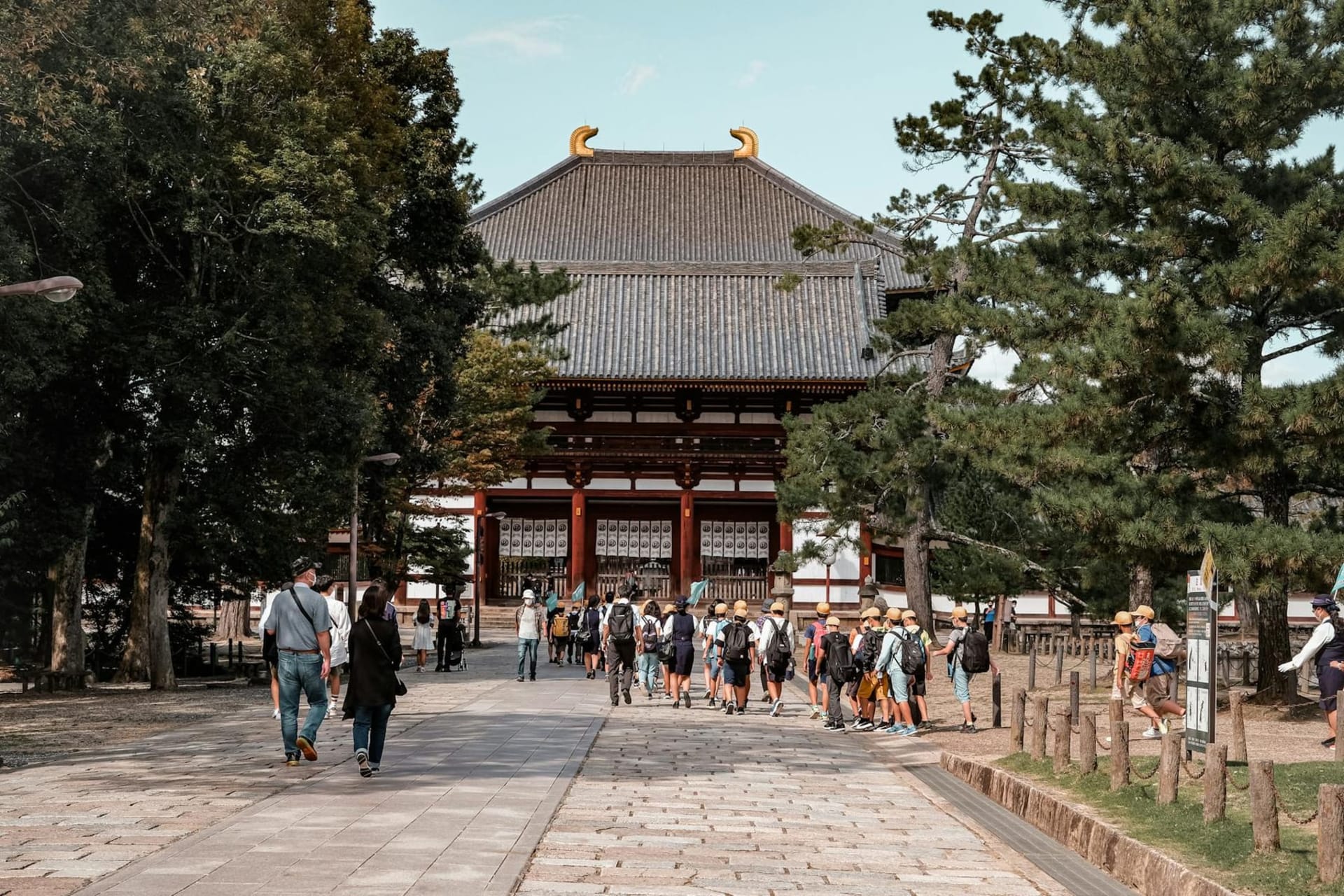
Todai-ji is the kind of place that recalibrates your sense of scale. The wooden gate — Nandaimon — is already staggering, flanked by two muscular guardian figures frozen mid-roar, their paint flaked but their fury intact. Then you pass through and the main hall rises ahead of you, the largest wooden structure in the world, and inside it the Daibutsu: a bronze Buddha fifteen meters tall, hands folded, eyes half-closed, an expression of absolute patience that no photograph has ever successfully captured.
I stood in front of it for longer than I expected. Lia wandered to the side to look at the pillar with the small hole carved through its base — legend says that squeezing through guarantees enlightenment, and there were children doing exactly that, laughing, parents photographing. The Buddha watched all of it without comment.
Cedar Light and Lantern Smoke
The path from Todai-ji toward Kasuga Taisha shrine is where Nara becomes something stranger and quieter. The deer thin out. The cedar forest closes in. Along the stone walkway, hundreds of bronze lanterns hang from brackets, and twice a year they are all lit simultaneously — but even unlit, their patina and the smell of old metal and resin give the path a density of time that is hard to articulate.
At Kasuga Taisha itself, I noticed something I hadn’t expected: the innermost corridors are lined with hanging lanterns donated by worshippers, each one inscribed with a name or a wish, swaying almost imperceptibly in the draft from the forest. I had come for the deer and the Buddha. I stayed longest for those lanterns.
That evening we ate kakinoha-zushi near Naramachi — salmon and mackerel pressed into rice, wrapped in persimmon leaves that perfume the fish with something faintly bitter and green. It tasted like the forest had decided to become food.
When to go: Late October through early November brings autumn foliage that turns Nara Park into something from a woodblock print. Spring cherry blossoms (late March to mid-April) are spectacular but crowded — arrive before 8am to have the deer and the temples almost to yourself.