Kamakura
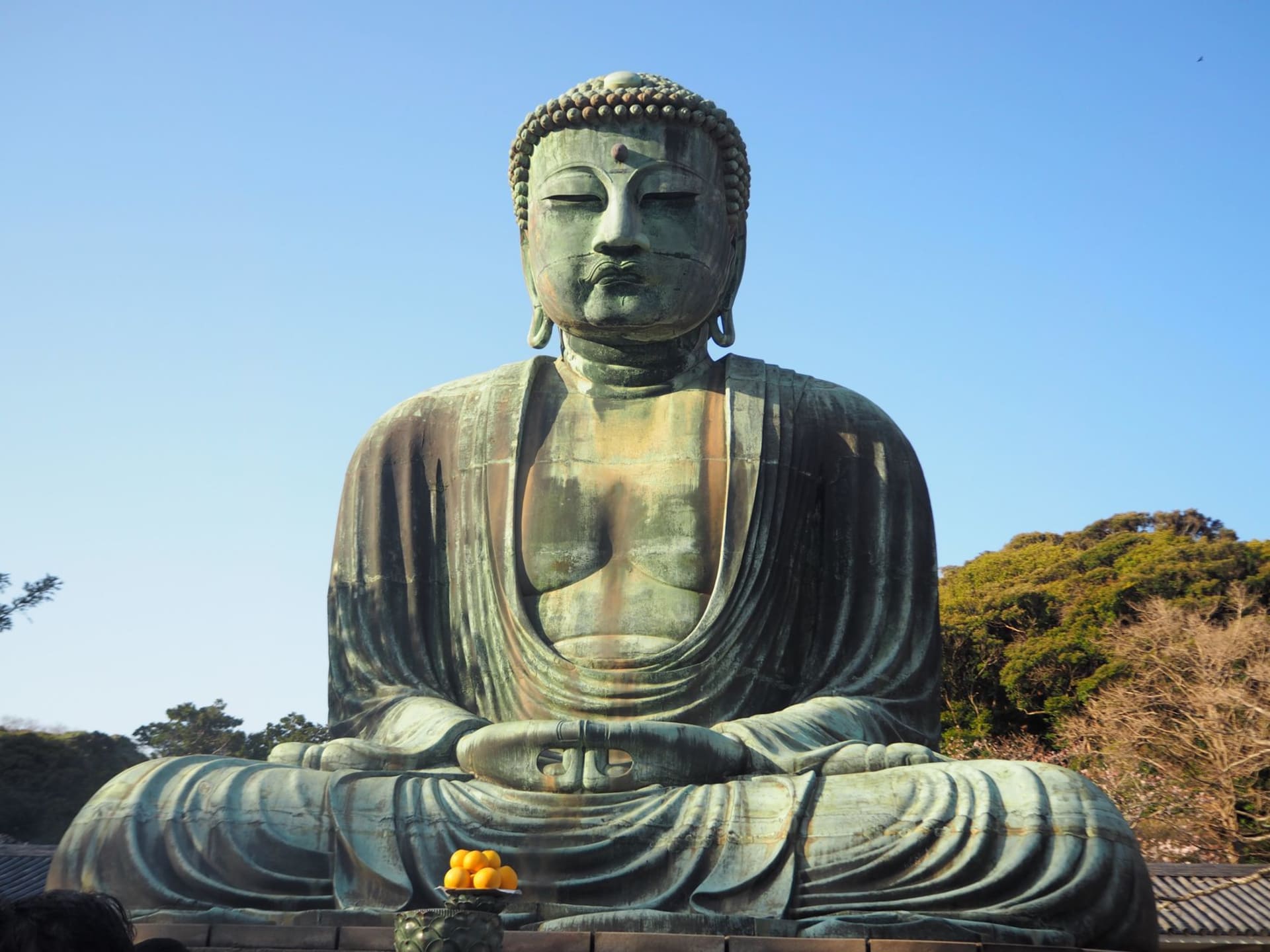
"The hall that once sheltered the Great Buddha was washed away by a tsunami centuries ago. Now he sits in the open. He looks better for it."
Kamakura is the day trip every Tokyo guidebook recommends, which had made me suspicious of it. Lia overruled me, as she usually does about the things I’m wrong about, and we took the green Yokosuka line south on a clear winter morning, the sea appearing and disappearing between the houses. Within an hour we’d swapped the vertical density of Tokyo for a low town of temples, hills and surf, and I spent the rest of the day quietly conceding the point.
A Buddha with no roof
The Great Buddha — the Daibutsu at Kotoku-in — is the reason most people come, and it earns it. Cast in bronze in 1252, it sits cross-legged and serene at over eleven metres, its face composed in that particular half-smile that Japanese Buddhist sculpture does better than anyone. What I hadn’t known is that it once sat inside a great wooden hall, and that the hall was destroyed — by storm, by fire, and finally by a tsunami in 1498 that simply carried it off and never returned. The monks chose not to rebuild. So the Buddha sits in the open now, weathered green, rain falling on his shoulders, and the absence of the building is the whole point: a statue meant for an interior, sitting calmly under the sky for five hundred years.

You can, for a few coins, go inside the Buddha — climb into the hollow bronze body through a small door and stand in the dim, faintly metallic interior, looking up at the casting seams. Lia loved this; I found it slightly claustrophobic and was glad to come back out into the cold light. We ate afterward at a tiny shop near the gate that did nothing but shirasu — tiny translucent whitebait from Sagami Bay, served raw over rice — which is the local specialty and exactly the kind of hyper-regional food I travel for.
Into the hills
The mistake most day-trippers make is to do the Buddha, the giant Kannon at Hase-dera, and the main Hachiman shrine, and then get back on the train. The better Kamakura is up in the wooded hills behind the town, threaded with old walking trails between smaller temples. We took the Daibutsu hiking trail, a rooty path through forest that links several of them, and found ourselves almost alone at a moss-furred temple where a single monk was sweeping leaves and a stream ran under a red bridge. After the crowds at the Buddha it felt like stepping behind the curtain.

We finished the day at the beach, which surprised me most of all — Kamakura is a surf town, with a long grey-sand shore facing Sagami Bay and, on a clear day, the cone of Mount Fuji floating across the water at sunset. We sat on the seawall with hot canned coffee from a vending machine, watched the surfers and the dog-walkers, and Fuji obligingly appeared, pink and improbable, exactly as it does on every postcard and somehow not at all the same. The day trip the guidebooks recommend turned out to deserve the recommendation. I hate when that happens.
When to go: Year-round, but autumn for the maple colour in the temple gardens, or clear winter days for the best chance of Fuji from the beach. June brings the hydrangeas at Hase-dera and the heaviest crowds with them. Go early; Kamakura fills up by mid-morning on weekends.