We arrived from Kyoto on a thirty-minute train ride that cost five hundred and eighty yen — less than a coffee in most European capitals — and within an hour of dropping our bags in Namba I understood why people call Osaka the anti-Kyoto. Where Kyoto is restrained, considered, wrapped in centuries of ceremony and the expectation that you will lower your voice in the presence of beauty, Osaka is loud, generous, and entirely uninterested in formality. The city’s unofficial motto is kuidaore — eat until you drop — and it is not a joke or a slogan designed for tourists. It is a civic philosophy, a way of life, and possibly a medical condition that the entire population has collectively decided to embrace.
Lia and I spent six days here. I could have stayed six more. I did not expect this. I had planned Osaka as the coda to the trip — a few days of street food before the flight home, a way to decompress after the intensity of Kyoto’s temples and the emotion of the tea ceremony and the bamboo grove. What I got instead was a city that grabbed me by the shirt and said: Stop being serious. Eat this. Laugh. Eat this other thing. Laugh again. By the third day I had sauce on every shirt I owned and a conviction that Osaka might be my favourite city in Japan. By the sixth day, I had dropped the “might.”
Shinsaibashi — The First Stroll
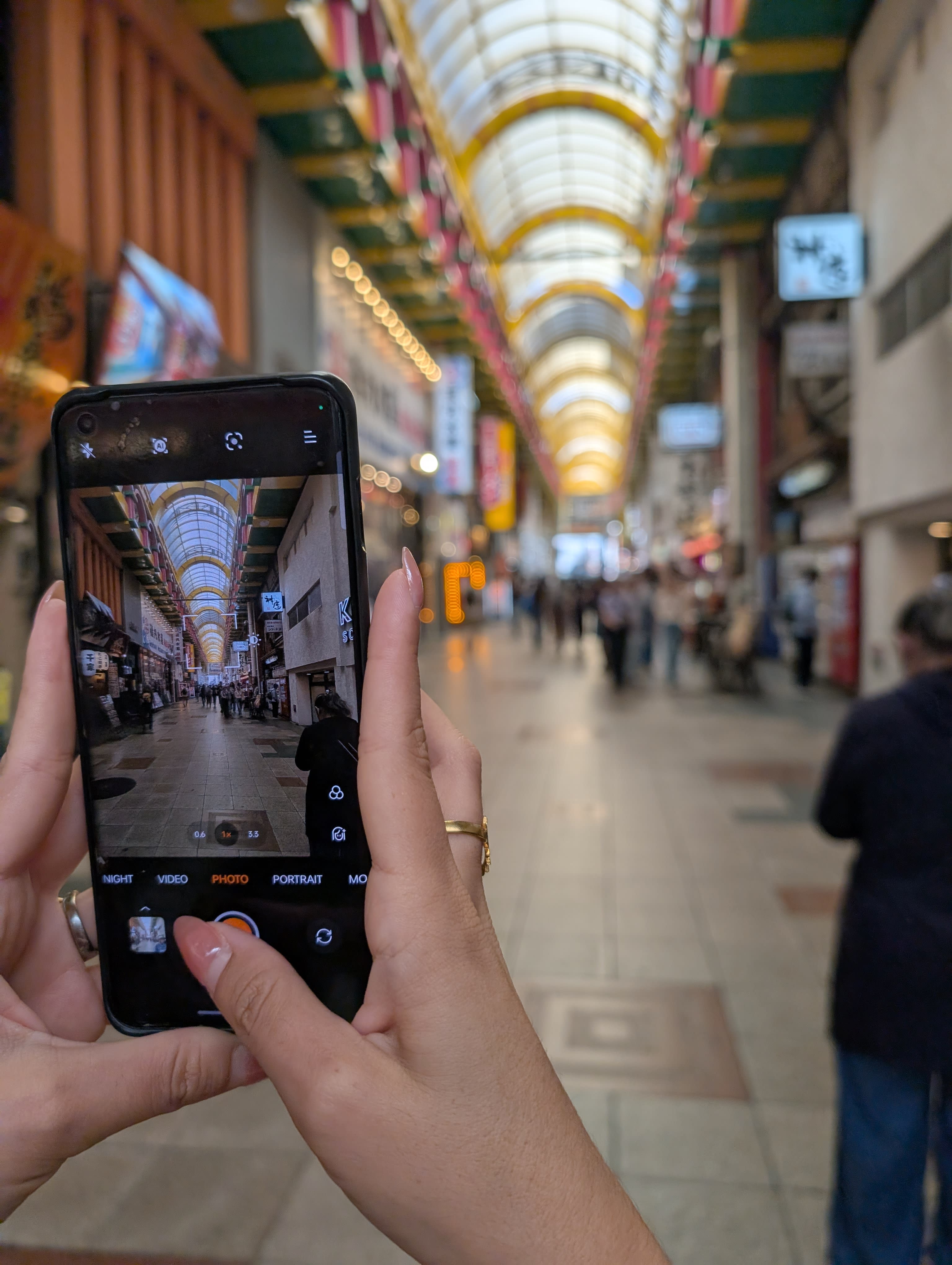
Our first afternoon, before the neon kicked in, we walked the Shinsaibashi-suji Shopping Arcade — a covered street that runs for six hundred metres through the centre of the city. Lia had her phone out before we were ten steps in, photographing the endless tunnel of shops, lights, and people stretching into the distance.
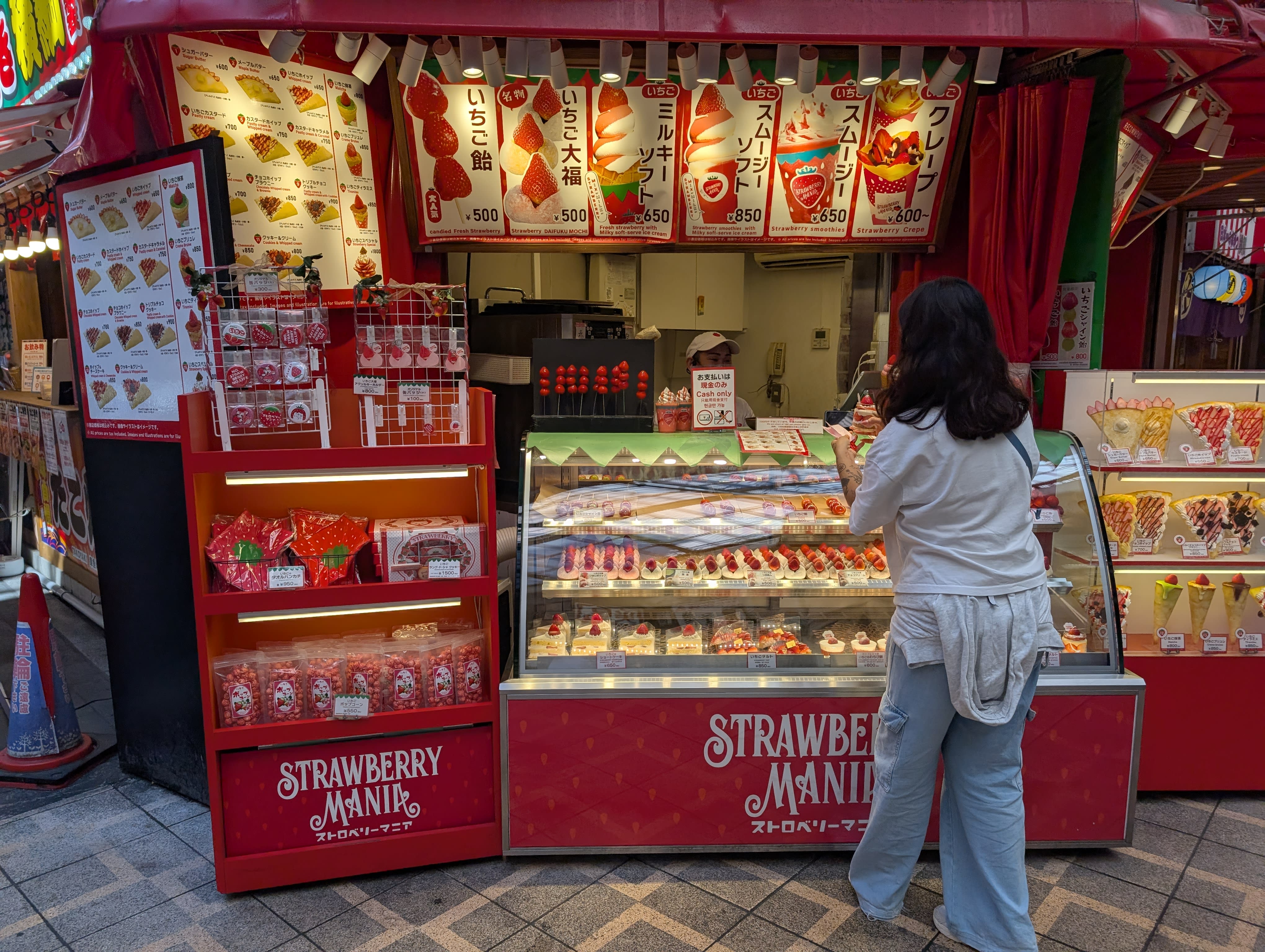
She found a strawberry stand — Strawberry Mania, a red-and-gold stall selling every conceivable strawberry product — and positioned herself in front of it with the focus of someone conducting market research. She was gone for five minutes. She came back with a strawberry daifuku and no regrets.
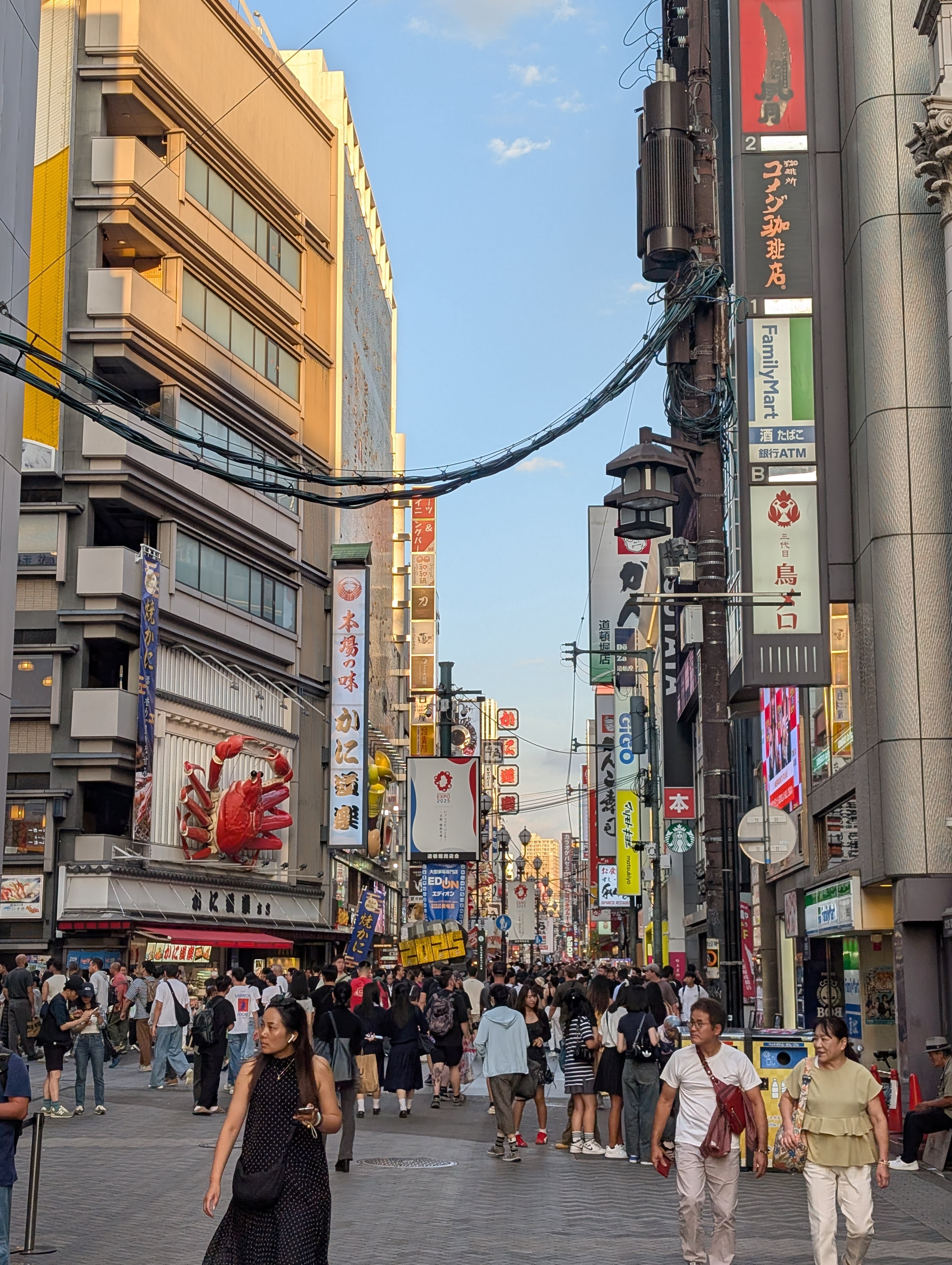
The arcade opened onto the main Dotonbori street — the giant mechanical crab, the crowds, the signs stacked ten high on every building. Osaka announces itself without subtlety. I loved it immediately.
Dotonbori — The Centre of Everything
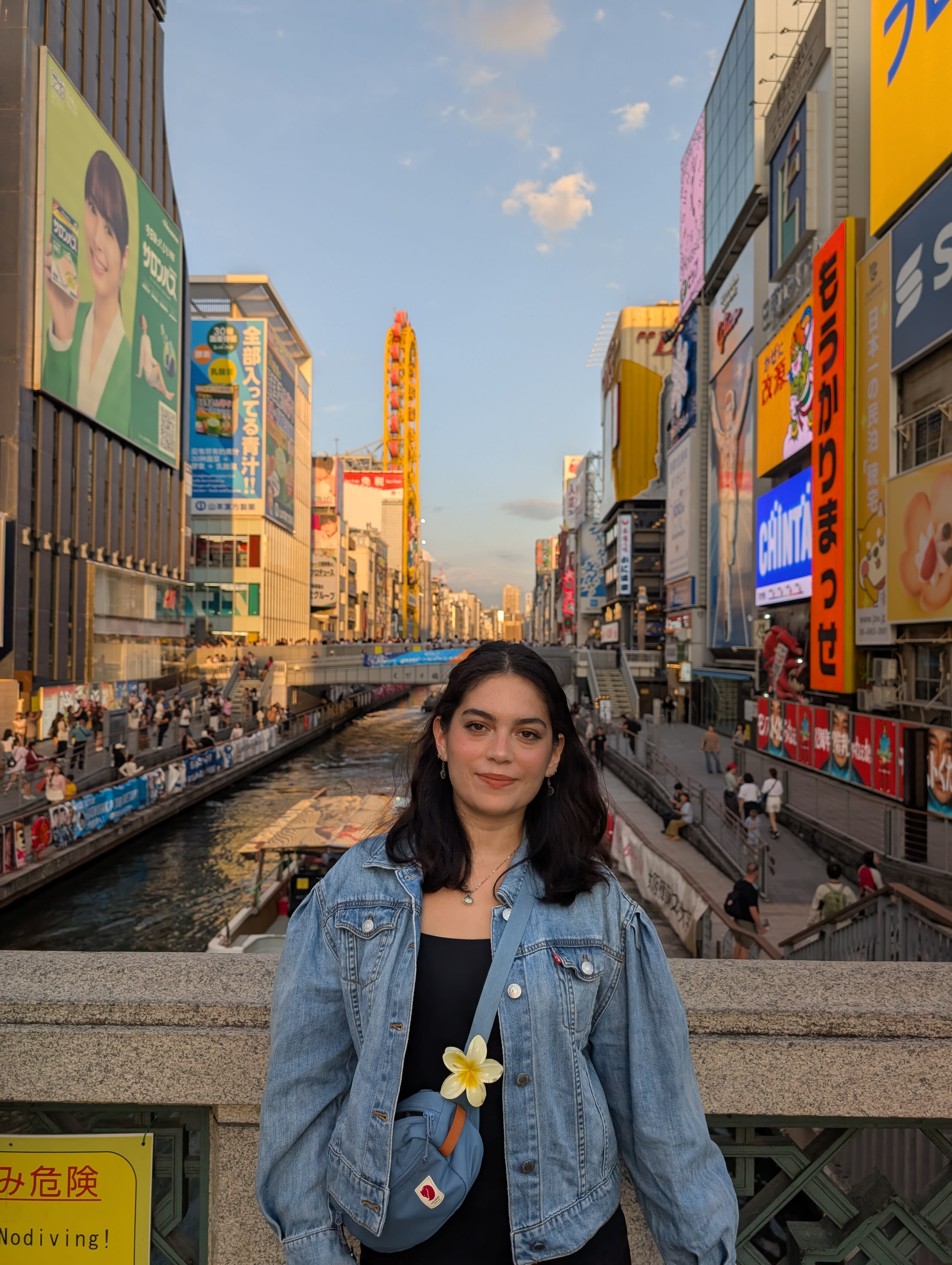
Dotonbori is Osaka’s beating heart, and it beats in neon. The canal runs through the centre of the entertainment district, and both banks are lined with signs so bright and so dense that the water below glows in colours that do not occur in nature. The Glico Running Man — the billboard of a sprinter crossing a finish line that has been here since 1935 — presides over the chaos.
Lia stood on the bridge with the canal behind her and the Glico sign catching the last of the daylight, and I took a photograph that has become one of my favourites from the trip. The city was just beginning its transformation from day to night — the signs warming up, the crowds thickening, the smell of frying batter rising from every direction.
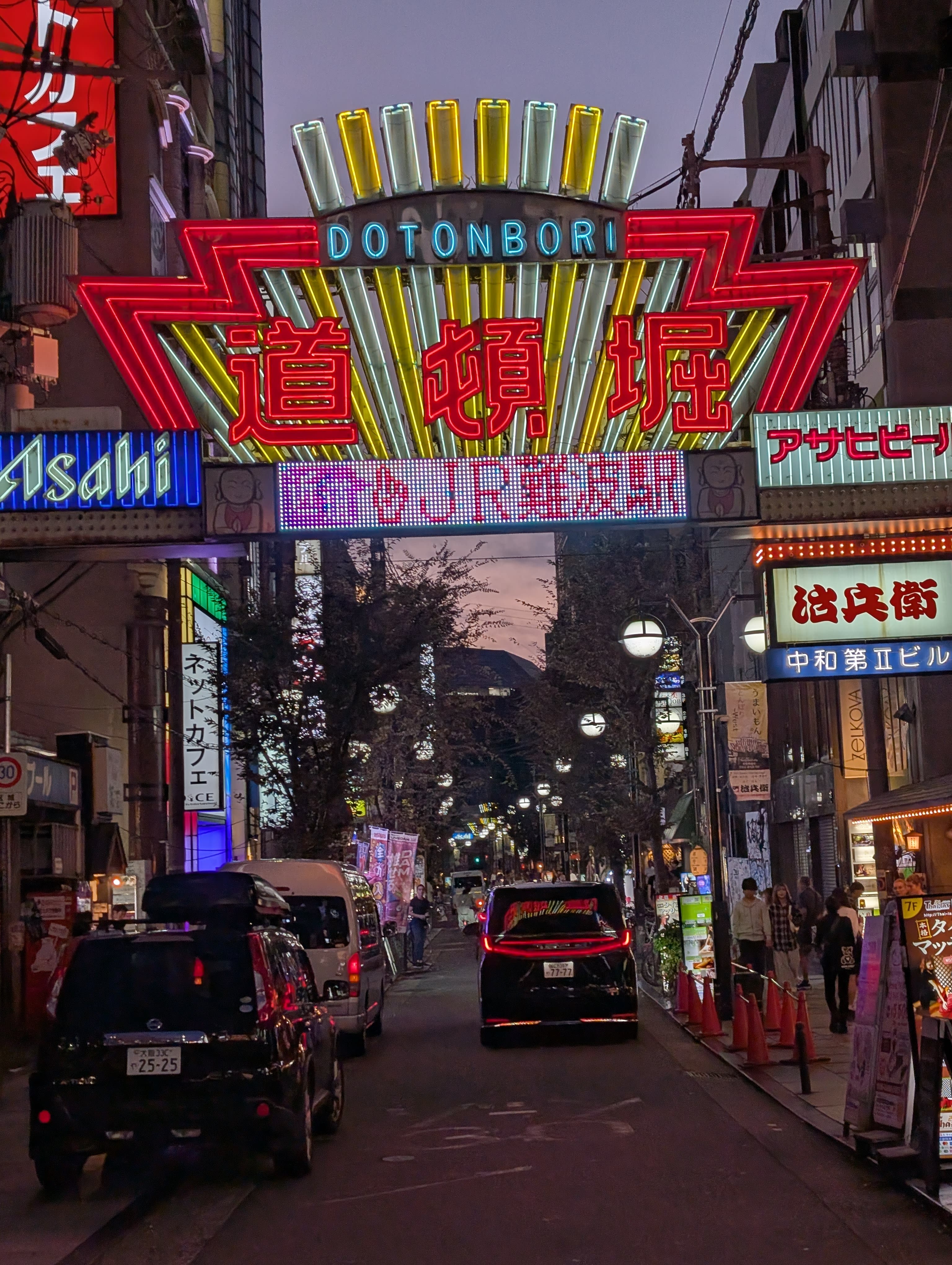
As night fell, the transformation was complete. The Dotonbori neon gate lit up over the entrance to the district — kanji glowing in red and yellow, the Asahi sign beside it, cars passing beneath into the light.
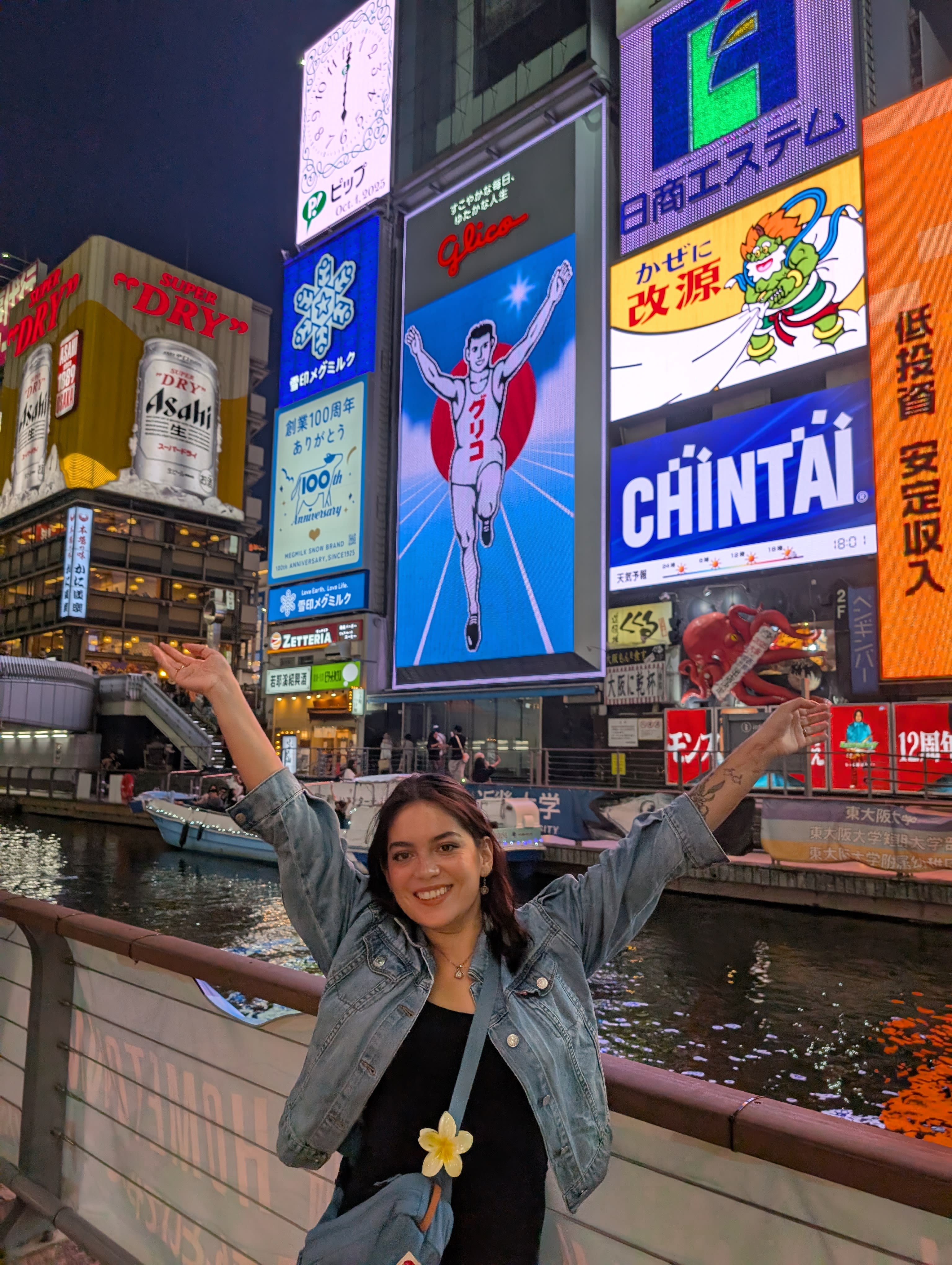
And then Lia did the thing. The Glico Running Man pose. Arms up, grinning, the billboard behind her in perfect alignment. Every tourist does this. Lia did it better than every tourist.
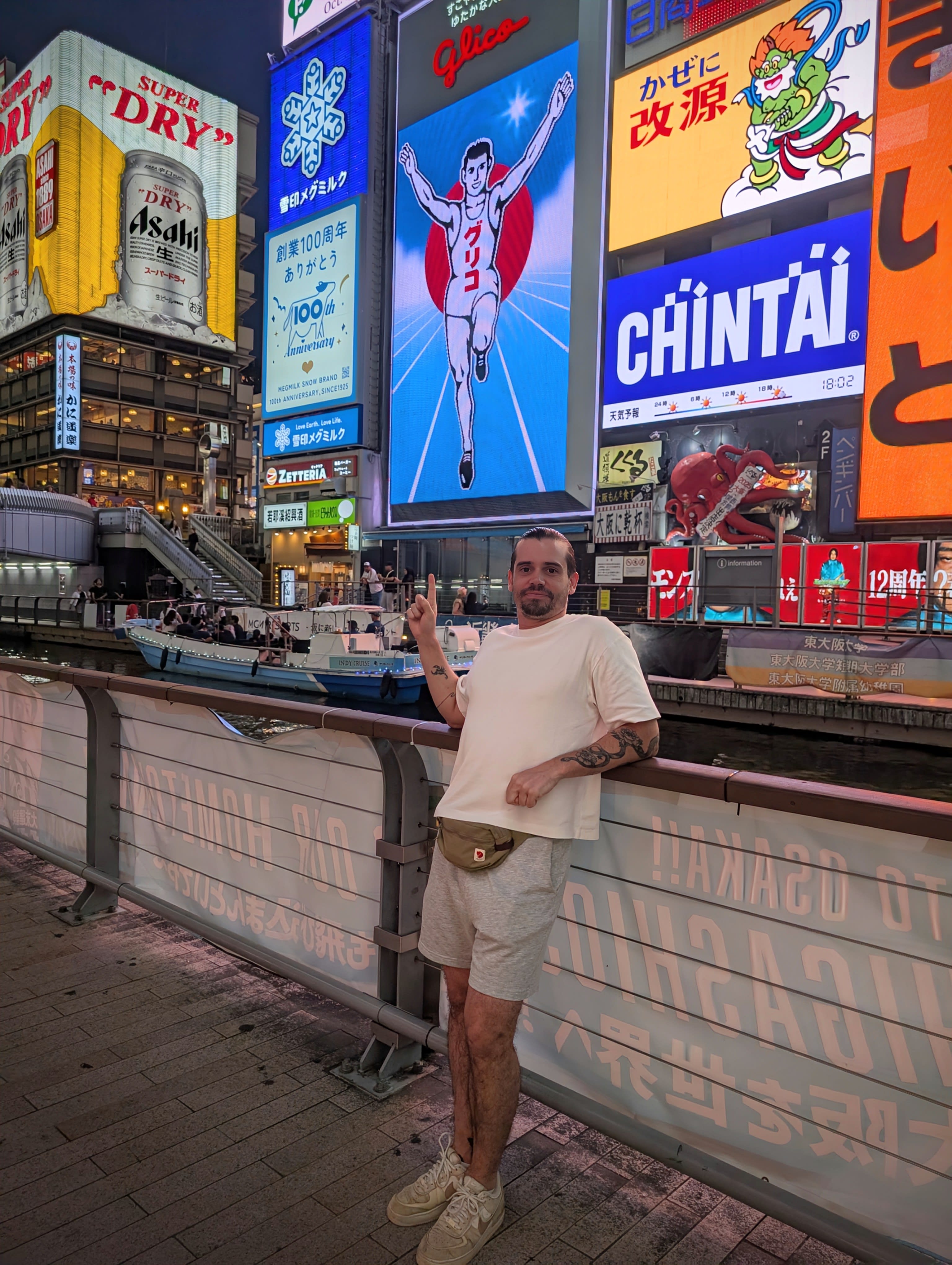
I did it too. Slightly less enthusiastically. The canal boat was passing behind me. A tourist bus was honking. I was already thinking about takoyaki.
We went to Dotonbori every single night. By the third evening, the takoyaki vendor recognised us and gave us an extra piece without being asked. By the fifth, she waved us over before we had made a conscious decision to stop. Osaka adopts you quickly and completely, and the adoption process involves being fed until you cannot move.
The canal at night, seen from the bridge — the boat tour lights, the neon on both banks, the reflections swimming in the dark water — was the image that came to define Osaka for me. Not a single building, not a single dish, but this: a canal full of light, a city full of noise, and the feeling that you could stand here forever and never see the same colour twice.
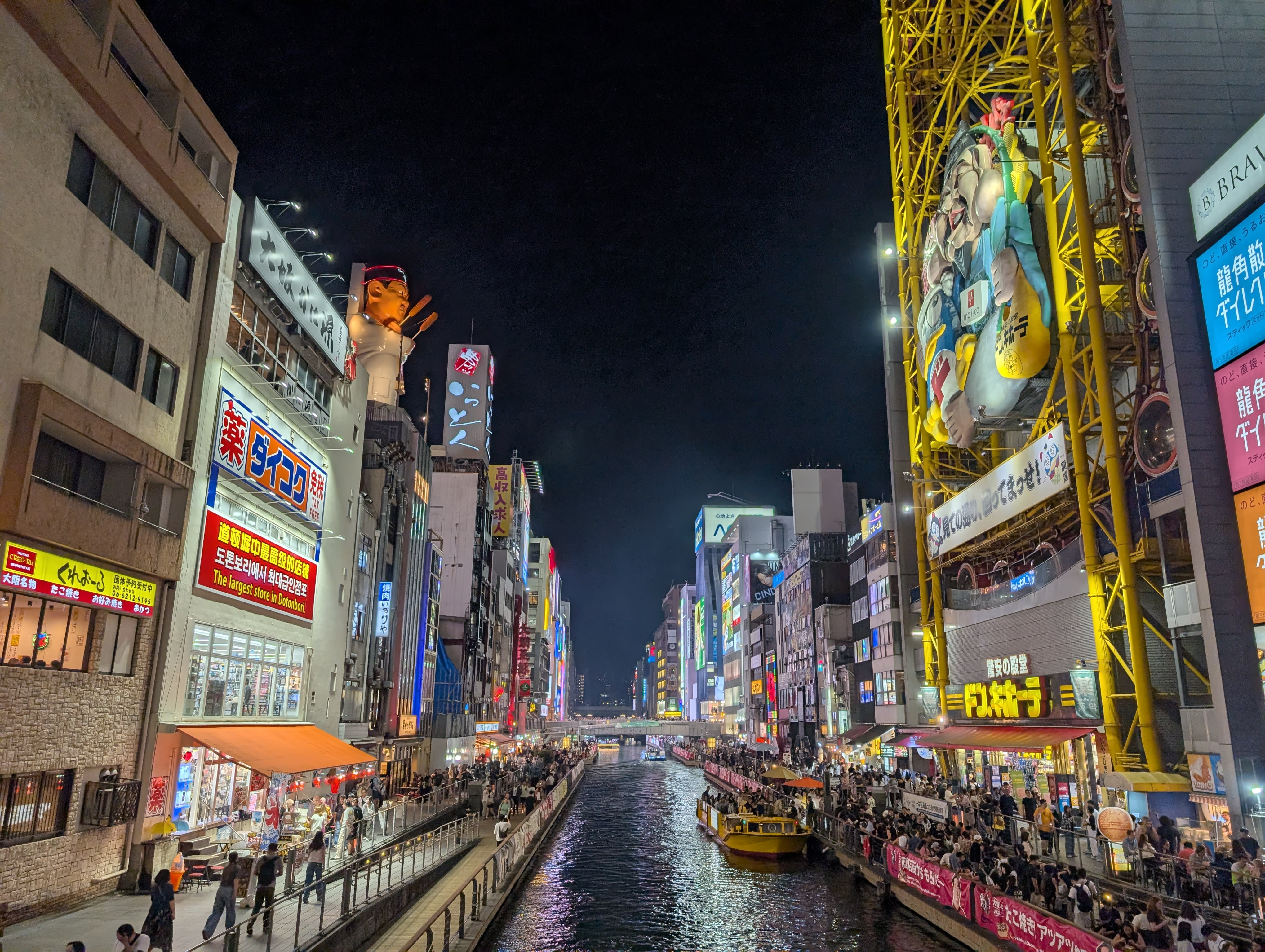
Dotonbori After Dark
The narrow alleys behind the canal are where Dotonbori becomes something more intimate. We found Hozenji Yokocho — a stone-paved lane lit by red paper lanterns, packed with tiny restaurants and bars, the atmosphere shifting from carnival to something warmer, older, quieter.
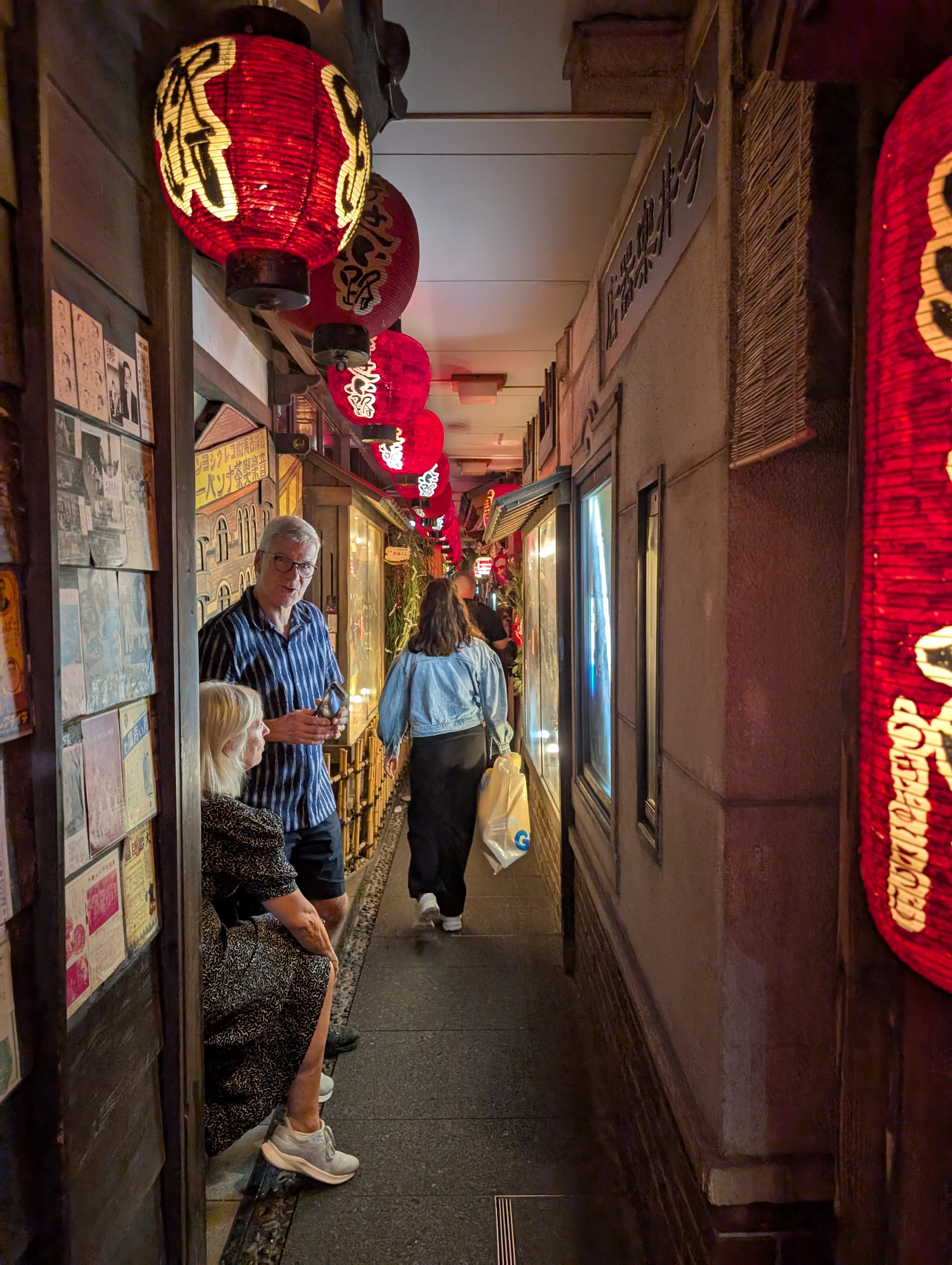
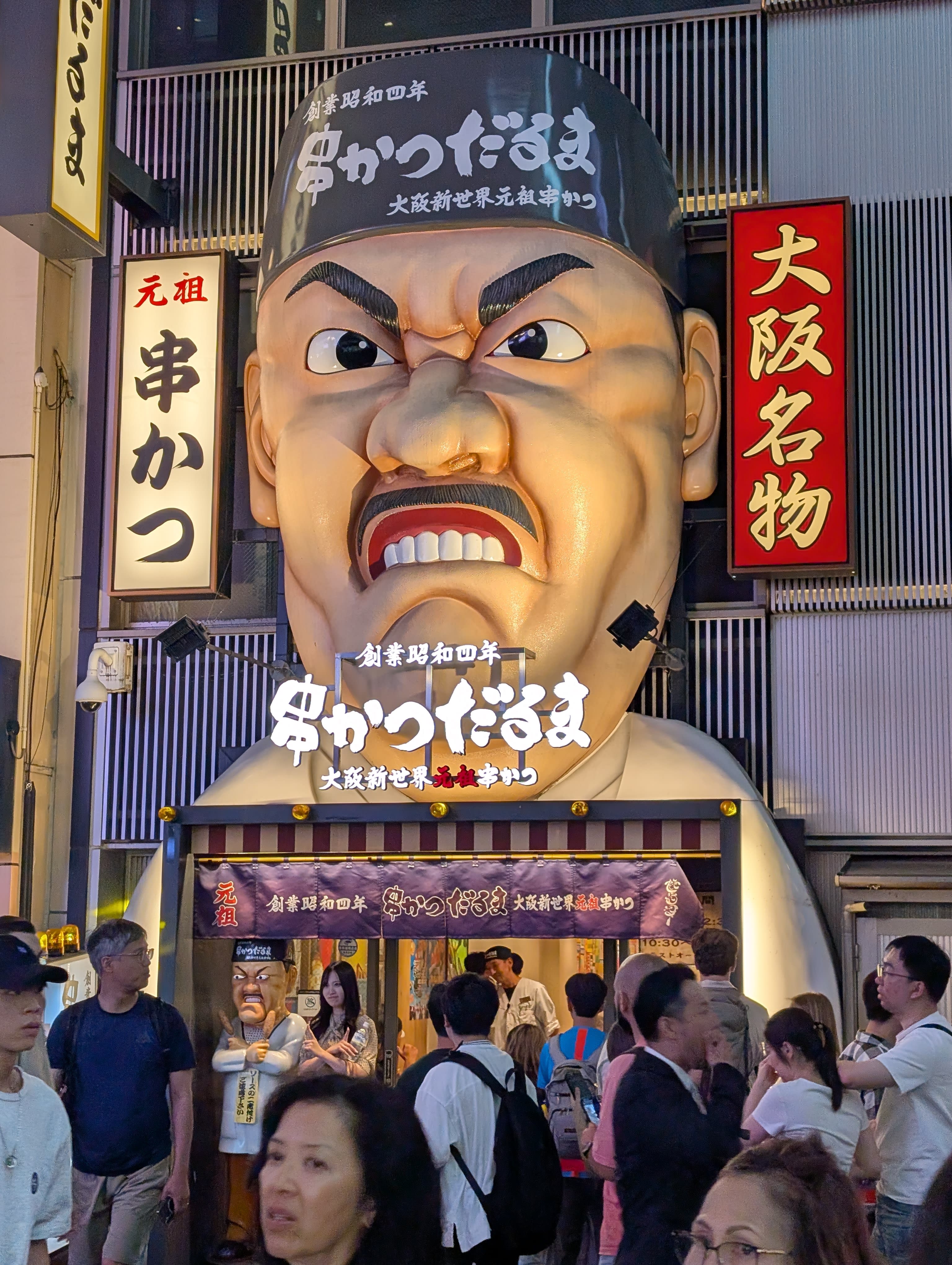
The kushikatsu restaurants are everywhere in the alleys around Dotonbori. The most famous is Kushikatsu Daruma — you cannot miss it. A giant, angry-faced statue glares down at the street, fists clenched, daring you to double-dip your skewers in the communal sauce. The rule is one dip only. The statue is there to remind you. The skewers are there to make you forget everything else.
Osaka Castle — Stone and Gold
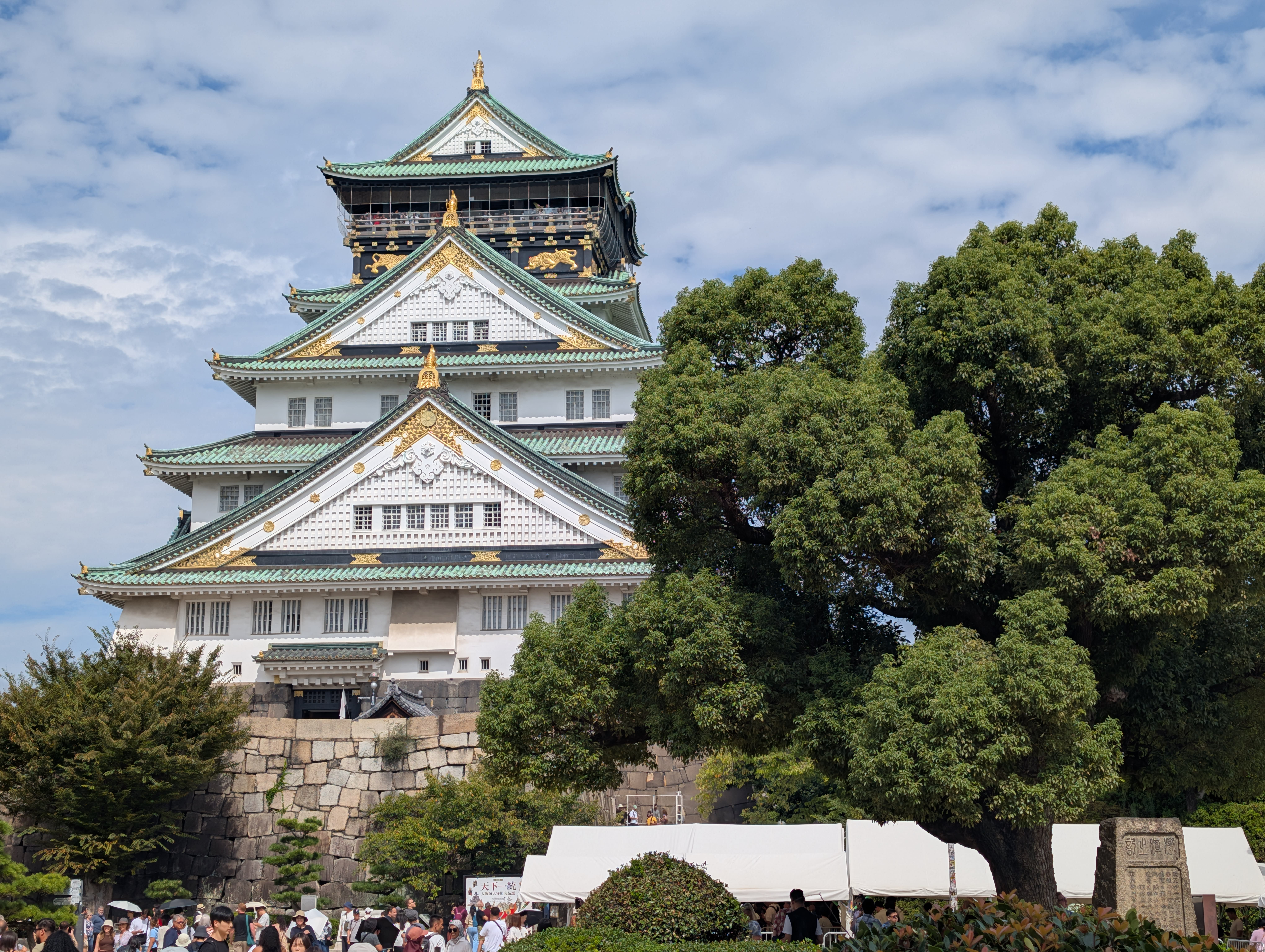
Osaka Castle sits in a park so large it has its own microclimate — the trees are taller, the air is cooler, and the city noise fades to a background hum within minutes of entering. Lia stood in front of the main tower with her sunglasses on and the white-and-gold facade rising behind her, looking like she belonged on the cover of a travel magazine, which I told her, and which she dismissed with the particular eye-roll she reserves for compliments she secretly enjoys.
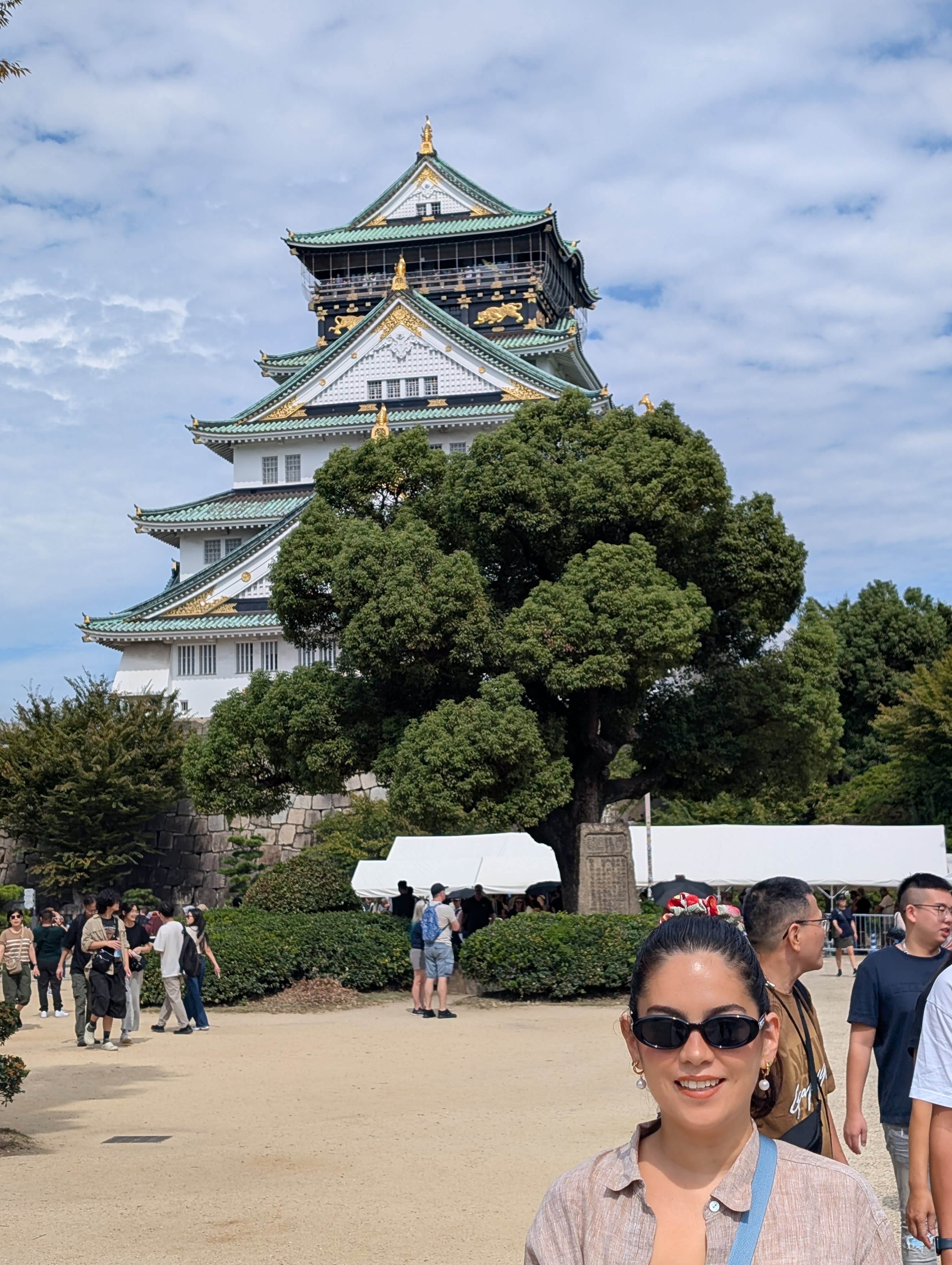
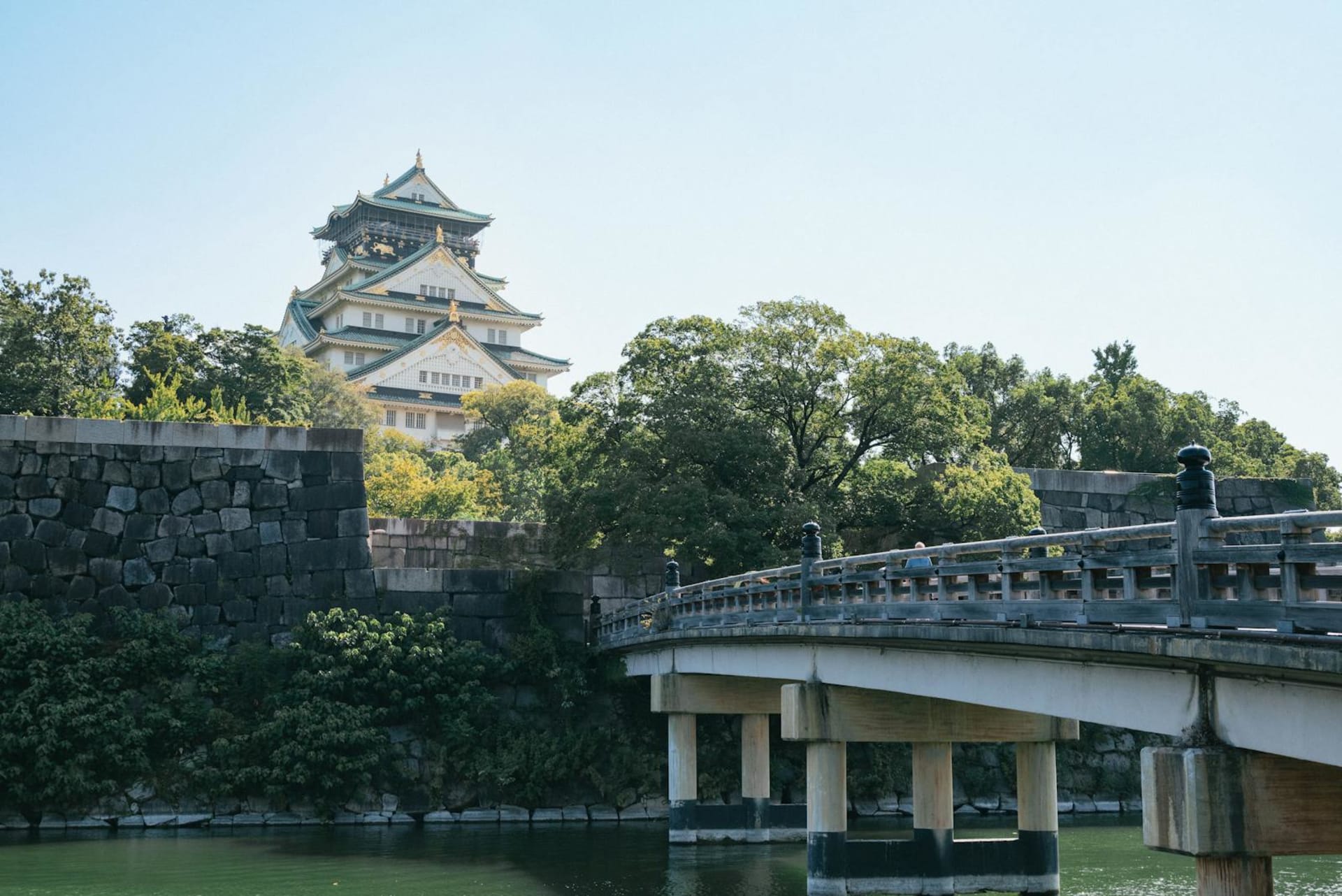
The castle is a reconstruction — the original has been destroyed and rebuilt several times — but the park surrounding it is genuine and the moat is massive and the whole scene, particularly in the golden light of late afternoon, has a beauty that no amount of historical footnoting can diminish.
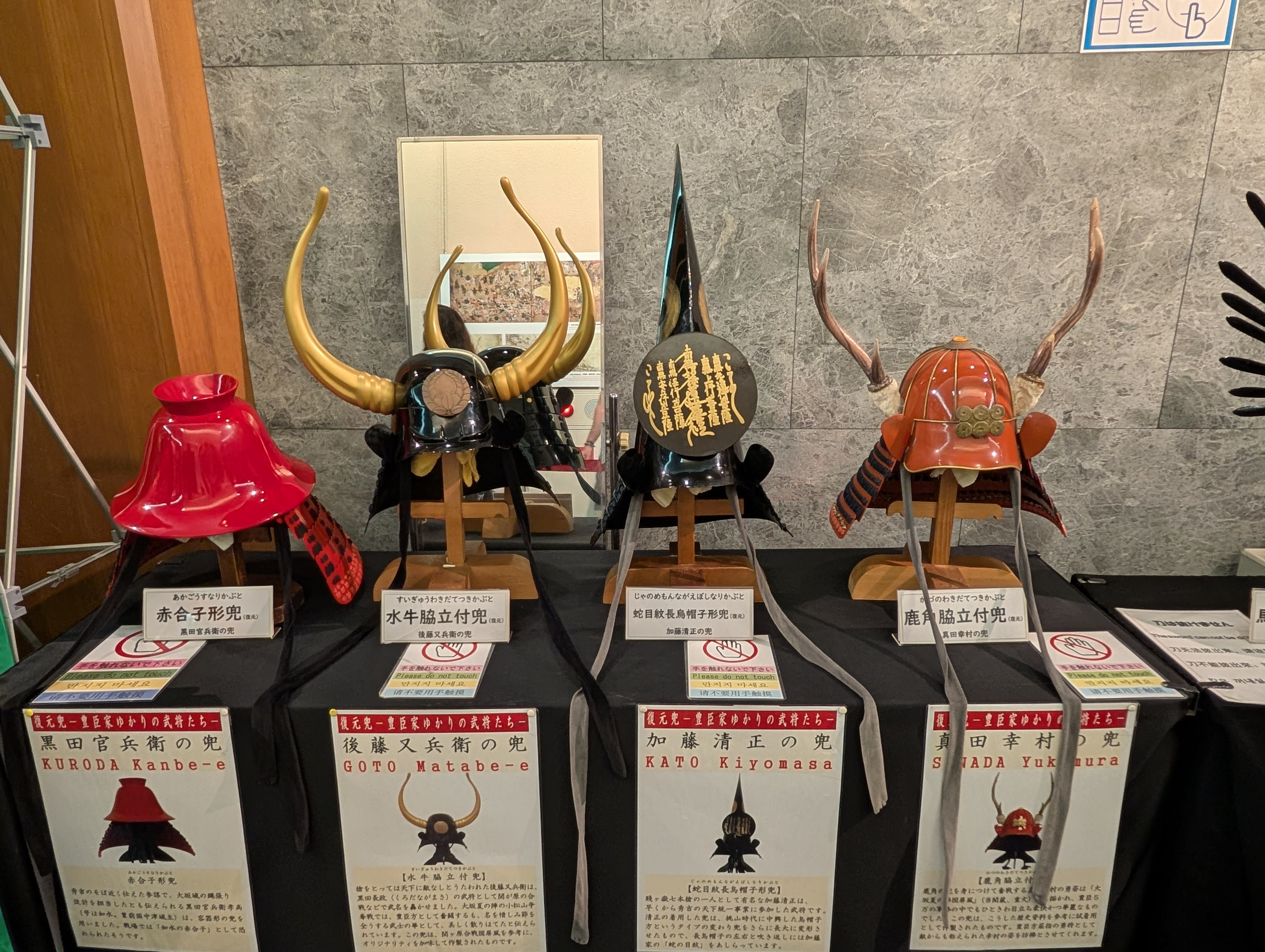
Inside, we found samurai helmets on display — four of them, each more elaborate than the last, with gold horns and crescent moons and deer antlers, each designed to make the wearer look simultaneously terrifying and magnificent. I stood in front of them for ten minutes. Lia had to come back and get me.
Namba — Pop Culture & the Night
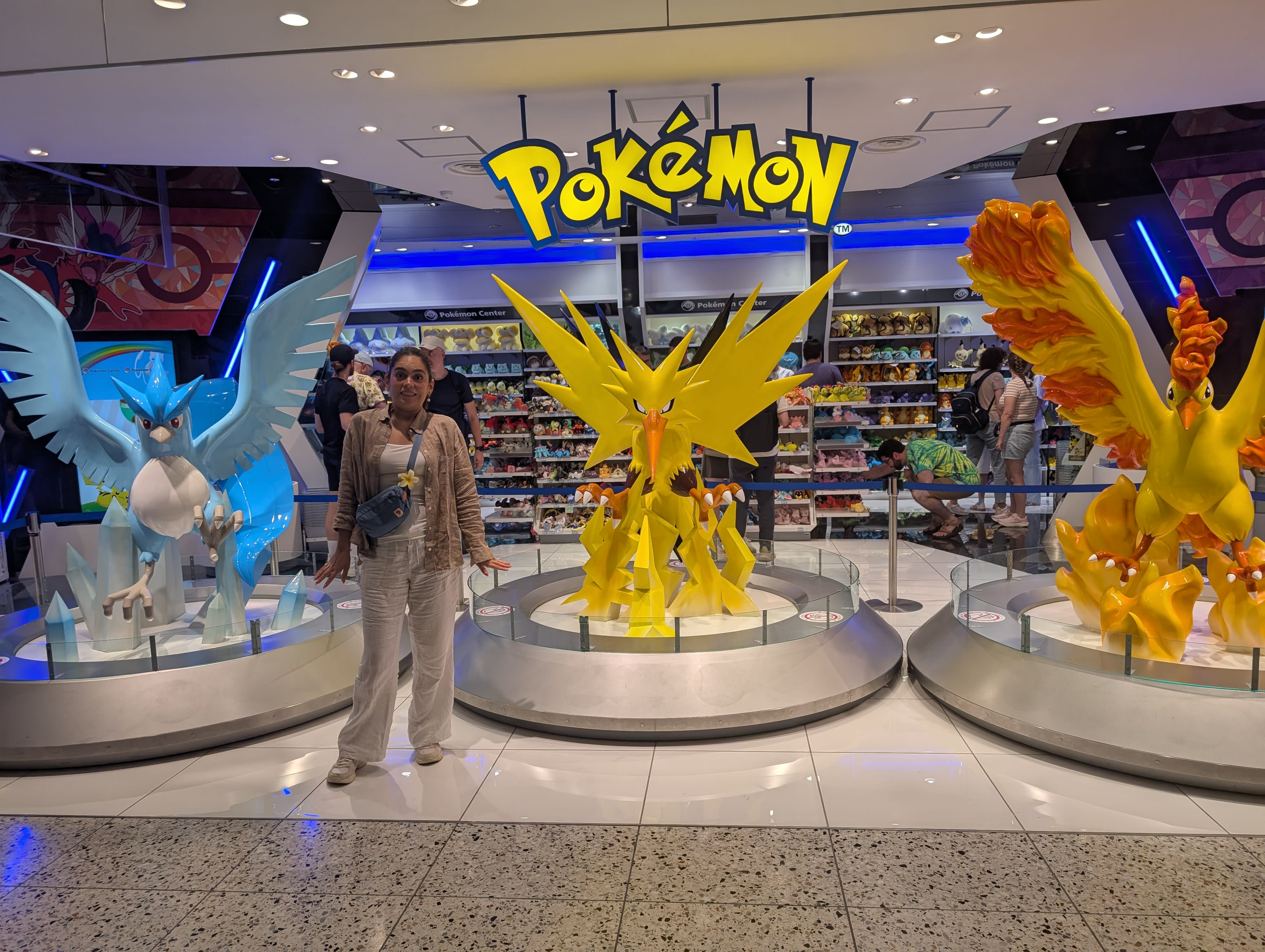
Osaka’s Namba district was our home base, and every day offered a different flavour of Japanese pop culture. The Pokémon Center was Lia’s temple — she stood among the life-sized legendary birds and looked at me with an expression that said do not rush me.
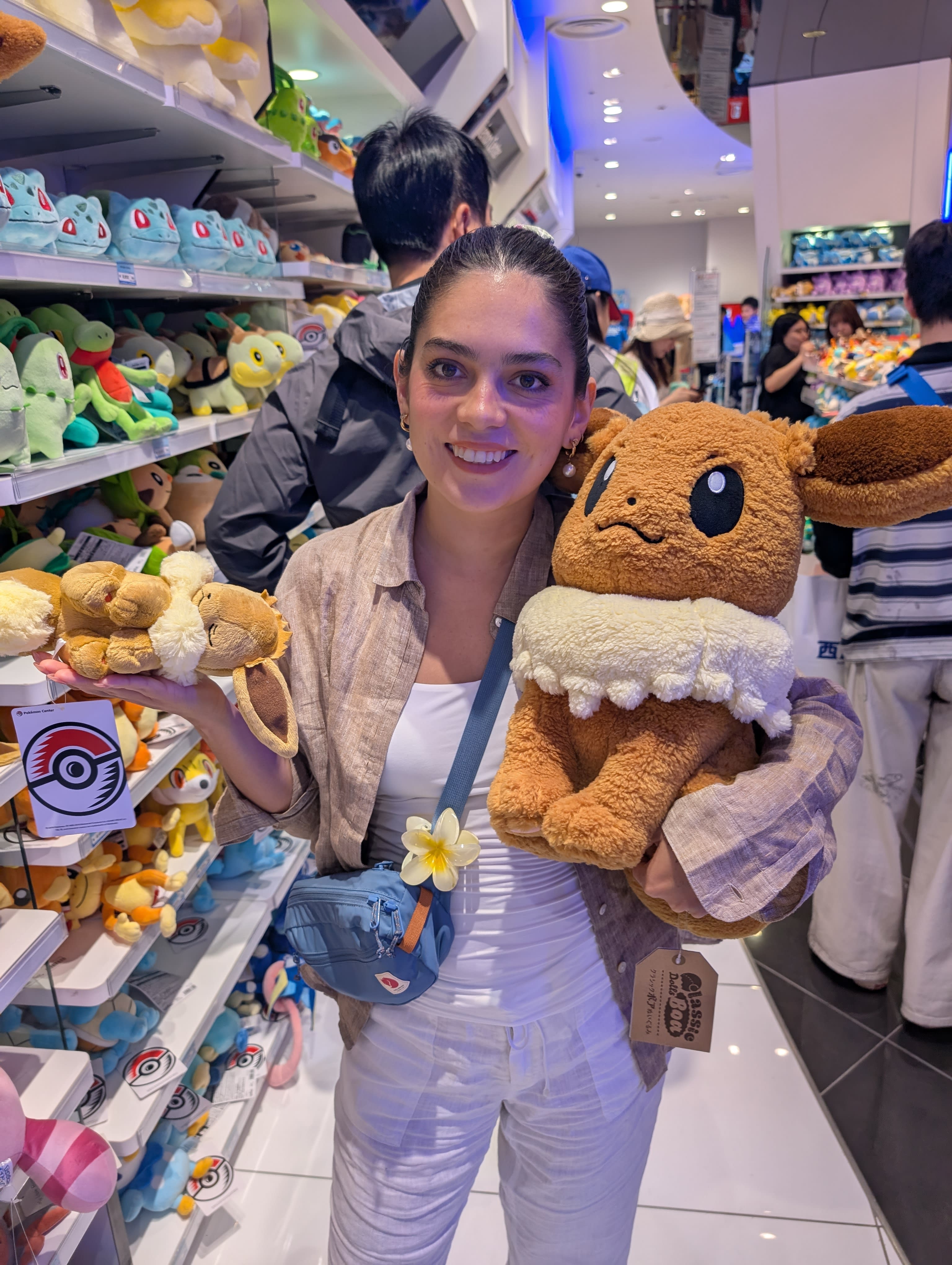
She did not maintain composure. She emerged with an Eevee plush the size of a small dog, held it up for a photograph with a grin that I have not seen outside of Christmas morning, and informed me that this was a non-negotiable purchase.
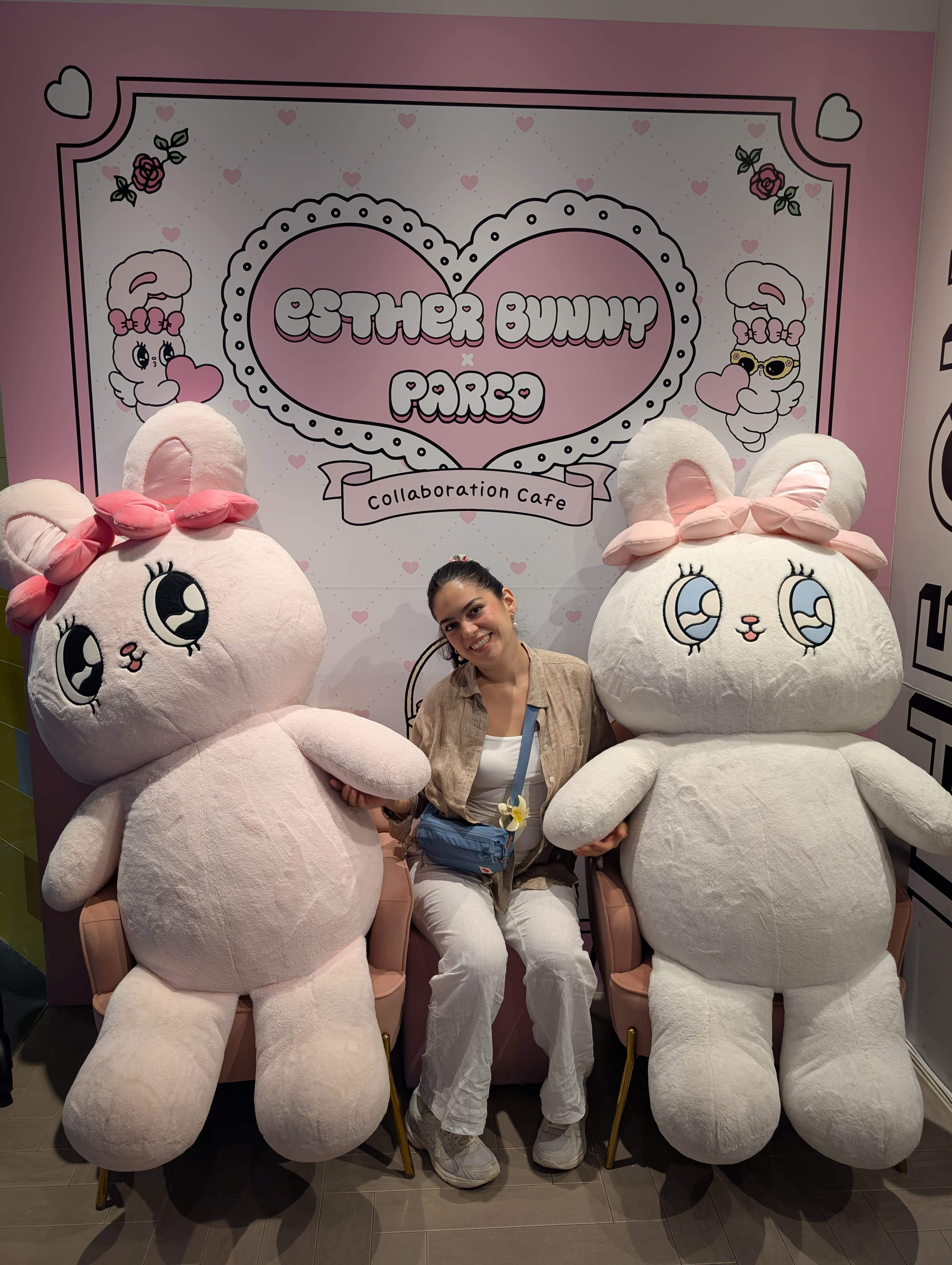
The Esther Bunny Café at Parco was Lia’s next stop — she sat between two enormous stuffed bunnies and looked perfectly at home, which is either a compliment to the café’s atmosphere or an observation about Lia that I should keep to myself.
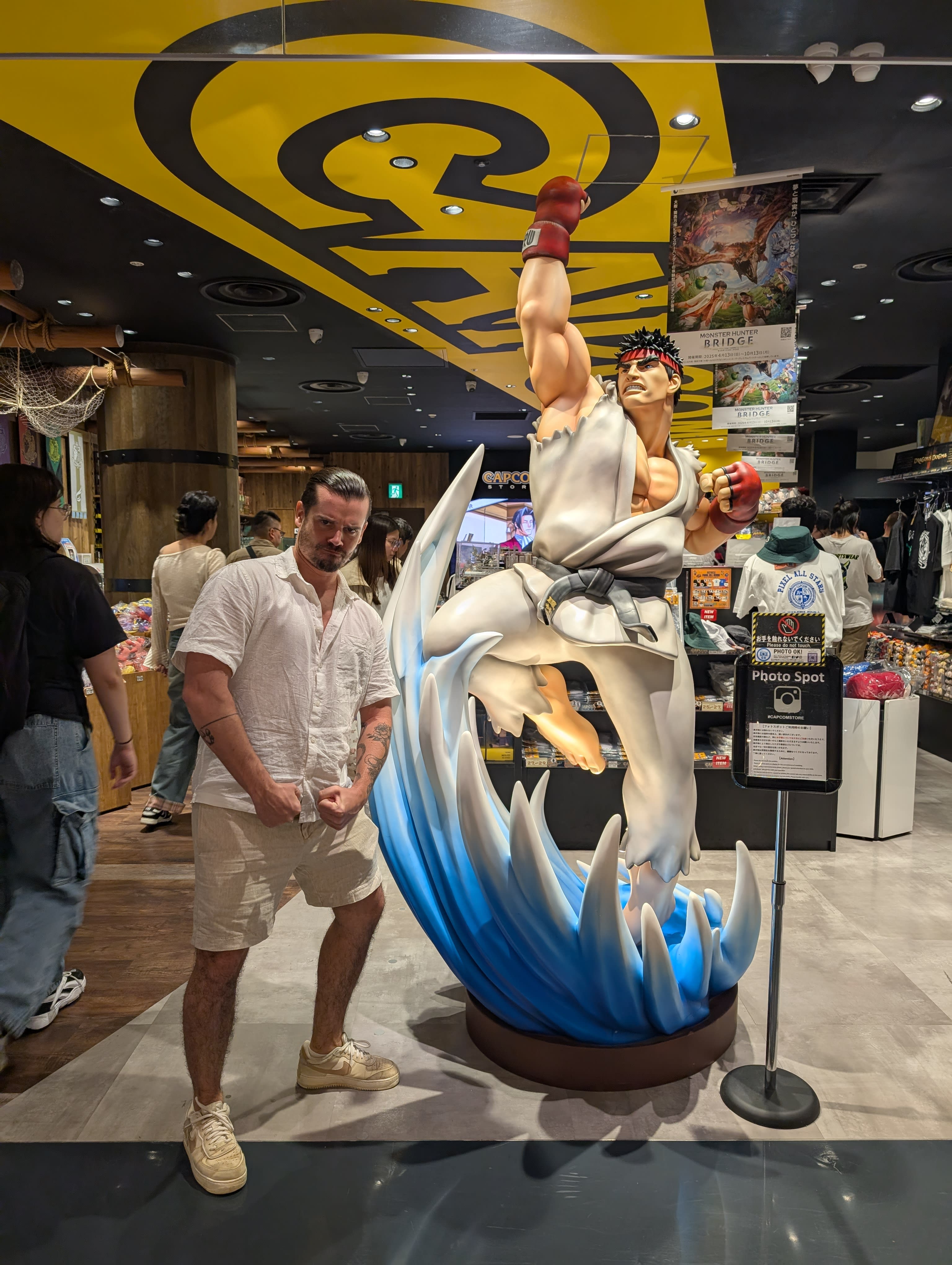
I found my own obsession at a Capcom store — a life-sized Ryu statue from Street Fighter, frozen mid-uppercut, two metres of pixelated nostalgia rendered in resin. I stood next to it. I did not do the pose. I have some dignity left. (I did the pose. Lia has the photograph. She has agreed not to post it.)
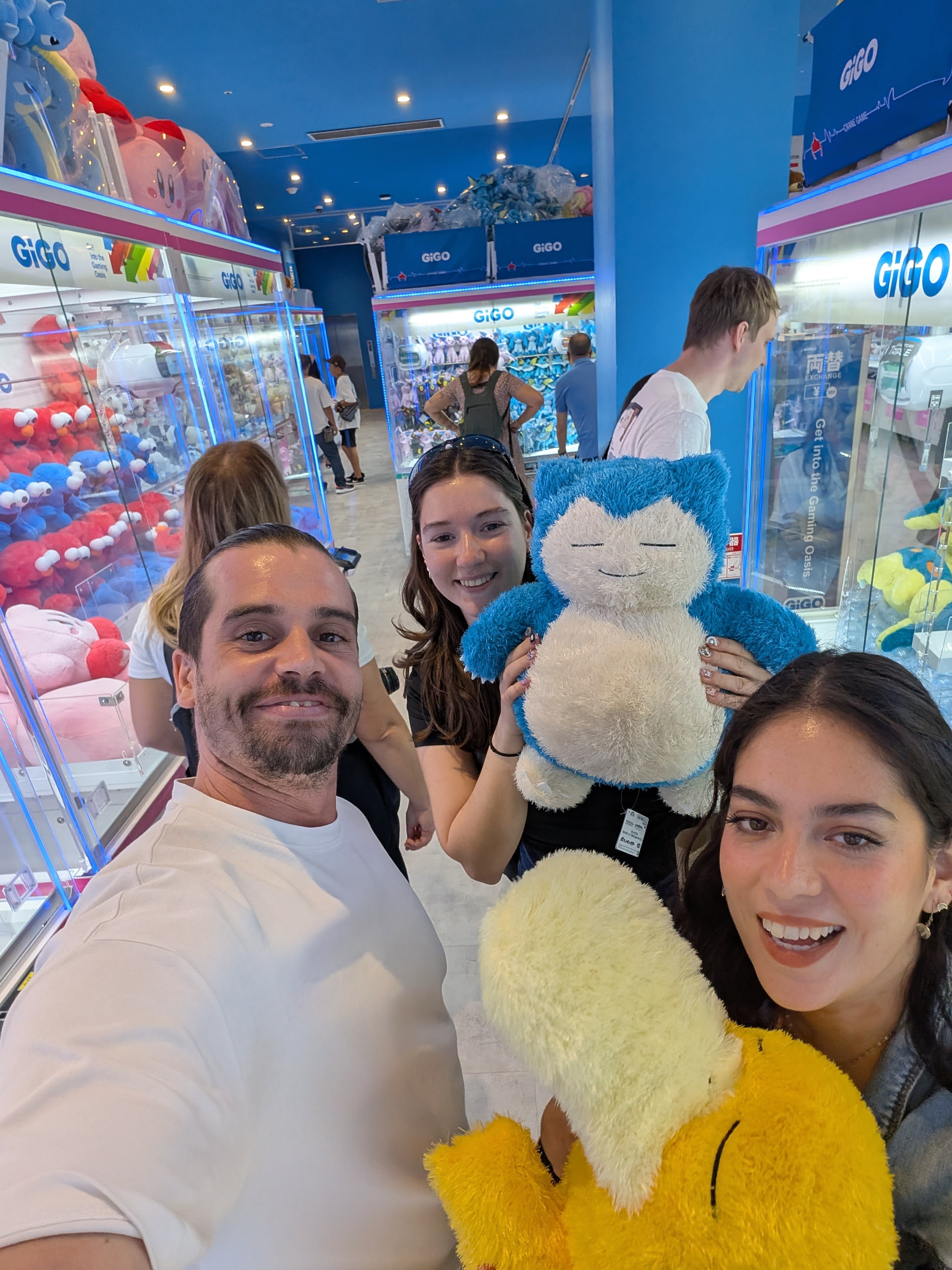
At a GiGO crane game centre, we met a girl who had just won an enormous Snorlax from the machine. She celebrated. Lia celebrated. I held a yellow plush I had not won and smiled for the camera. The crane games in Japan are rigged just enough to make winning feel like an achievement and losing feel like a reasonable investment.
I found a LEGO store and emerged with a Gizmo set from Gremlins that I did not need and have not regretted. Some purchases justify themselves. This was one.
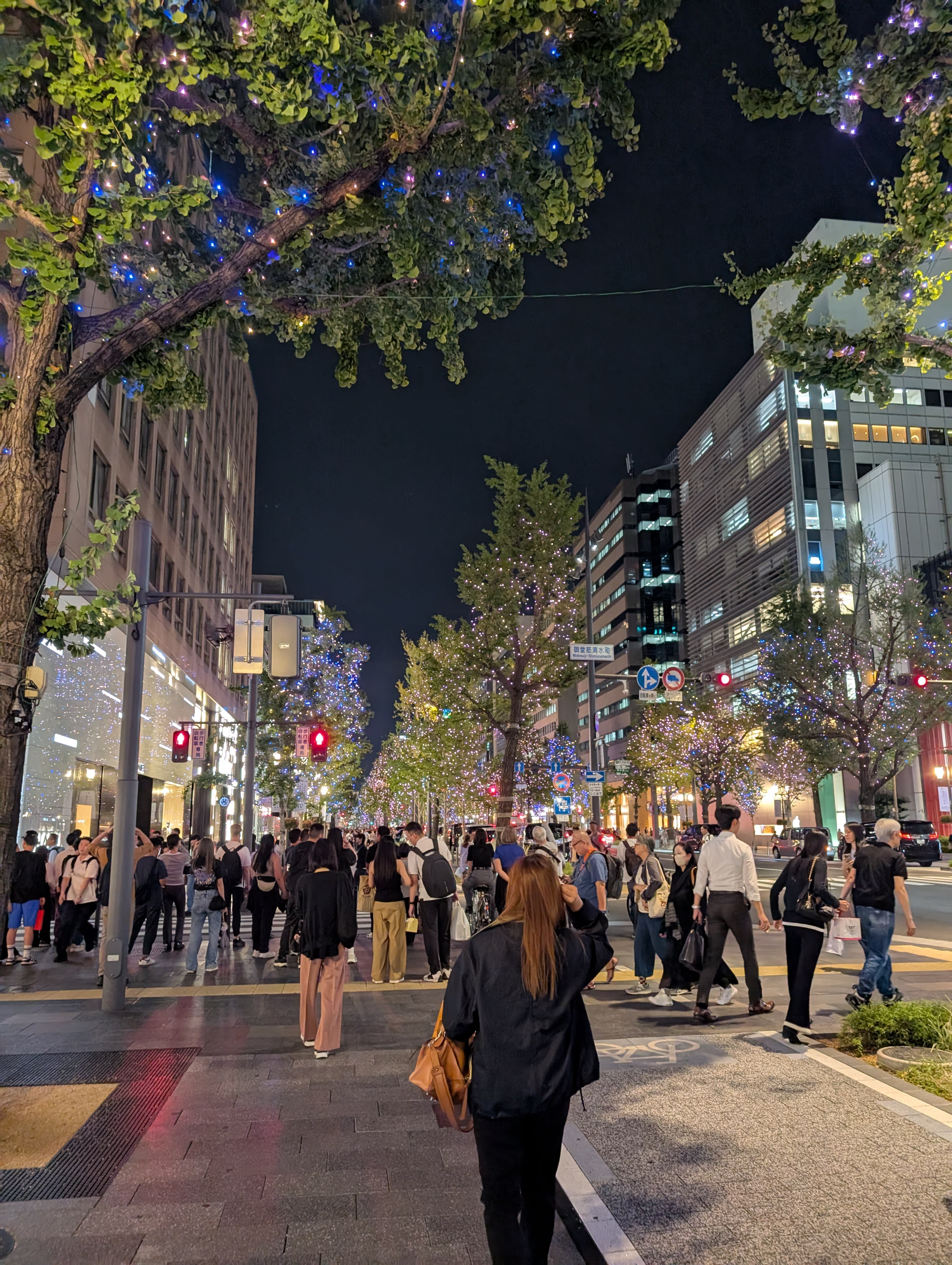
The nights in Namba had their own rhythm. The tree-lined boulevards lit up with blue and white lights, the crowds streaming between shops and restaurants, the energy building rather than fading as the hour got late. Osaka does not wind down. It winds up.
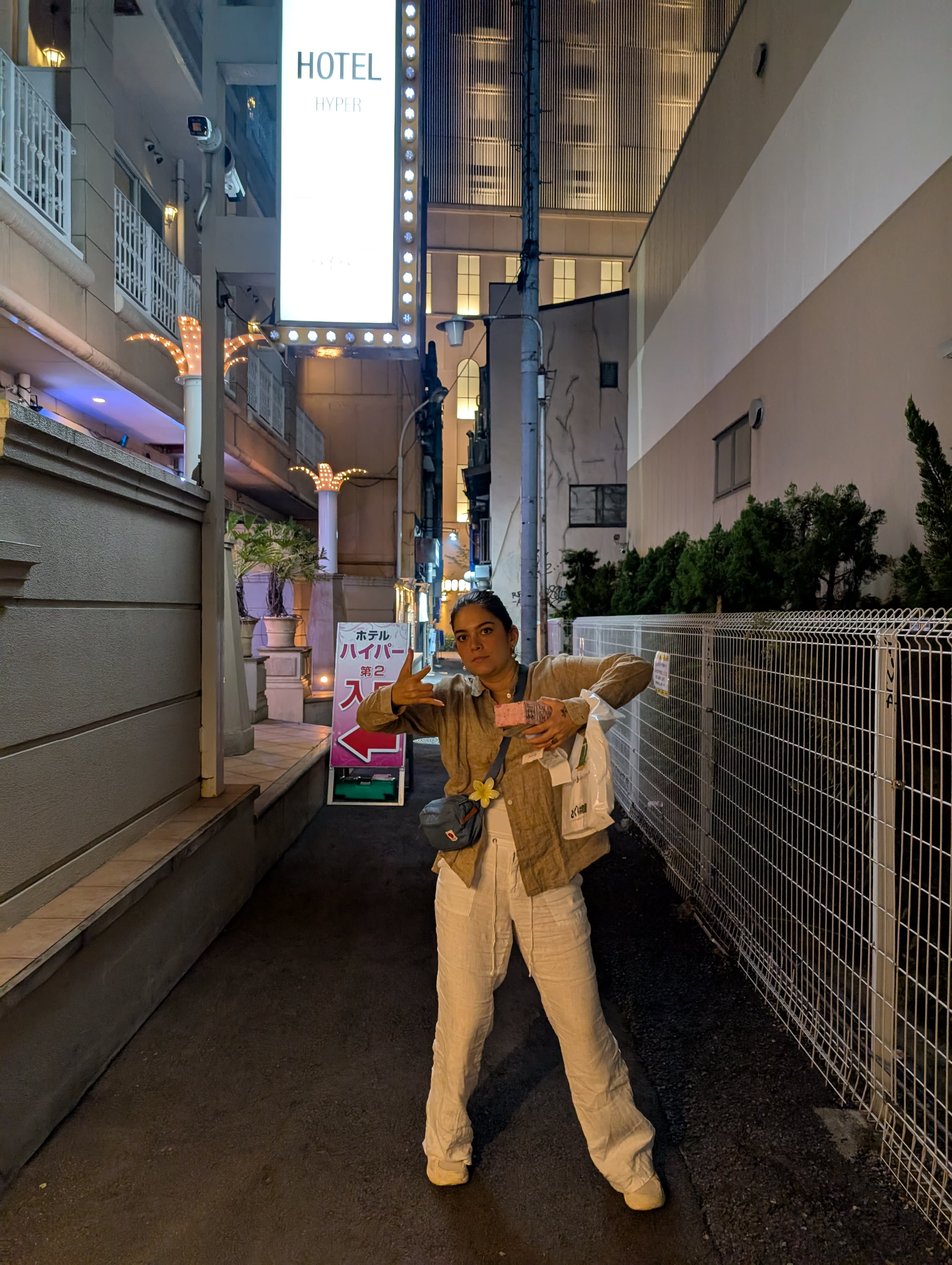
And Lia, posing in a back alley near the hotel on one of our late-night walks, looking like someone who has entirely figured out how to exist in this city.
A Day in Nara — The Deer, The Temples, The Chaos
We took a day trip to Nara — forty-five minutes by train from Osaka — and spent the afternoon in a state of delighted confusion. The Nara deer are famous, sacred, and completely without shame. They roam the park, the temple grounds, and the surrounding streets with the confidence of animals that know they are protected by Shinto tradition and national law. They are polite until they smell the deer crackers you bought at the entrance, at which point they become insistent in a way that borders on aggressive and crosses into hilarious.
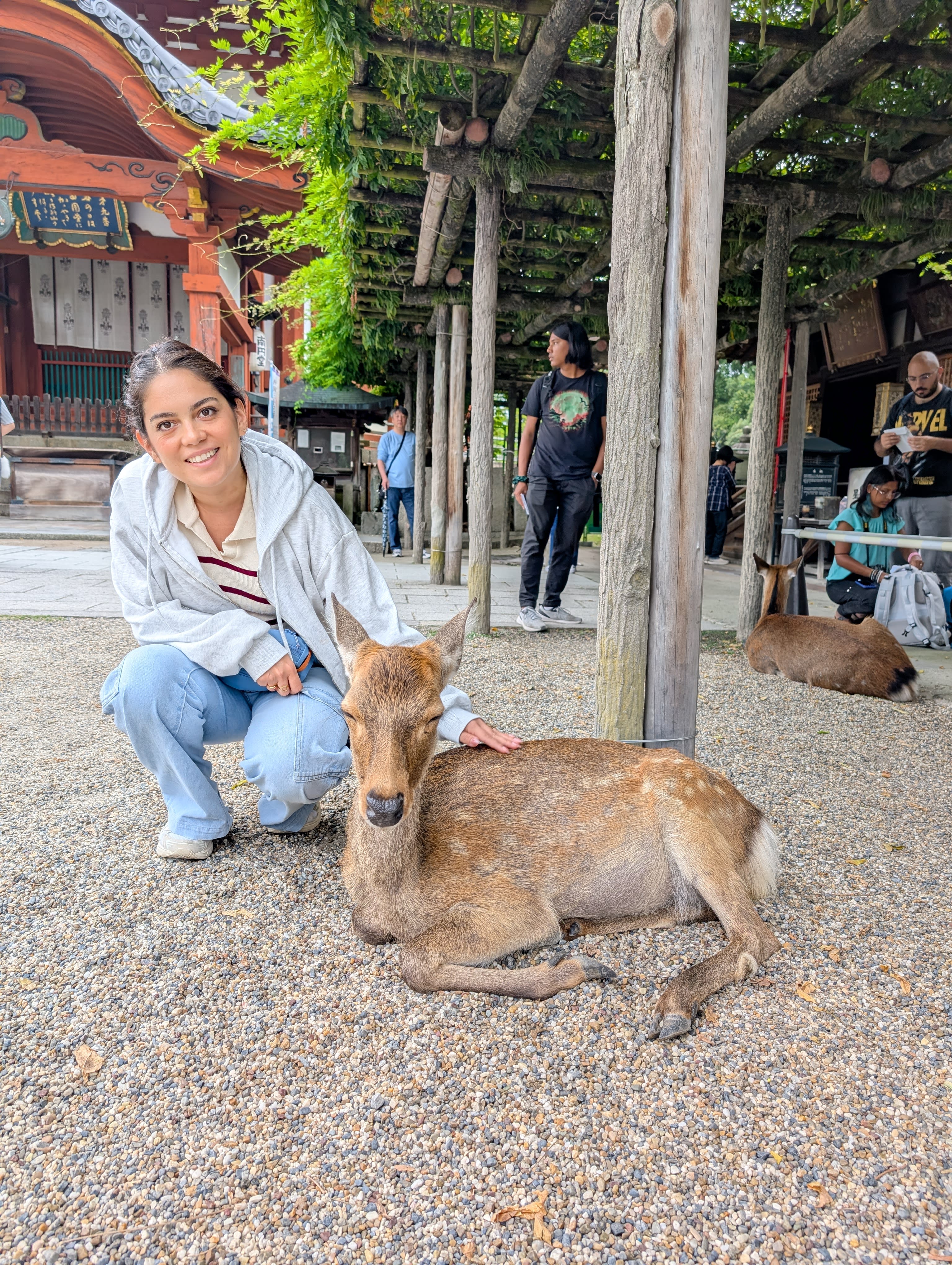
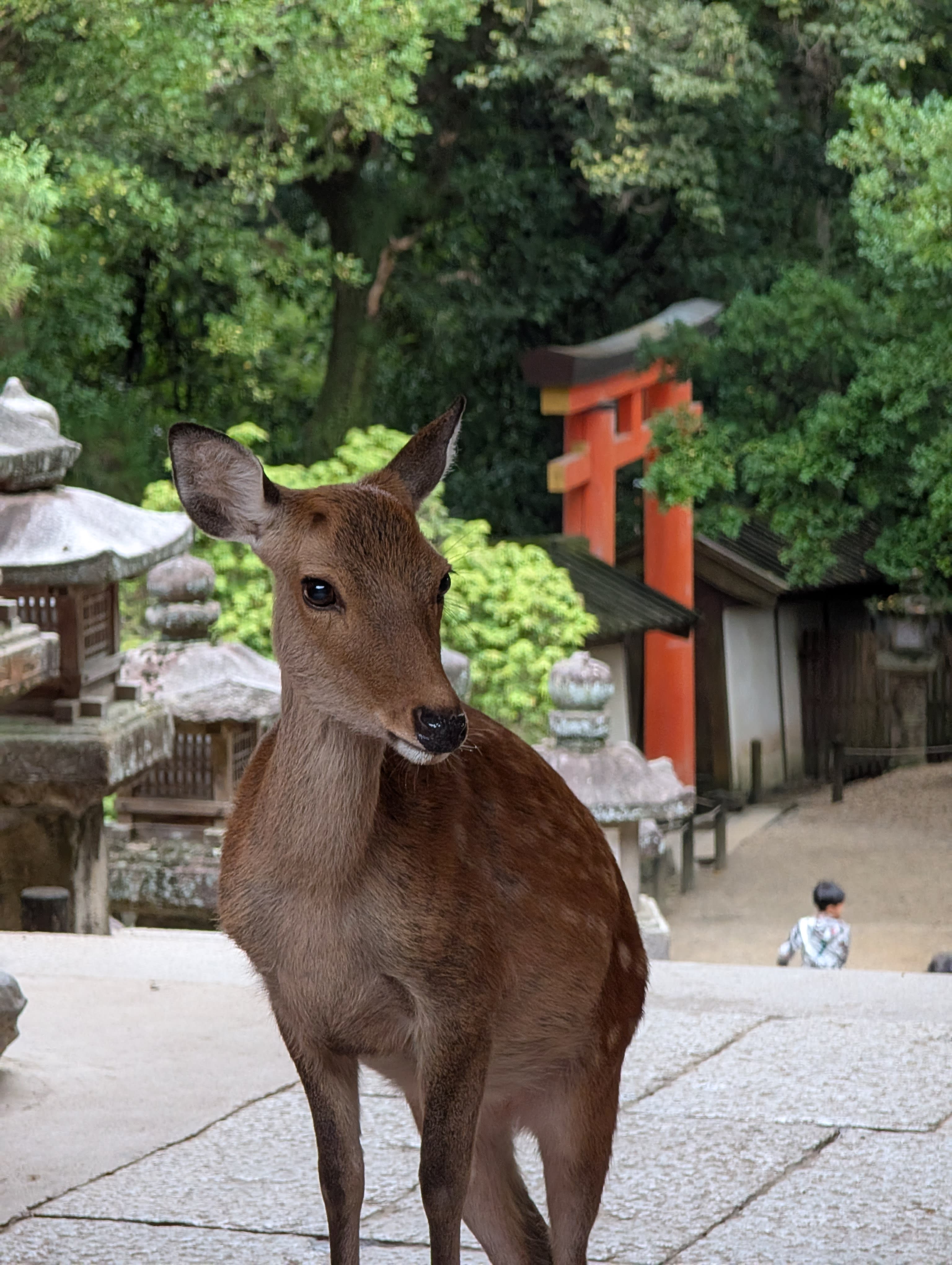
Lia crouched next to one at Kasuga Taisha shrine and it posed for the photograph with the patience of a professional model. Another deer watched from a distance with a red torii gate behind it, and I took a photograph that looked like a postcard someone had art-directed.
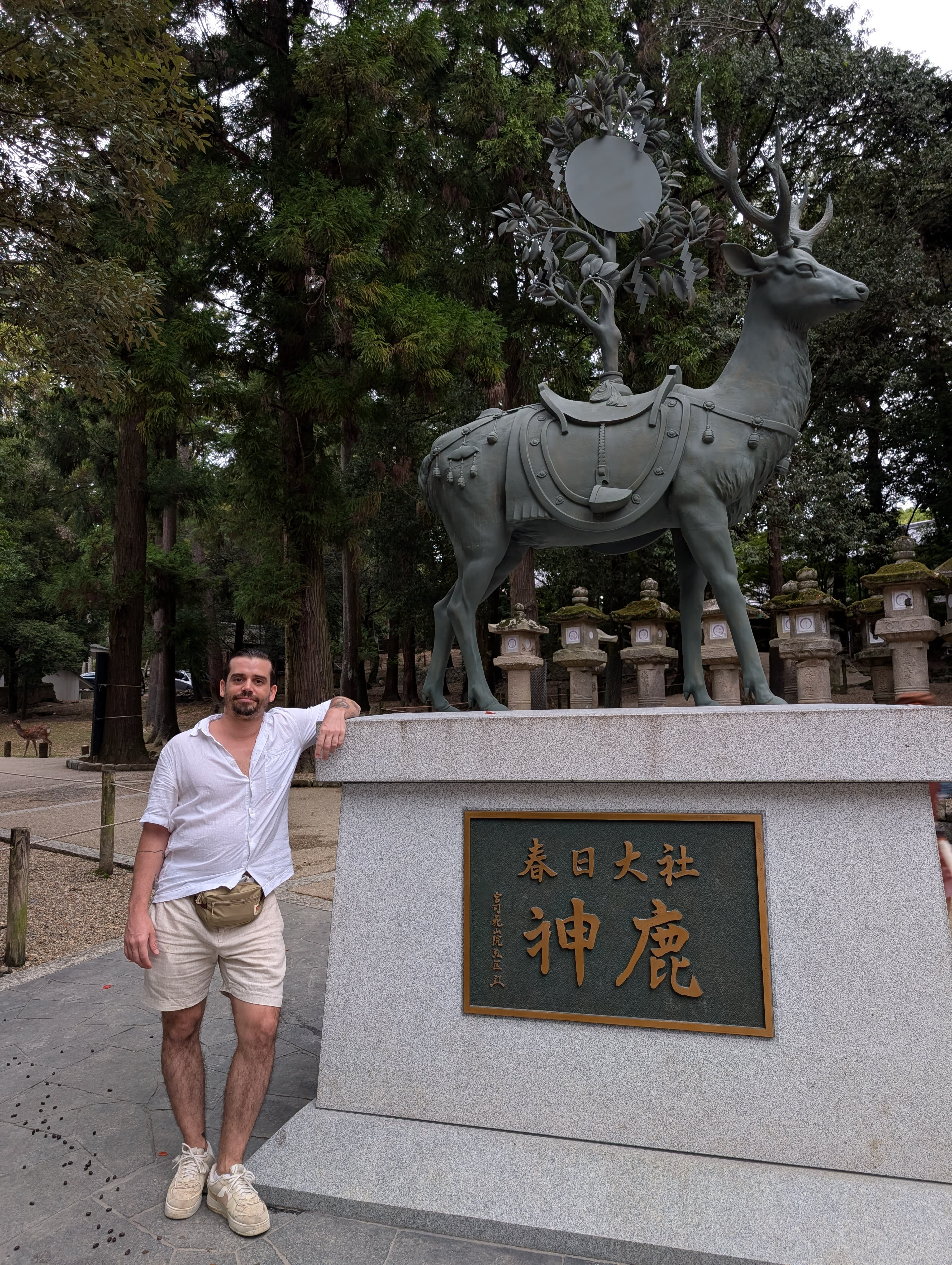
I stood next to the bronze deer statue at Kasuga Grand Shrine — the sacred deer carrying a mirror on its back, the stone lanterns lining the approach through the cedar forest.
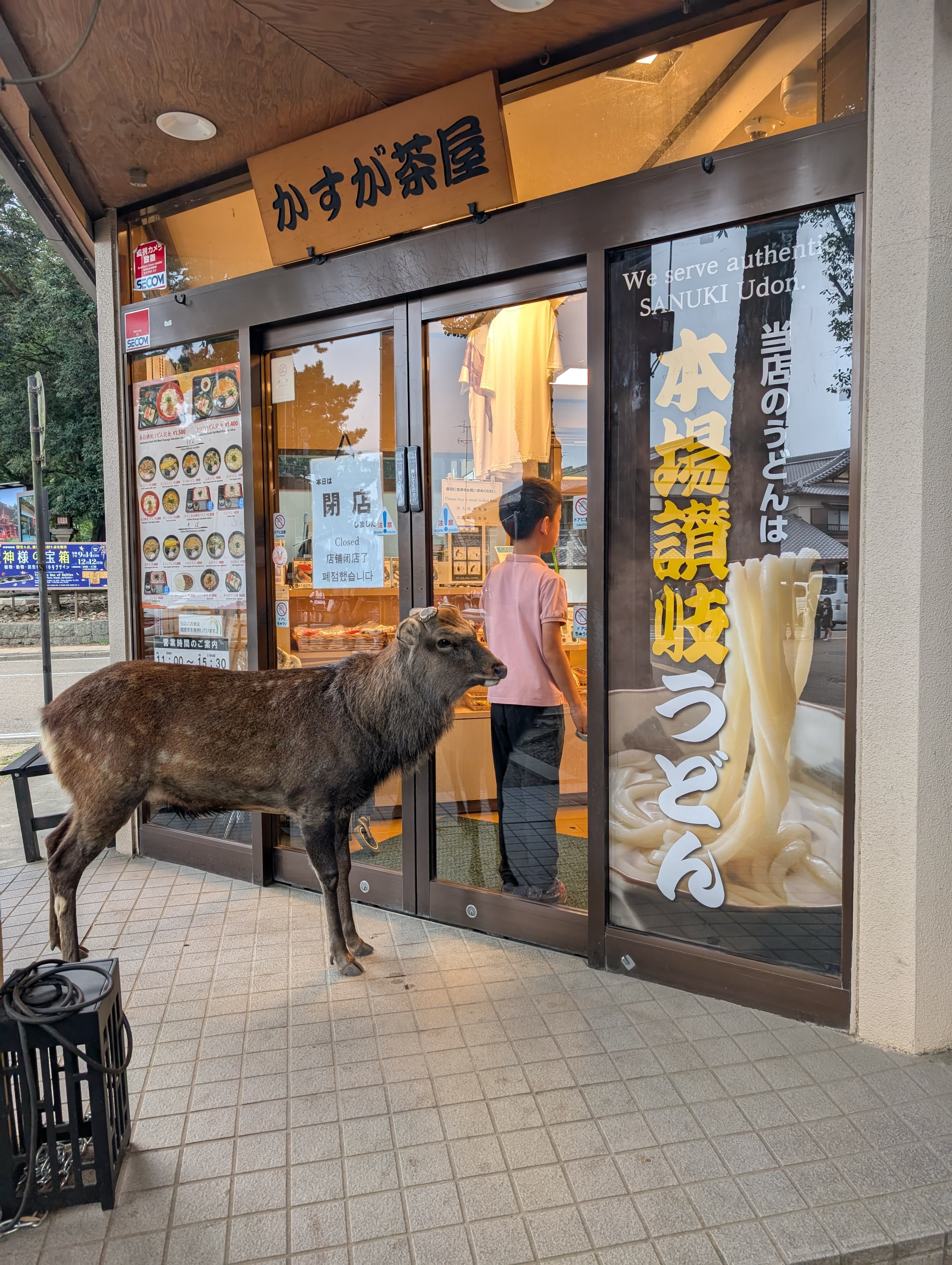
The best moment, though, was one I almost missed. A deer had walked up to the entrance of an udon restaurant — Kasuga Chaya — and was standing at the door, staring at the menu, its head tilted slightly, as if genuinely considering whether to go in and order a bowl. A man in a pink shirt walked past without looking. The deer did not flinch. It had places to be and noodles to evaluate.
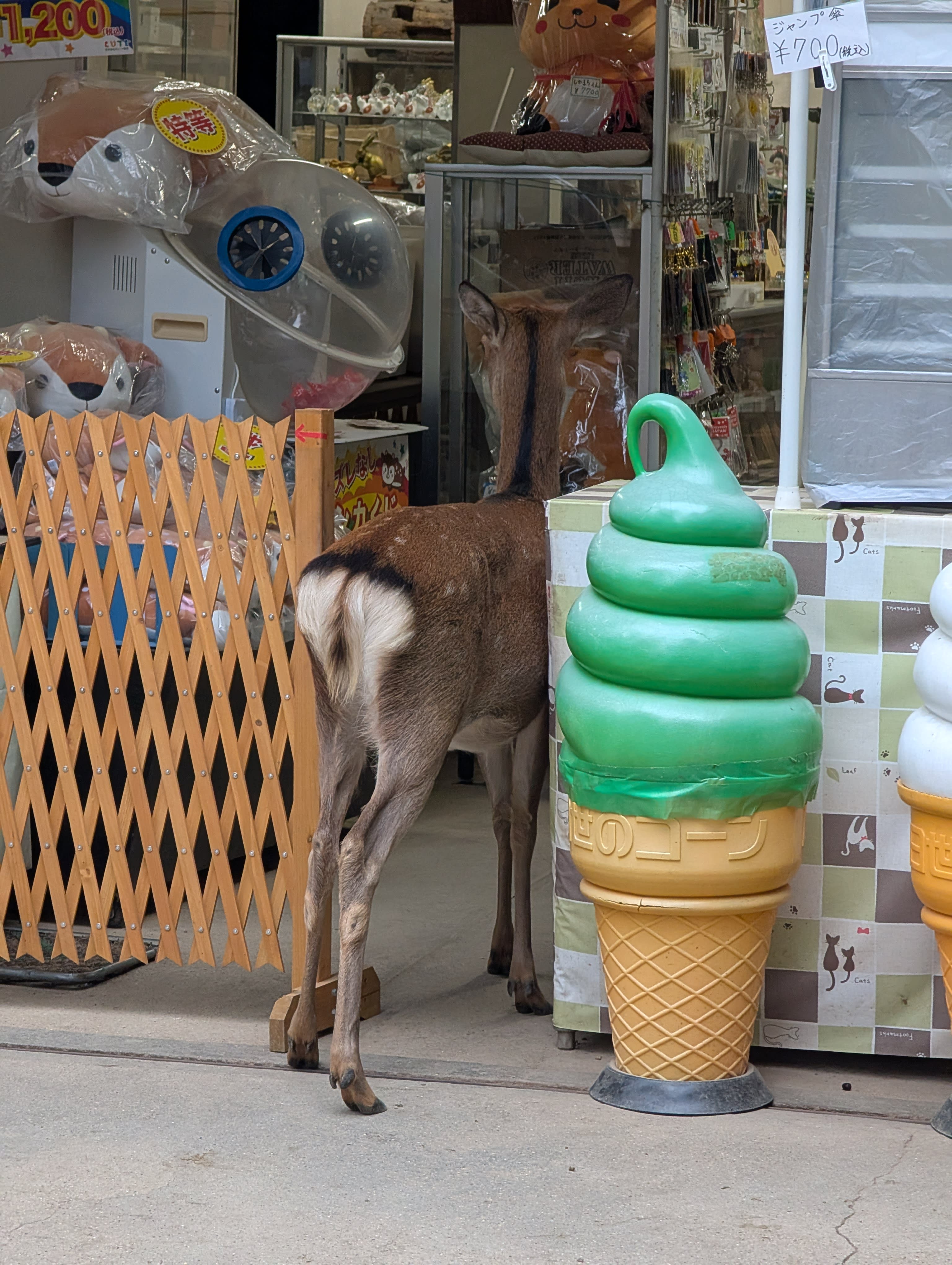
Another deer had found the ice cream shop and was browsing with the same casual intensity, its head nearly inside the doorway, apparently drawn by the giant green soft-serve cone statue outside.
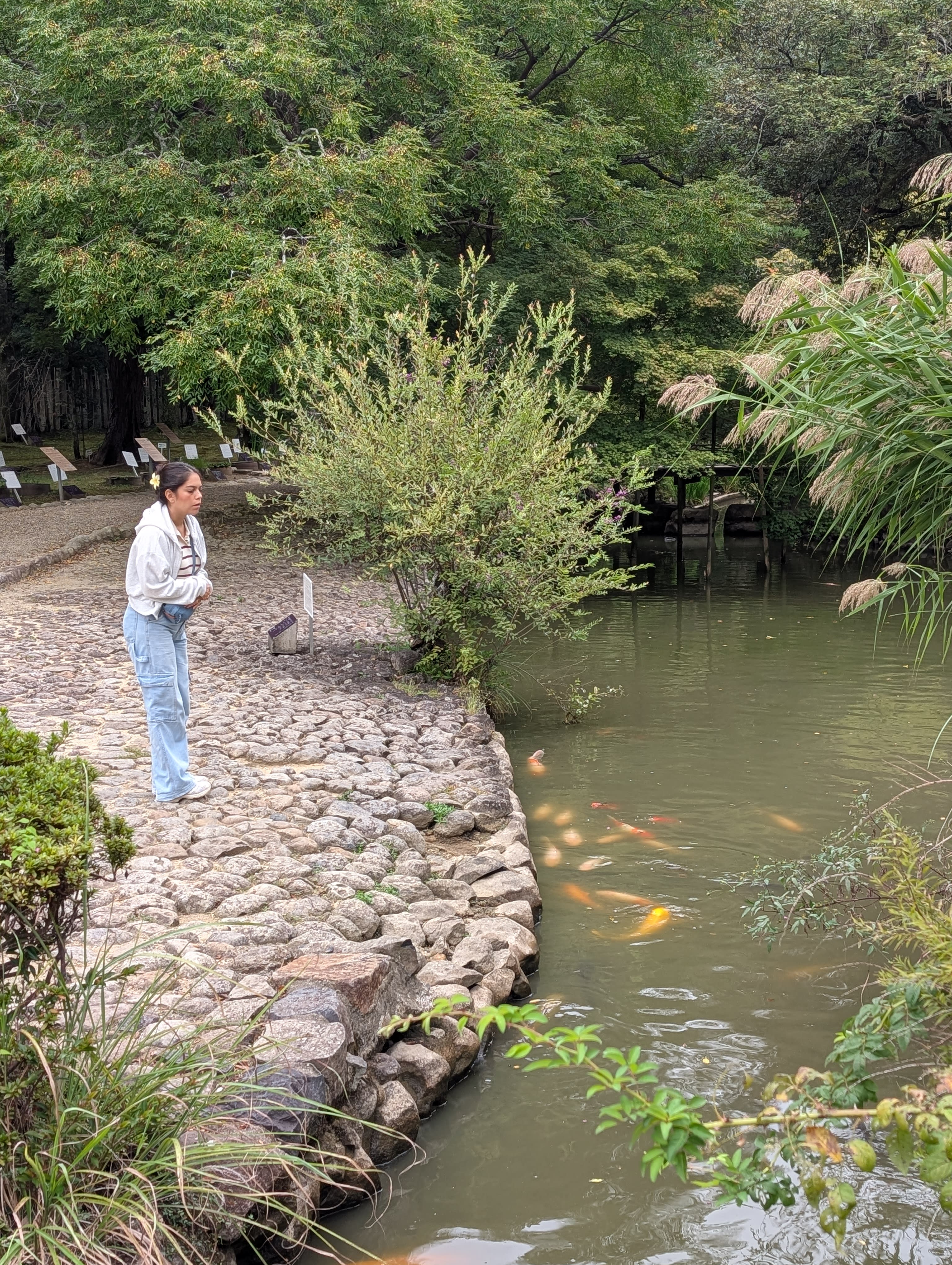
Lia stood by the koi pond at Isui-en Garden and watched the orange and white fish circle beneath the surface, the green canopy reflected in the water, and the silence — after the chaos of the deer — was the kind of quiet that only exists in Japanese gardens, the kind that makes you feel like time has been paused for your benefit.
Shinsekai — The Beautiful Absurdity
Shinsekai was Lia’s favourite neighbourhood, and I understand why. It is a district built a century ago as a futuristic entertainment zone — modelled on Paris in the south and New York in the north — that today looks like a retro arcade crossed with a carnival. Tsutenkaku Tower — Osaka’s miniature Eiffel Tower — presides over streets packed with kushikatsu restaurants, pachinko parlours, and game centres.
The kushikatsu restaurants in Shinsekai are the neighbourhood’s identity. We ate at a standing counter — no seats, no pretension, just a cook dropping skewers into oil with the rhythm of a jazz drummer. Pork belly. Prawn. Lotus root. Pumpkin. Mochi. Camembert. We ate fourteen skewers between us, dipping each one exactly once in the communal sauce, and the bill was less than the cost of a single appetiser at a mid-range restaurant in Paris. It was four in the afternoon. Nobody batted an eye.
The Rooftop & The Last Night
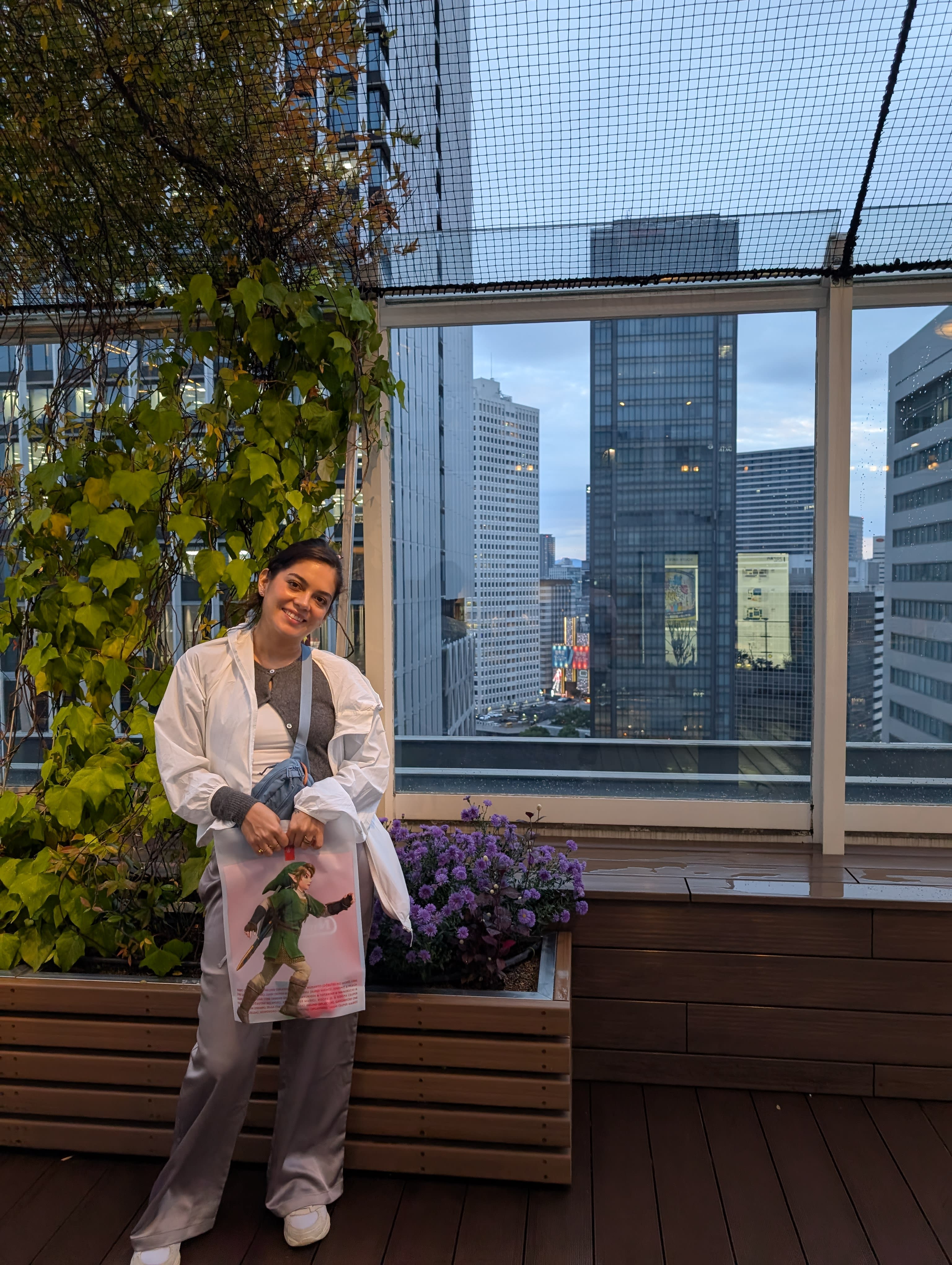
One evening, Lia sat on a rooftop terrace somewhere in Umeda — the business district north of Namba — with the skyscrapers rising behind her and purple flowers in a planter beside her, and she looked out at the city with an expression that was neither tourist wonder nor local indifference but something in between — the look of someone who has been somewhere long enough to feel at home but not long enough to stop being amazed.
Our last night in Osaka — our last night in Japan — we went back to Dotonbori. We ate takoyaki from the vendor who knew us. She gave us an extra piece, as she had every night for the past week, and this time she added a small bow that was different from the others — slower, more deliberate, the kind of bow that says I know you are leaving and I want you to remember. We drank beer on the canal. The neon reflected in the water. Lia said something about how she was not ready to go home, and I said I was not either, and we stood there watching the lights and eating octopus balls and sitting inside one of those moments that you know, even as it is happening, you will remember for the rest of your life.
I came to Japan for Kyoto. I left wanting to live in Osaka. That surprised me. It should not have. Kyoto is Japan’s soul — refined, ancient, sacred. Osaka is Japan’s heart — generous, loud, warm, and absolutely certain that the best things in life are a good meal, a cold beer, a noisy street, and the company of people you love. Both are essential. But if I had to choose, I would choose the city that taught me that joy does not require silence.
When to go: Year-round, but October to November and March to April are ideal. Late September and early October, when we went, was warm and lively and the castle park was beginning to turn. Cherry blossom season transforms the parks into pink tunnels. Summer is hot and humid. Winter is mild by Japanese standards and the street food tastes even better when the air is cold. There is no bad time for Osaka. The city is always eating, and it is always inviting you to join.