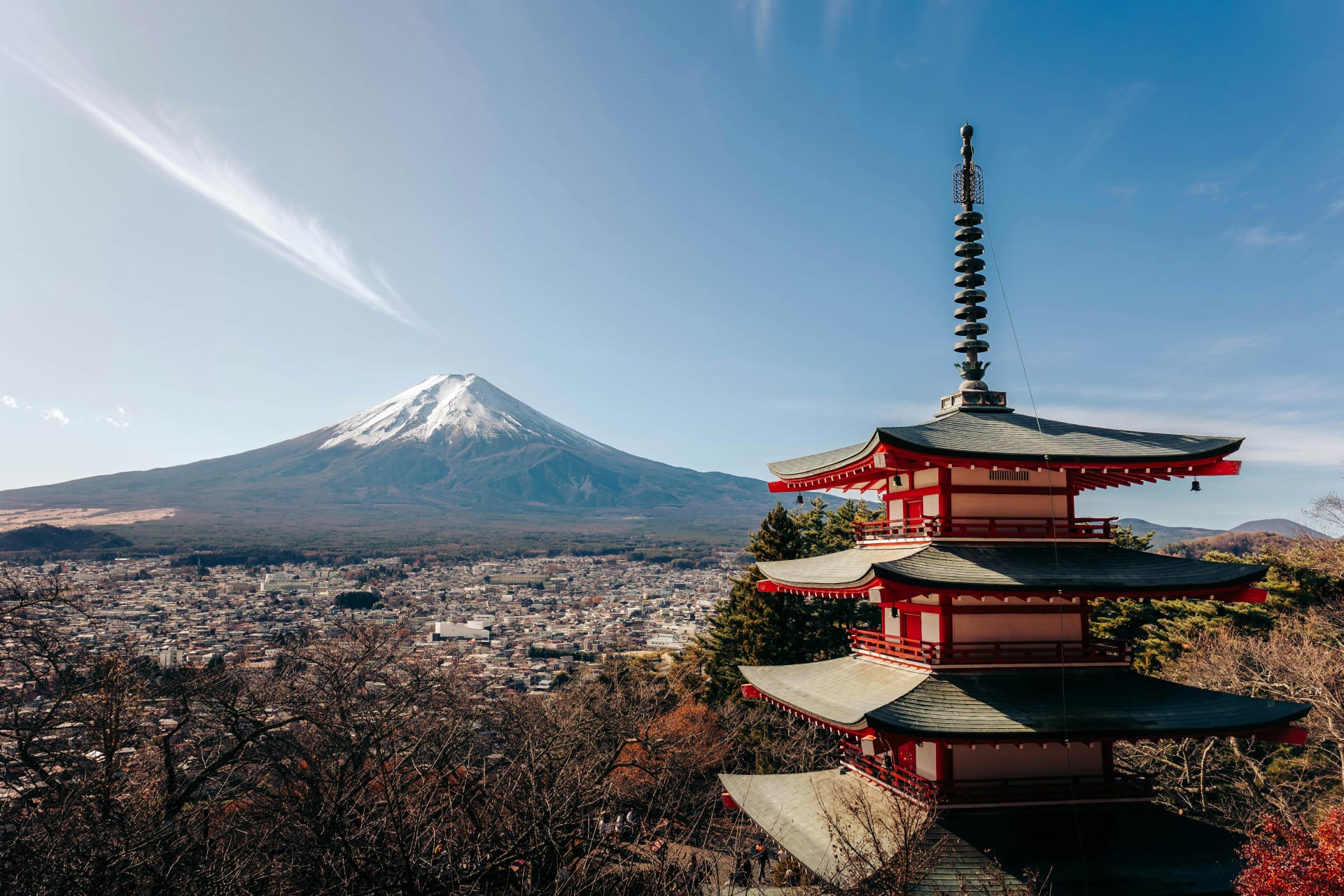
I almost did not go. Our Tokyo itinerary was already full, and adding a side trip to see a mountain that might be hiding behind clouds felt like a gamble. Lia insisted. She had seen the Chureito Pagoda photograph — the one with the five-storey pagoda in the foreground and Fuji rising behind it, framed by cherry blossoms — and she said, very simply, that she would not leave Japan without trying to see it in person.
She was right. She is usually right about these things.
First Glimpse
We took the highway bus from Shinjuku — two hours through a landscape that shifted from megacity to forested hills to rice paddies — and stepped off at Kawaguchiko Station into a completely different Japan. Cooler air. Quiet streets. The smell of cedar. And there, above the rooftops of the station, half-veiled in a thin haze that made it look like a watercolour, was the mountain.
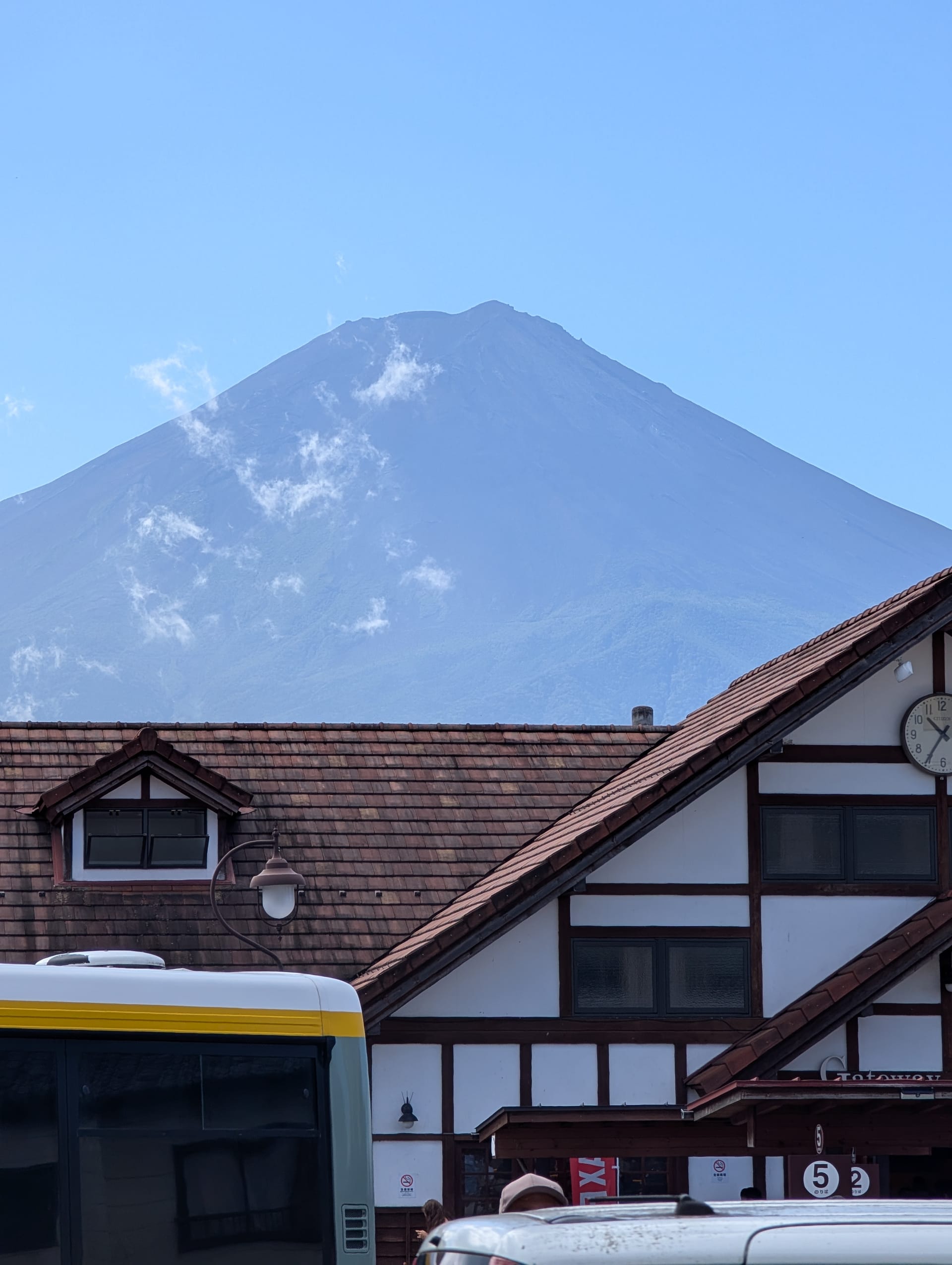
I had seen Fuji in a thousand photographs, on woodblock prints, on currency, on the shinkansen window three days earlier. None of it prepared me for the scale. The mountain does not sit in the landscape. It presides over it — a single symmetrical cone rising above everything, so perfectly shaped it looks engineered. Even through the haze, even partially obscured by cloud, the effect was immediate. I stood on the pavement outside the station and stared. Lia took a photograph of me staring. I am pointing at the mountain like a child who has just discovered that something enormous exists in the world and needs everyone to know about it.
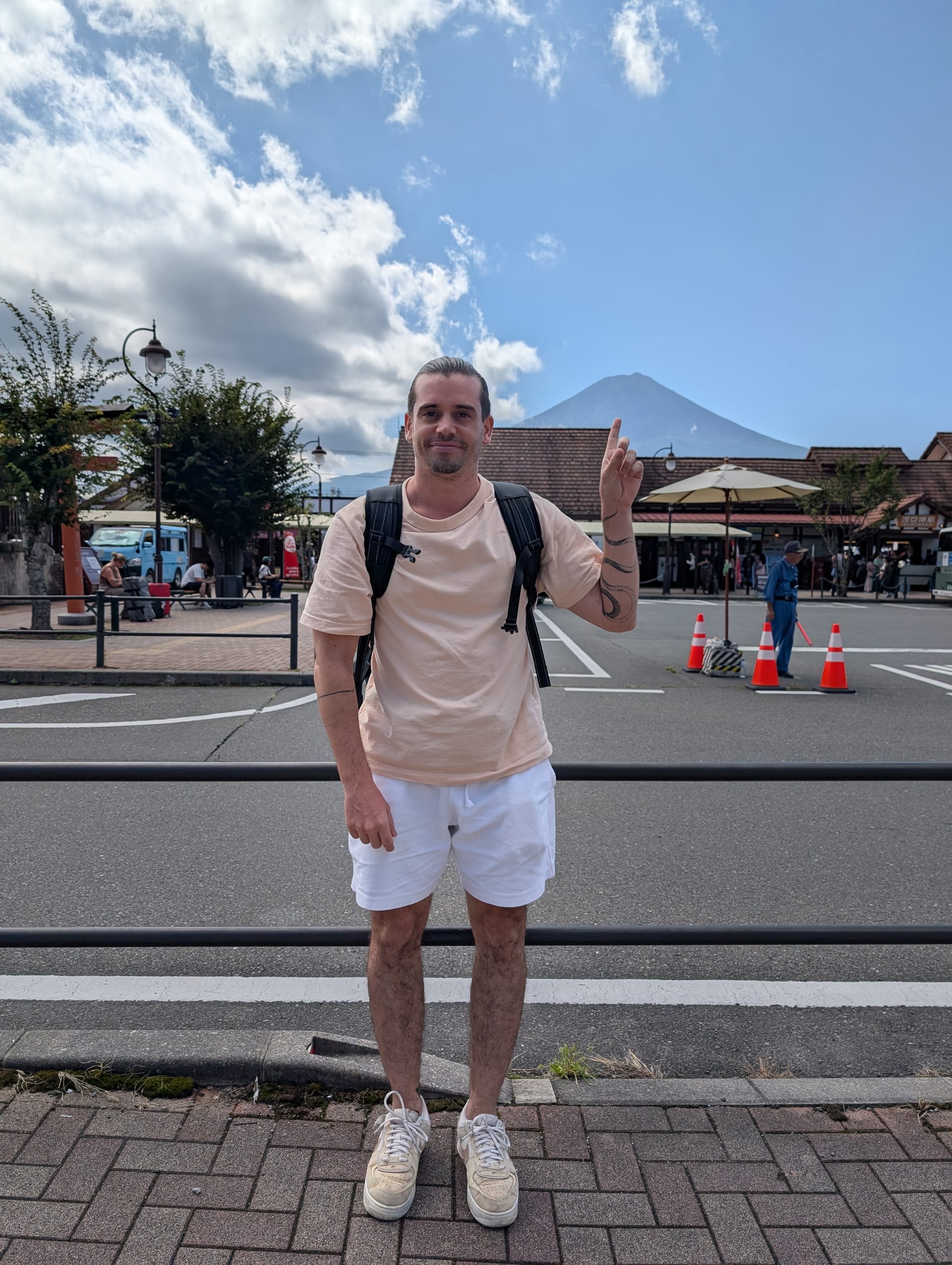
Not my most dignified moment. But an honest one.
The Four Hundred Steps
From Kawaguchiko Station, we took the Fujikyuko Line — a small local train that felt like a toy after the shinkansen — to Shimoyoshida Station, about fifteen minutes and three hundred yen. From there, it is a ten-to-fifteen-minute walk to the base of Arakurayama Sengen Park and the climb to Chureito Pagoda.
The steps. There are approximately four hundred of them, and they climb through a forest that filters the light into green streaks and offers no views until you reach the observation deck at the top. I counted them because my calves were counting them and I wanted to share the misery. Lia went ahead. She always goes ahead on stairs. Halfway up, I stopped at a small shrine to catch my breath and pretend I was admiring the architecture. A Japanese man in his seventies passed me without breaking stride. I reconsidered my fitness.
The view from the top was worth every step. The pagoda stood in the foreground, its five tiers painted in the dark red that the Japanese call aka, and behind it the valley opened — the town of Fujiyoshida spread below like a miniature — and then, above the treeline, above the clouds, Fuji appeared. The mountain was playing its usual game with the weather, half-revealed, half-hidden, the summit drifting in and out of cloud. But even partially veiled, the composition was extraordinary: pagoda, valley, volcano, sky.
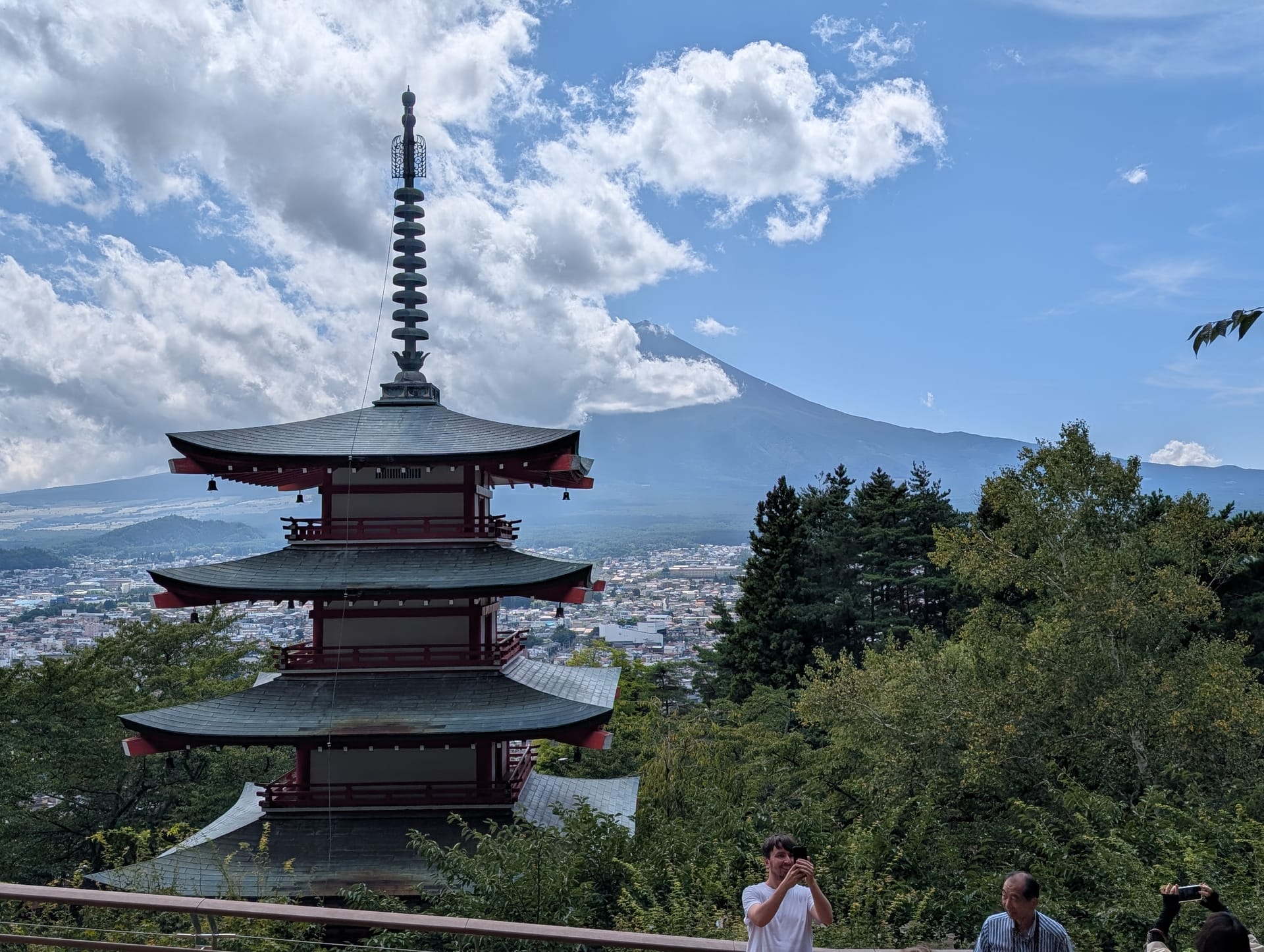
This is the photograph that sells Japan to the world. Standing inside it, rather than looking at it on a screen, was one of the most surreal experiences of the trip. The composition is real. The pagoda is real. The mountain is real. And the gap between the flat image and the actual moment — the wind, the altitude, the smell of cedar, the sound of other visitors gasping, the old man who passed me on the stairs — is the gap between knowing a place and being in it.
We stayed at the viewpoint for nearly an hour, watching the clouds shift. Sometimes Fuji was fully visible. Sometimes it disappeared entirely. Sometimes just the summit peeked through, snow-capped and improbable. Other visitors came and went — a couple with a tripod, a group of students, an older woman who sat on a bench and sketched the scene in a small notebook with the patience of someone who had done this many times before.
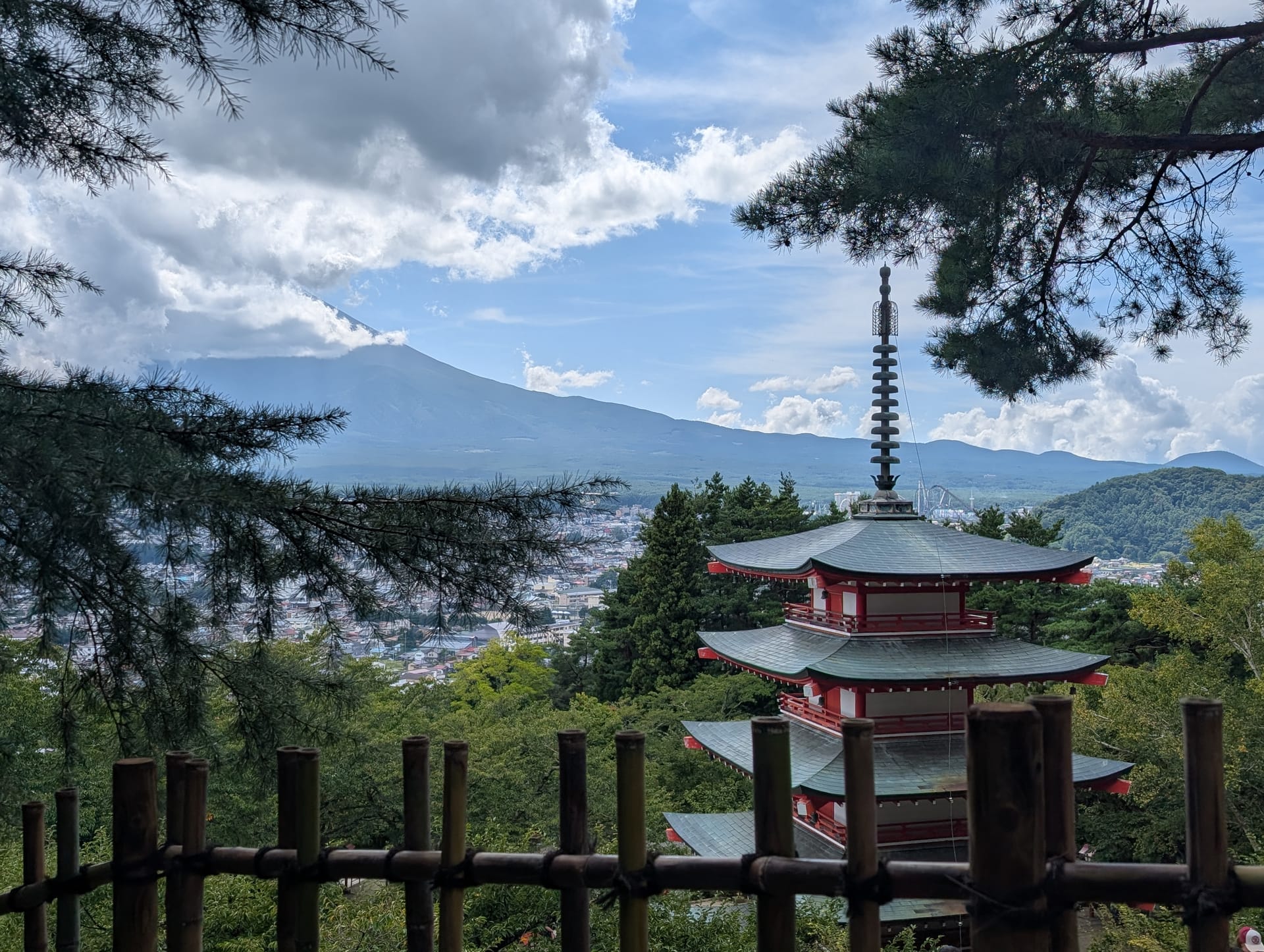
From a slightly different angle, framed by the branches of a Japanese pine, the pagoda looked smaller and the landscape looked infinite. I preferred this view to the famous one — less composed, more real, with the wooden fence and the greenery and the sense that you were looking at something that existed whether or not anyone was there to photograph it.
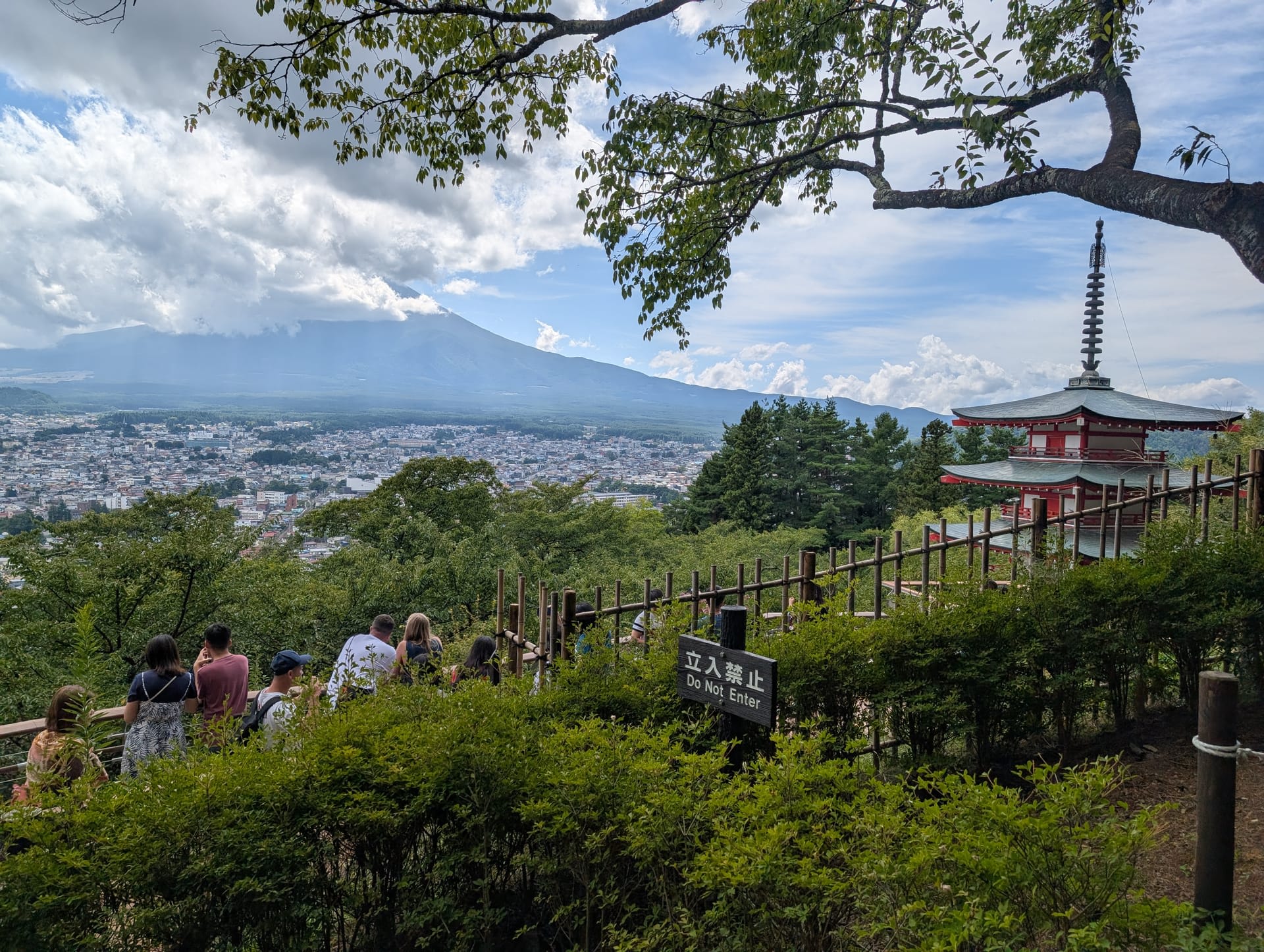
The observation platform was full of people doing exactly what we were doing: standing at the railing, looking at a volcano, trying to hold the moment. A tree branch overhead framed the scene. A sign reading “Do Not Enter” in Japanese and English marked the boundary of the maintained path. Nobody crossed it. In Japan, you do not cross the boundary. The boundary is part of the beauty.
The Walk Down — Fujiyoshida’s Quiet Side
The descent from the pagoda was easier on the legs and richer in detail. Rather than heading straight back to the station, we wandered into the streets of Fujiyoshida, the small town that sits at the base of the park. This is the Japan that most visitors to the Fuji area never see — a quiet, residential place with narrow lanes, traditional wooden houses, and the unhurried pace of a town that has existed in the shadow of a sacred mountain for centuries and sees no reason to rush.
We found a small canal running between old buildings, the water crystal-clear and full of koi — bright orange, white, speckled — moving lazily under a red arched bridge. Lia leaned over the railing to watch them, and I stood beside her, and for a few minutes neither of us said anything. A couple with a small child joined us on the bridge, the kid pointing at the fish with the same expression I had worn an hour earlier while pointing at the volcano. The scale was different. The wonder was the same.
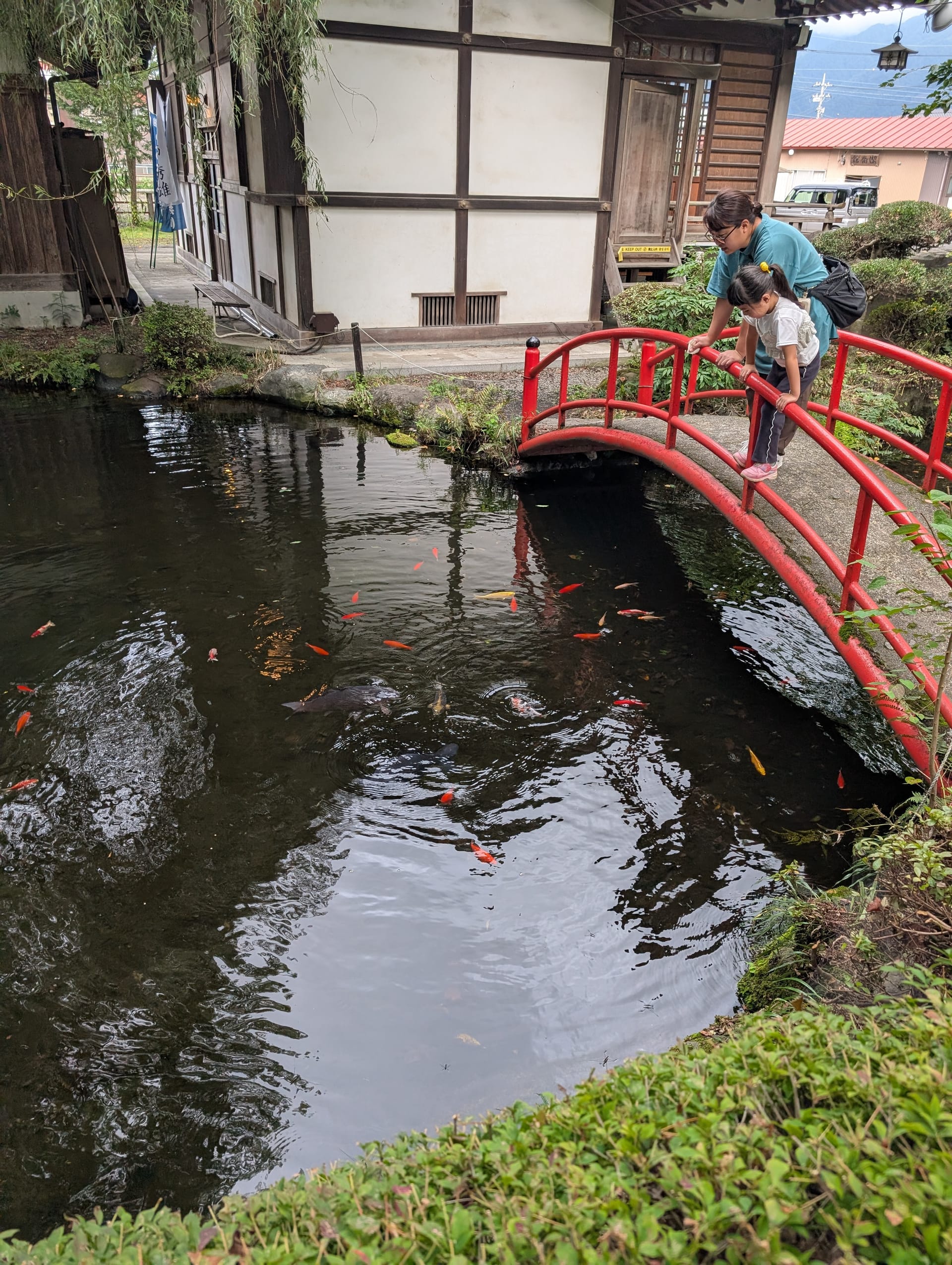
This is the photograph that would not make it onto a tourism poster. No volcano, no pagoda, no cherry blossoms. Just two people on a bridge in a small town, watching fish. It is, I think, the most honest photograph from the day — the one that captures not what the Fuji area looks like but what it feels like. Quiet. Gentle. A place where the extraordinary and the ordinary exist side by side, and the ordinary is not diminished by the comparison.
Arakura Fuji Sengen Shrine
Further along our walk, we came to the approach of the Arakura Fuji Sengen Shrine — a gravel path flanked by red-painted railings leading to a torii gate framed by ancient trees. The gate stood at the end of the path like a threshold between the town and something older, and the symmetry of it — the red verticals against the green canopy, the gravel beneath, the lantern hanging from the crossbeam — had the particular beauty of things that have been placed with intention and maintained with care for a very long time.
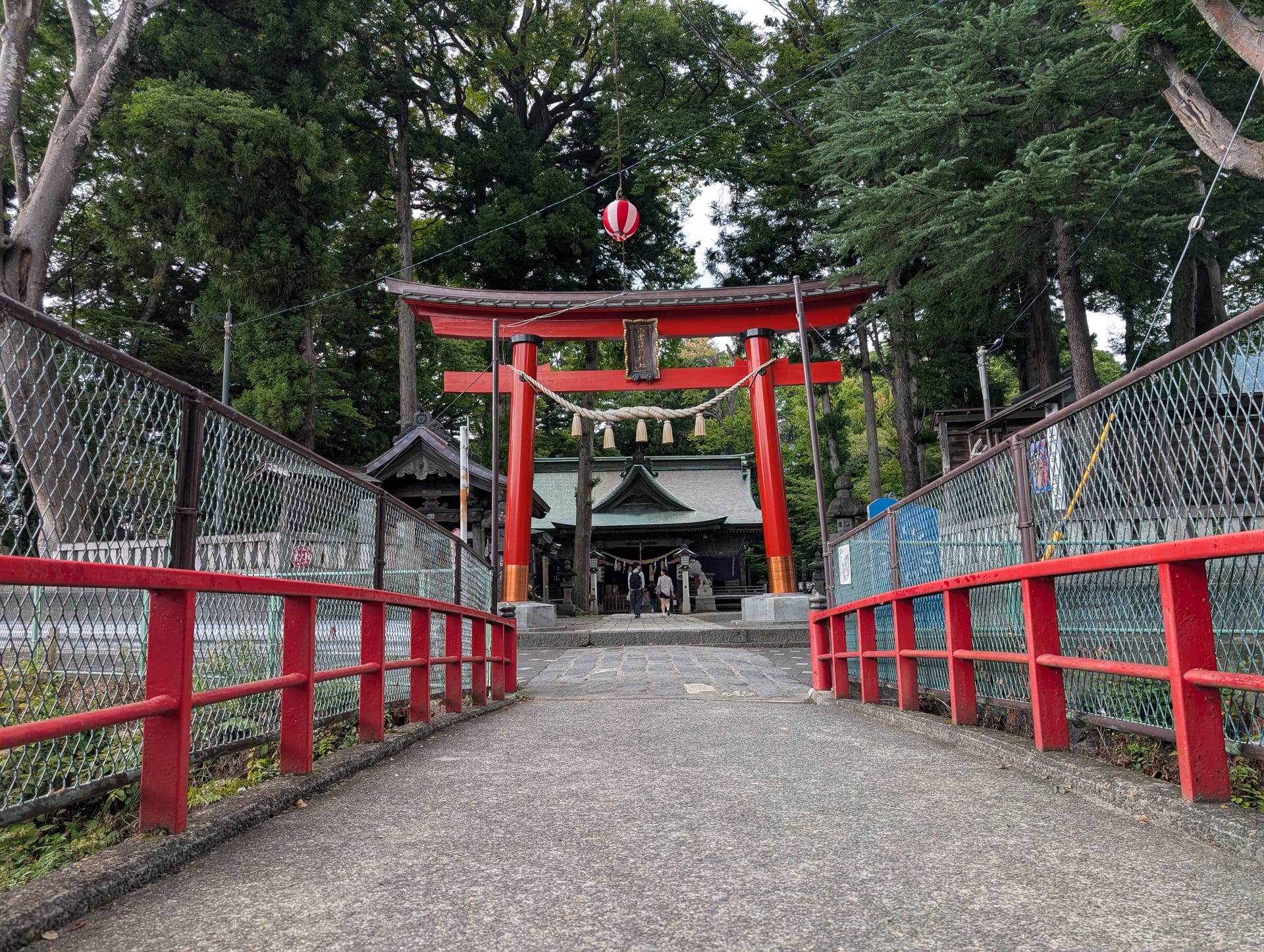
The shrine is dedicated to Konohanasakuya-hime, the goddess of Mt. Fuji, and the torii gates and stone lanterns leading to it are beautiful in the understated way that makes you slow down without being told to.
We drew omikuji — fortune papers — from a box at the shrine. You shake a metal cylinder until a numbered stick falls out, then find the corresponding paper in a drawer of small wooden compartments. Lia got “great blessing.” I got “small blessing,” which she found hilarious and I found entirely unfair. The tradition is to tie the paper to a rack at the shrine if your fortune is bad (to leave the bad luck behind) or keep it if it is good. I tied mine. Lia kept hers.
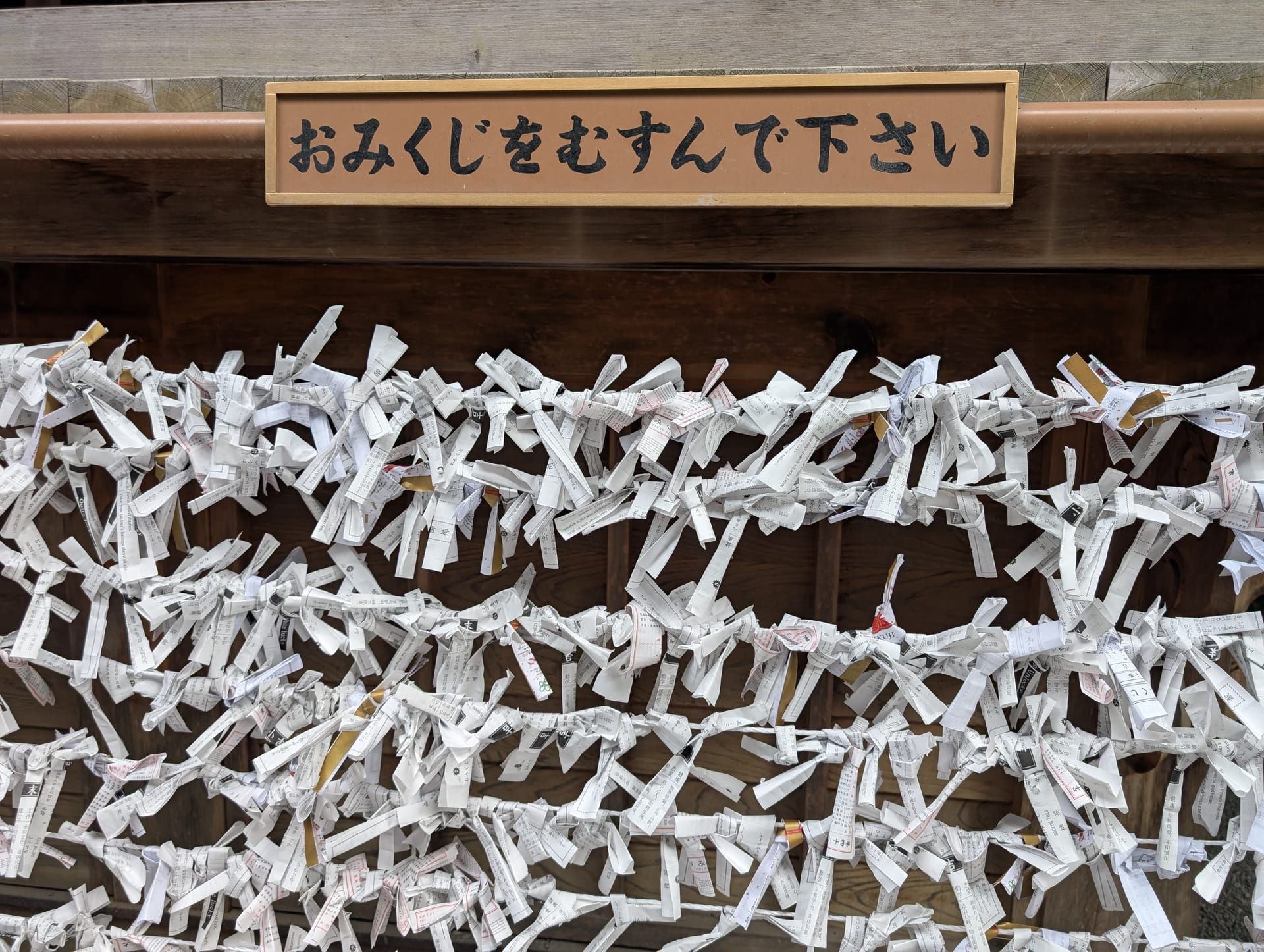
The rack of tied omikuji was a photograph in itself — hundreds of white paper fortunes knotted to strings, fluttering in the breeze, each one a small hope or a small fear left behind by a stranger. The sign above reads “Please tie your omikuji here.” The accumulation of all those tied papers, all those wishes, had a weight that was not physical.
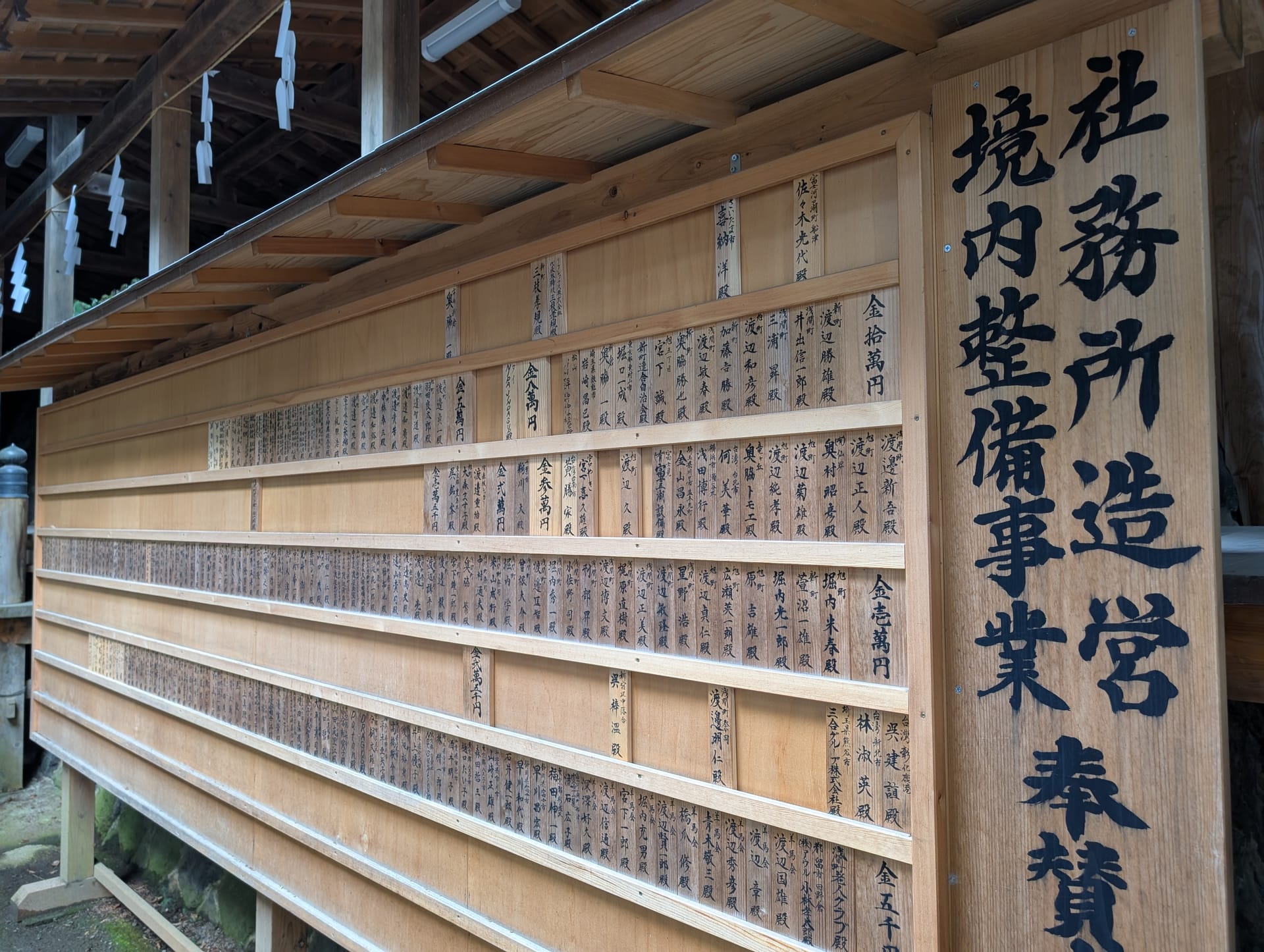
Inside the shrine, a wall of wooden donor boards listed the names of people who had contributed to the shrine’s maintenance — columns of kanji brushed in ink, each name a thread connecting the present to a tradition that has been continuous for centuries.
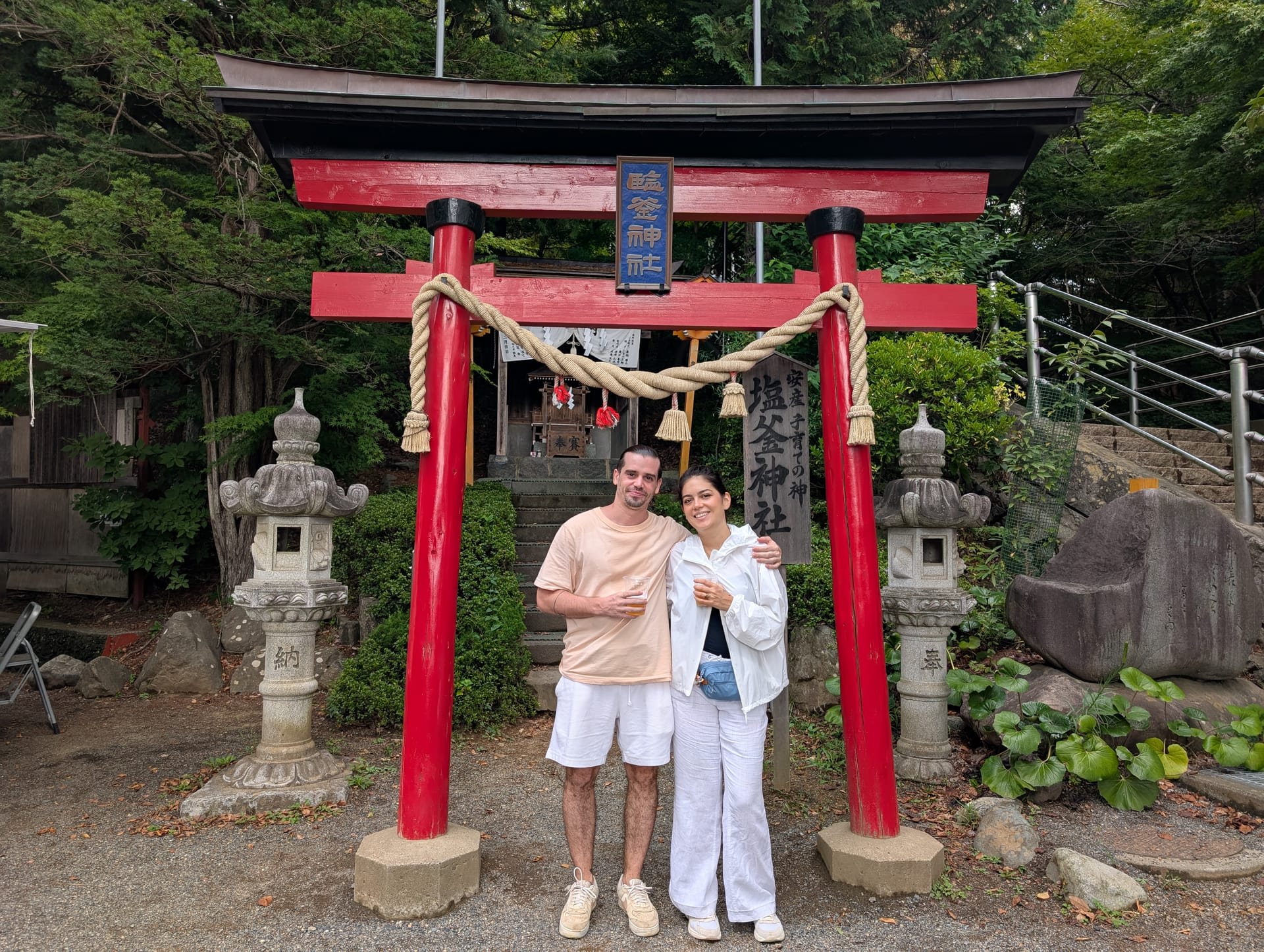
We found a smaller torii gate on the shrine grounds — red-painted, with a shimenawa rope strung between the pillars and stone lanterns on either side. It was set in a clearing surrounded by trees, quieter than the main approach, and it felt like the kind of place where you could stand for a long time without needing to explain why. We asked another visitor to take our photograph. It is my favourite image from the entire trip — the two of us under the gate, holding hands, smiling in a way that has nothing to do with posing and everything to do with being exactly where we wanted to be.
The Craft Beers
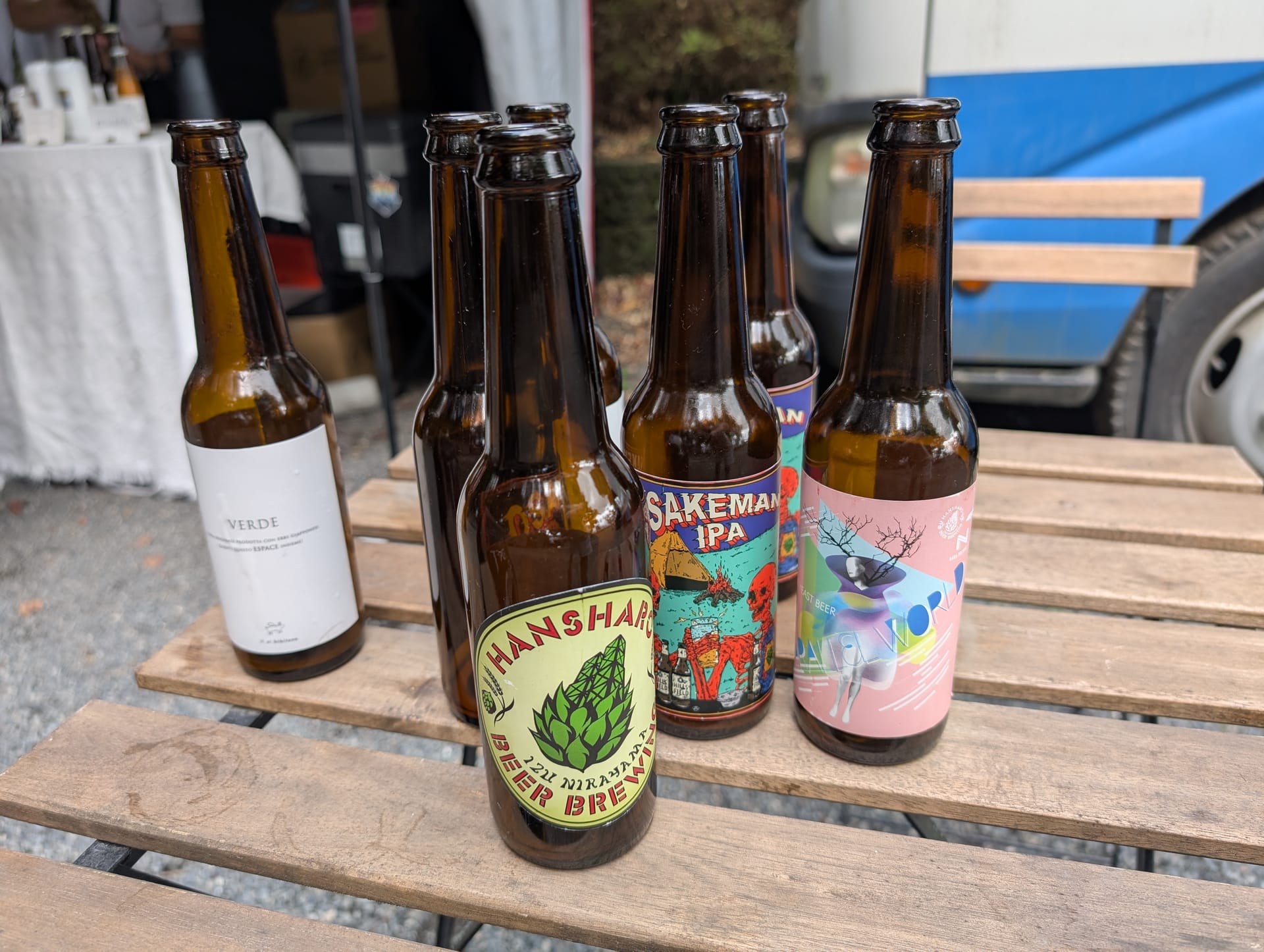
On the walk back from the shrine, we stumbled onto a small craft beer stall near the base of the park — a wooden table, a handful of bottles from local Fuji-area breweries, and a vendor who was clearly happy to see someone interested. We bought a selection: a Sakeman IPA, a Hansharo from Gotemba, and a couple of others with labels too beautiful to ignore. We sat on a bench, drank Japanese craft beer in the shadow of the most famous mountain on earth, and talked about nothing. It was four in the afternoon. We had nowhere to be. This is, I think, the best version of travel — the moments that are not in the itinerary, that happen because you walked slowly enough to notice a table with beer on it.
The Onsen — How the Day Ended
Back at Hotel Kasuitei Ohya, after the pagoda and the shrine and the koi and the beers, the day had one more gift. Our room had a private onsen — a wooden barrel bath on a small terrace overlooking the lake, fed by the same geothermal springs that have been heating water in this valley for centuries. The bath was already full when we returned, steam rising from the surface, the water a temperature that sits precisely at the boundary between comfort and surrender.
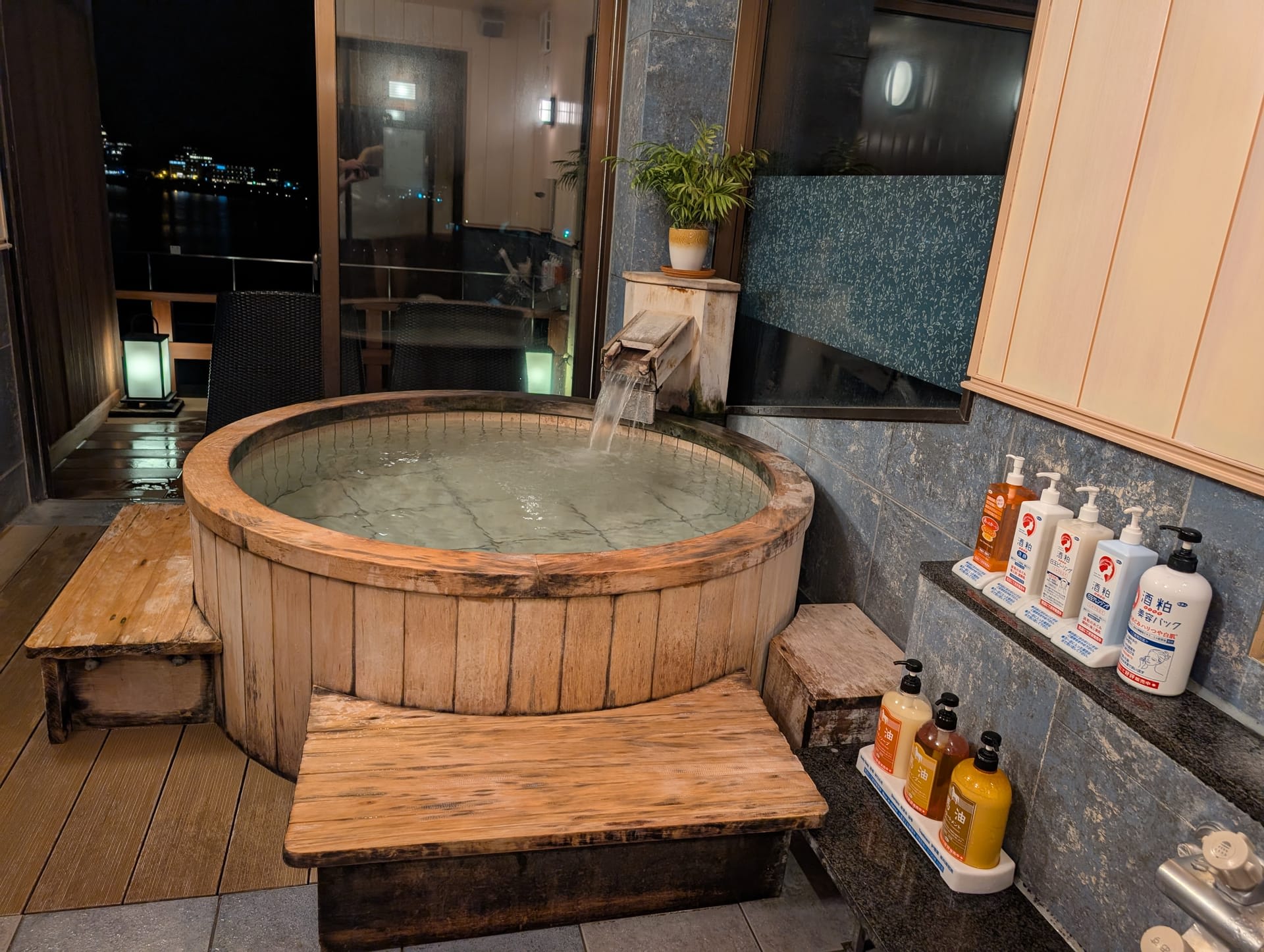
I sat in the bath as the light faded. Through the window, the lake turned from blue to silver to black. The mountains on the far shore became silhouettes. The bottles of shampoo and soap lined up on the shelf beside the bath — Japanese products, beautifully packaged, smelling of yuzu and hinoki wood — were the kind of small detail that Japan does better than anywhere. Every surface considered. Every experience designed. Not for luxury, but for care.
Lia joined me. We sat in the hot water and watched the lights of the lakeside hotels come on across the water, one by one, until the whole shoreline was reflected in the dark surface of the lake. We had climbed four hundred steps, seen the most famous mountain on earth, drawn fortunes at a shrine, watched koi from a bridge, drunk craft beer on a bench, and now we were sitting in volcanic water at the end of all of it, and the day felt complete in a way that very few days ever do.
This is what I mean when I say the mountain is not the whole story. The mountain is the reason you come. The onsen at the end of the day is the reason you remember.
What Fuji Taught Me
I came to Kawaguchiko expecting a photograph. I got something else — something harder to frame and more valuable to keep. The mountain is magnificent, but the mountain is not the whole story. The story is the four hundred steps and the view that earned them. The omikuji fortune that Lia will probably keep in her wallet for years. The torii gate where we stood together and felt, for a moment, like we were part of something older than us. The craft beer on a bench in the afternoon sun. The fact that Lia insisted we go, and I almost said no, and the entire day — one of the best of my life — existed because she was braver about beauty than I was.
Fuji is notoriously shy. The mountain hides behind clouds more often than it reveals itself. We got lucky — partial views, shifting clouds, enough visibility to feel the scale without ever getting the full postcard clarity. And honestly, I preferred it that way. A mountain half-hidden in cloud is more honest than a mountain perfectly displayed. It suggests that some things are not meant to be fully seen. That the glimpse is the gift.
When to go: October to November for the clearest skies and autumn colour framing the views. Cherry blossom season (mid-April) is the famous pagoda shot. The climbing season is July to mid-September. We went in late September and the clouds played a game of hide-and-seek that was, in retrospect, more interesting than a clear sky would have been. Check the forecast. Hope for the best. Go anyway.