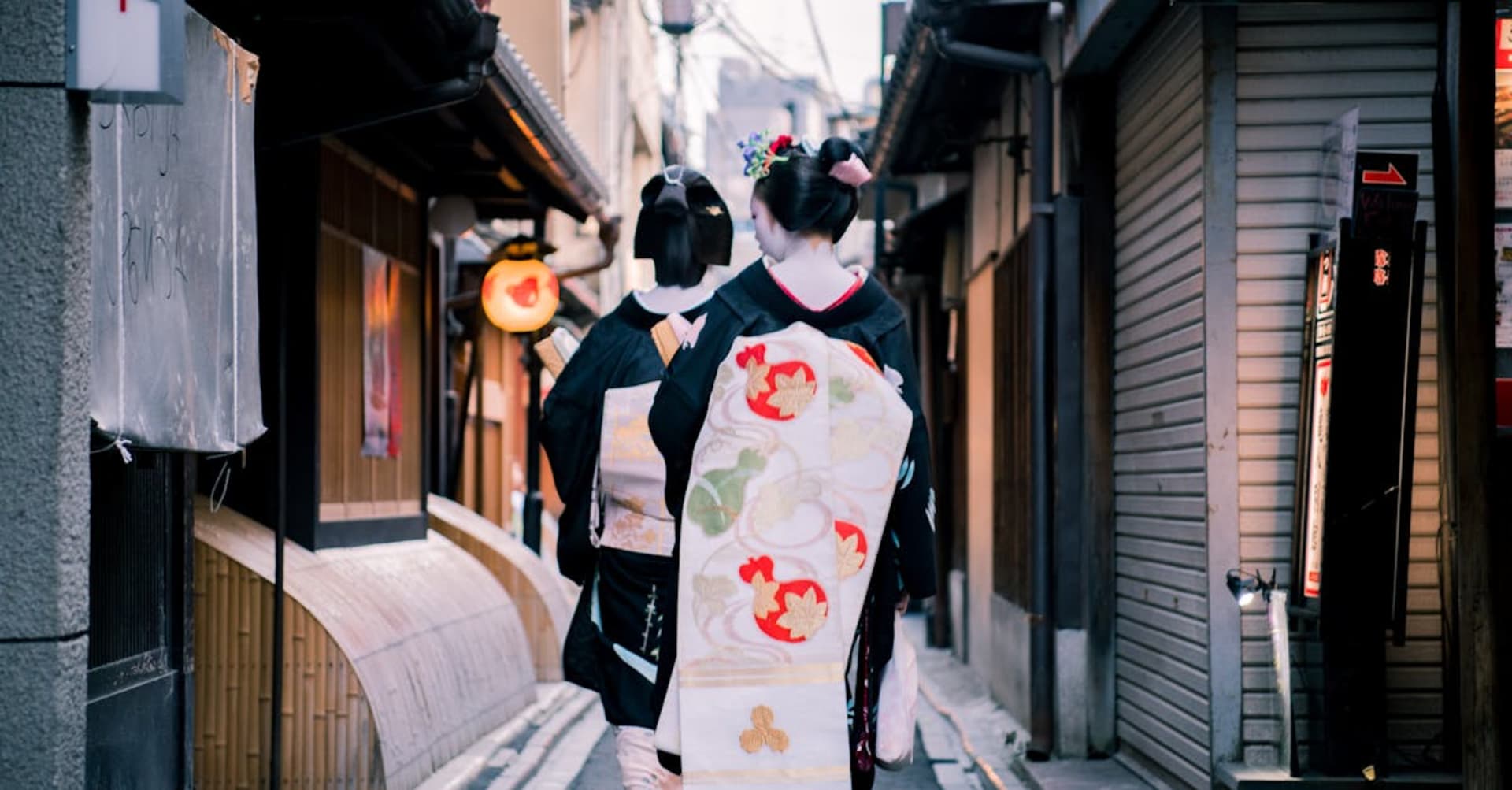
Kyoto
"The city that taught me the difference between looking at something and actually seeing it."
Lia and I arrived in Kyoto on a bullet train from Tokyo — two hours fifteen minutes, a bento box eaten at 285 kilometres per hour, and a window seat on the right side that gave us a brief, perfect view of Fuji sliding past like a painting being carried across a stage. The shinkansen alone would have justified the trip. But then we stepped out of Kyoto Station and into a city that operates on an entirely different frequency, and the next five days became the emotional centre of our three weeks in Japan.
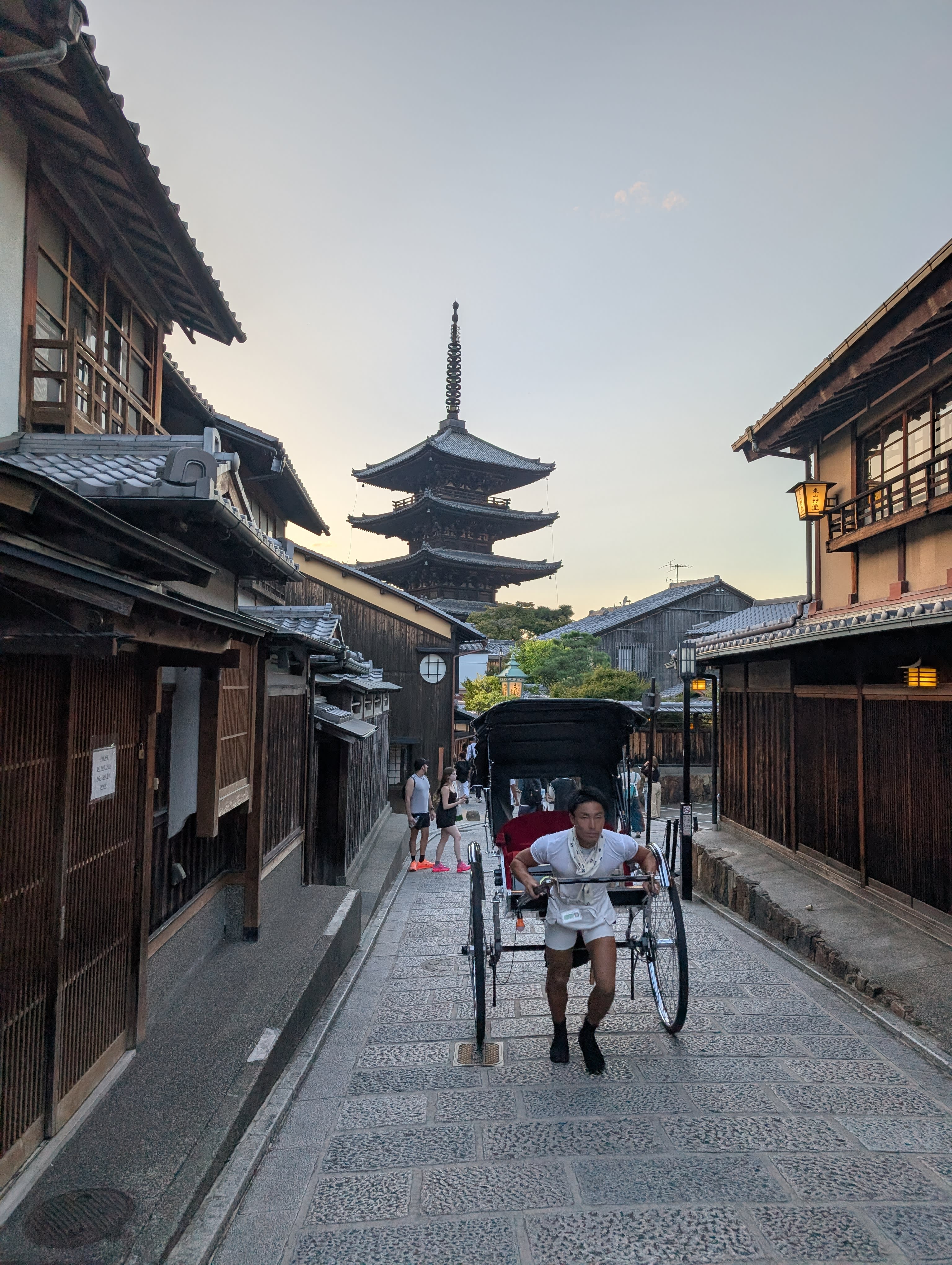
We stayed at Hotel The West Japan Kyoto Kiyomizu, on the hill leading up to Kiyomizu-dera, and the location made everything. Every evening walk was a descent through history — stone-paved lanes, wooden shopfronts, the Yasaka Pagoda appearing between rooftops like a punctuation mark — and every morning was a climb back up into something sacred. I would stay here again without hesitation.
Higashiyama — The Evening Walk
Our first evening in Kyoto was the best. We dropped our bags, walked out the door, and let gravity take us downhill through Sannenzaka and Ninenzaka — the preserved lanes that are Kyoto’s most photographed streets. In the late afternoon, with the sun low and the crowds thinning, they were extraordinary. The stones underfoot have been polished by centuries of feet. The wooden shops sell ceramics, sweets, incense. Women in rented kimonos walked ahead of us with parasols, their wooden sandals clicking on the stone, and the effect was less tourist spectacle than time travel.
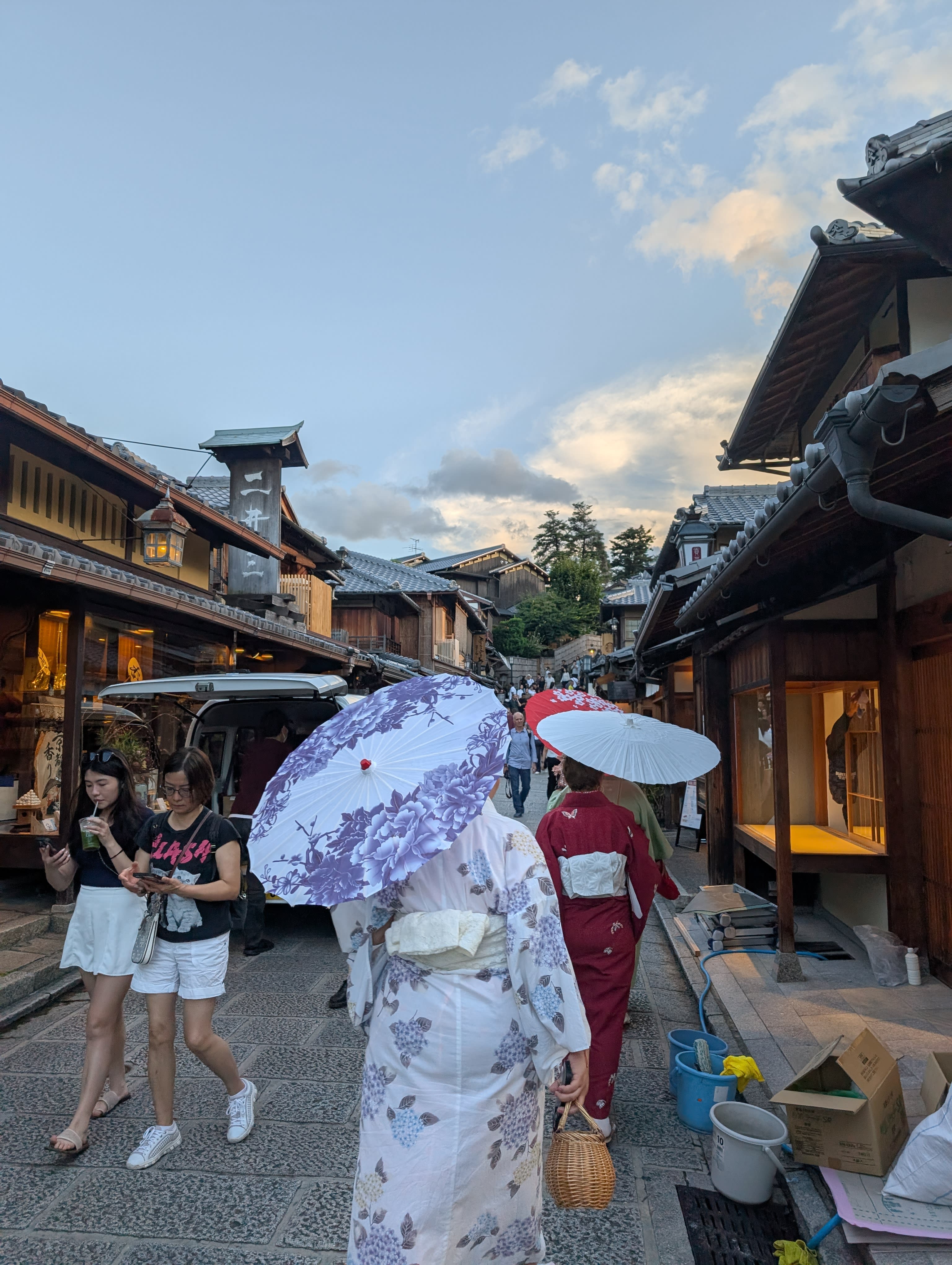
The Yasaka Pagoda appeared between rooftops on every turn — five tiers of dark wood against the sky, the kind of structure that makes you stop mid-sentence and stare. A rickshaw runner pulled a couple past us at speed, the pagoda rising behind him like something from a woodblock print come to life.
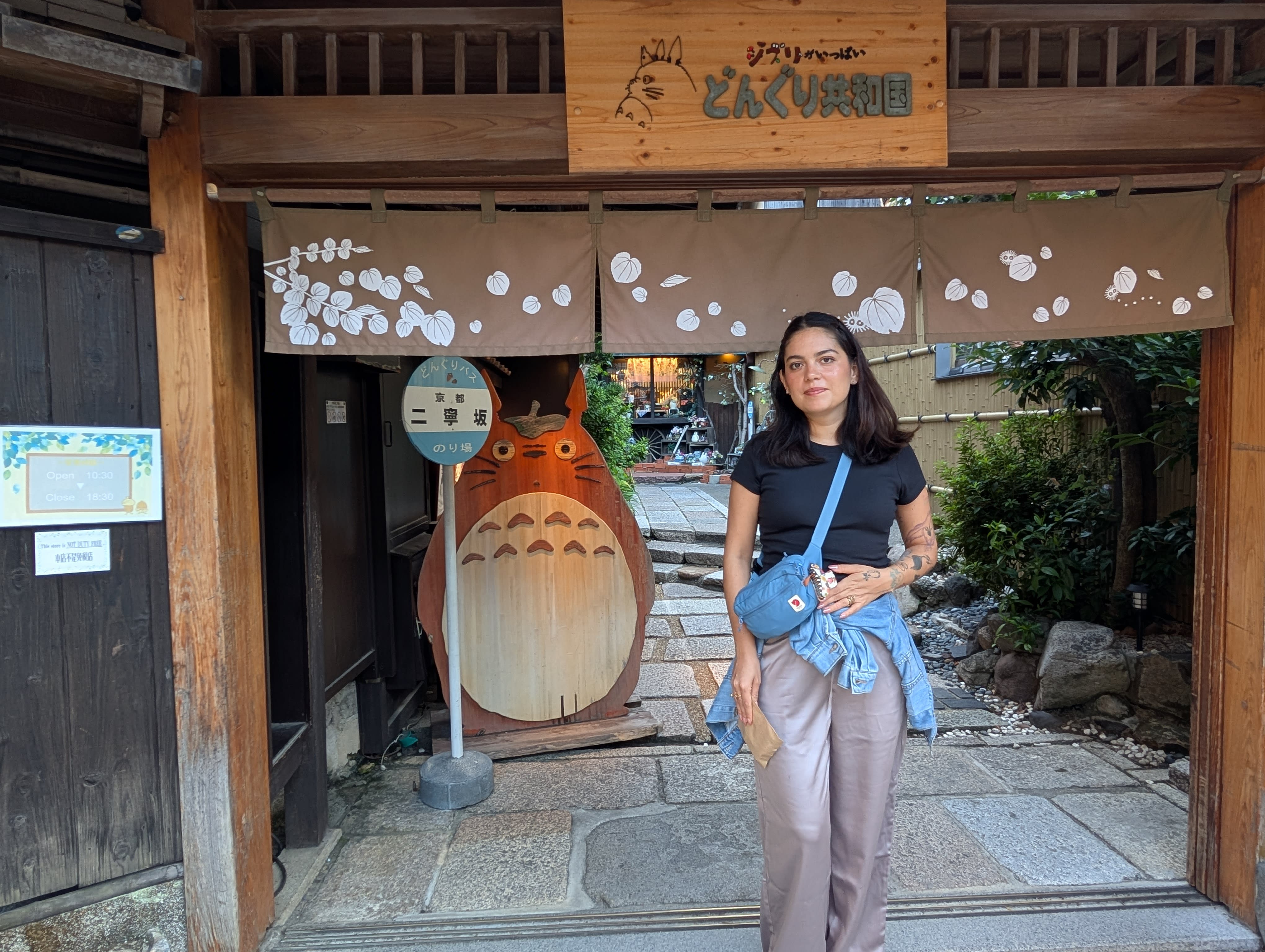
Lia found the Ghibli shop on Ninenzaka — a Totoro-themed store tucked into a traditional wooden building — and stood in the doorway grinning. She went inside. She was gone for twenty minutes. She emerged with a bag of things she refused to itemize.
We passed through Yasaka Shrine as day became evening — the massive vermillion gate illuminated against the night sky, visitors streaming through, the lanterns casting a warm glow that turned everything amber.
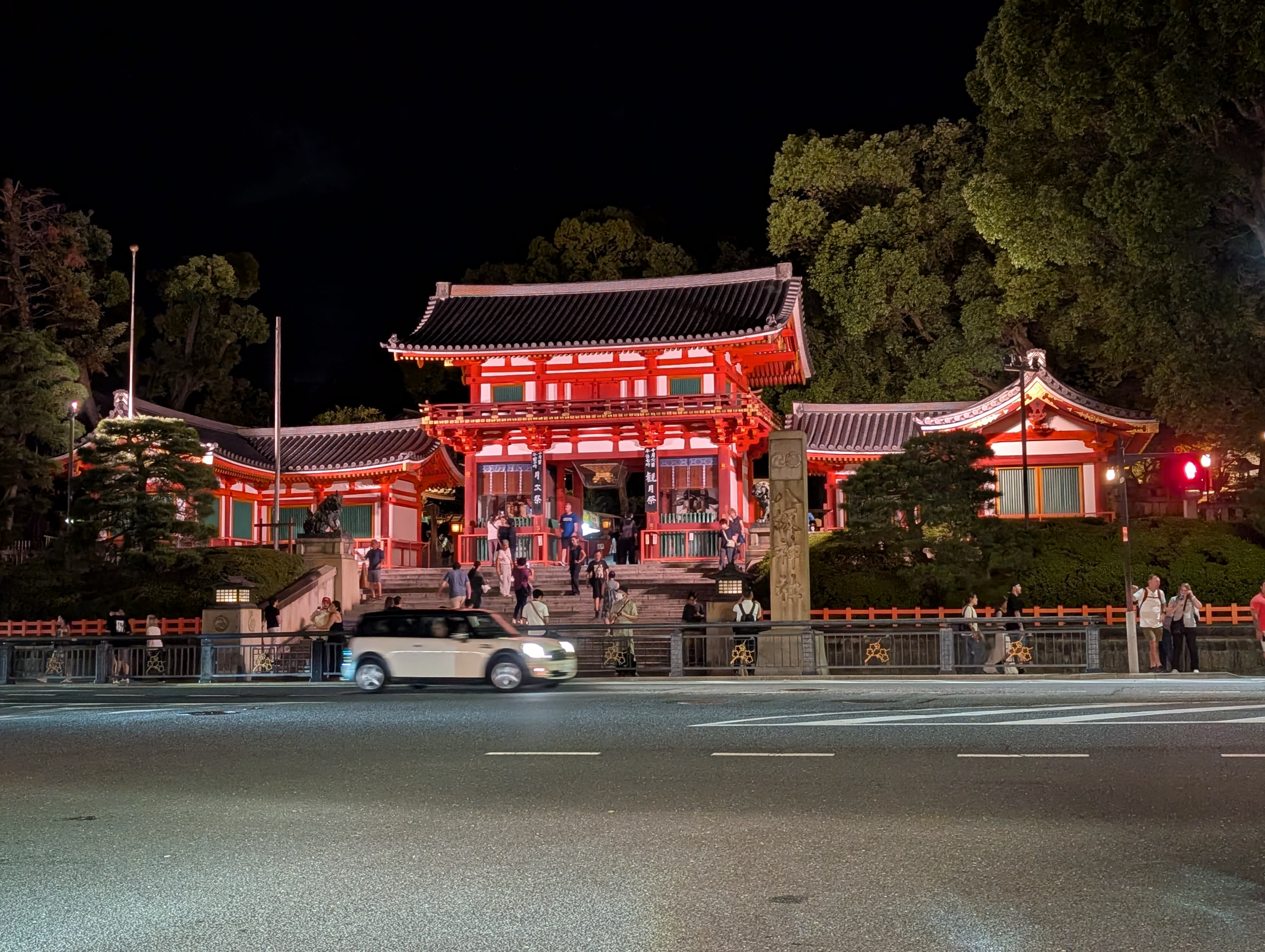
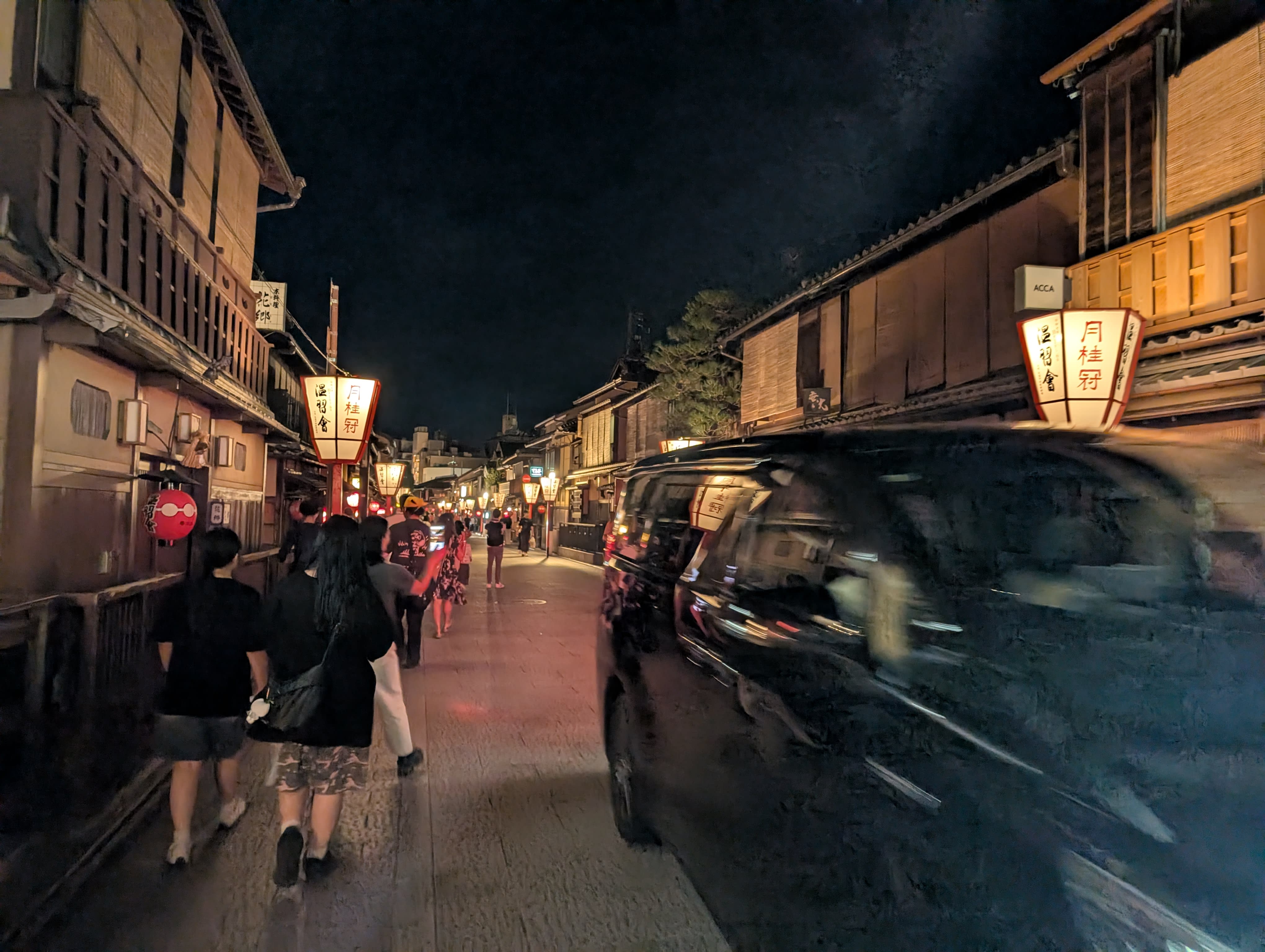
Then we were in Gion. Hanamikoji Street in the early evening has a particular electricity — the possibility of spotting a geiko or maiko on their way to an engagement, the lanterns coming on, the quiet click of wooden sandals on stone. We crossed the Kamo River to Pontocho Alley for dinner — a narrow lane packed with restaurants, lit by paper lanterns, running parallel to the river. The food was good. I do not remember what we ordered. I remember the light.
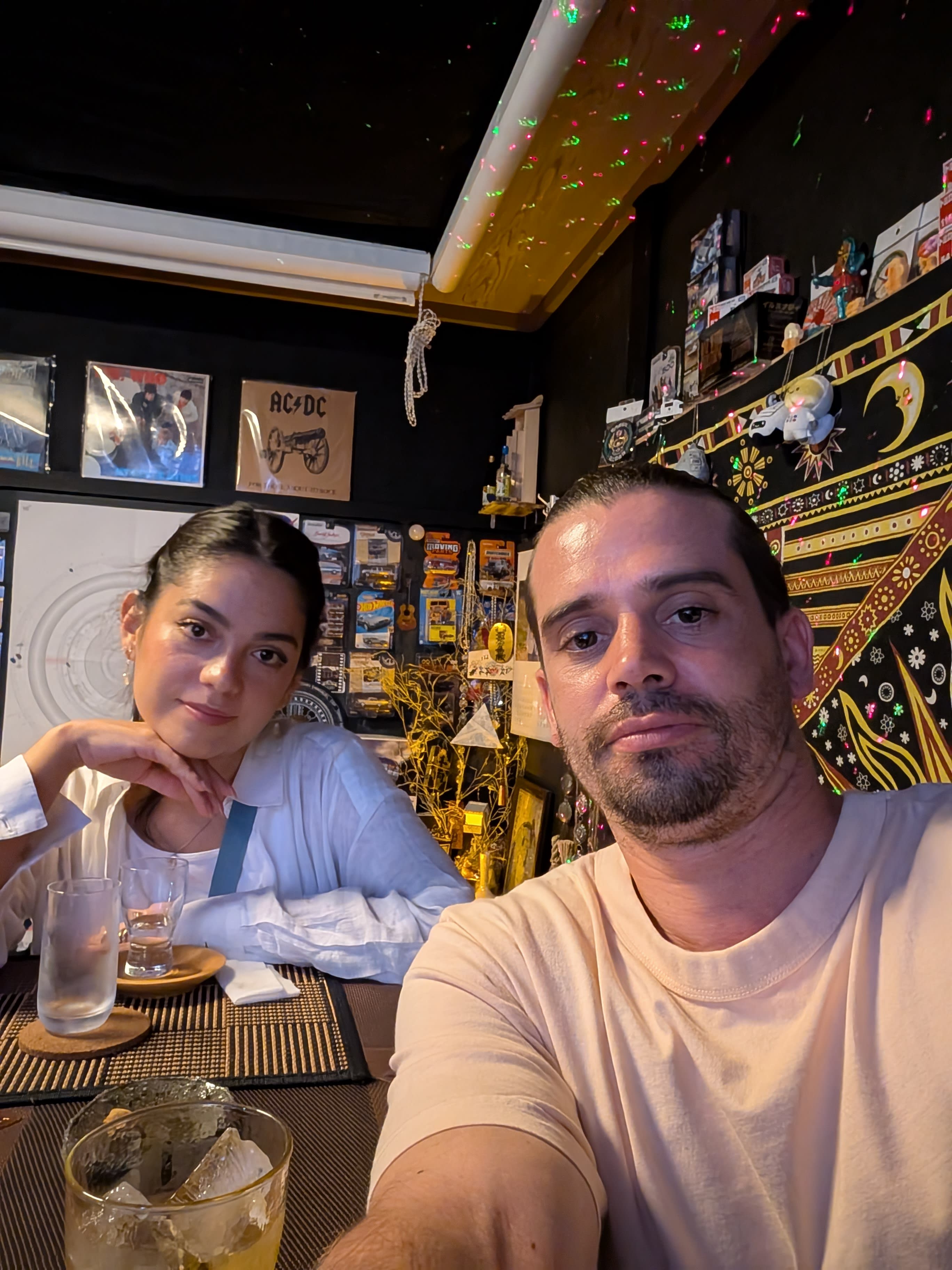
We ended the night at a tiny bar we stumbled into — the kind of place with six stools, an AC/DC poster on the wall, and a bartender who poured whisky with the precision of a surgeon. Lia sat across from me and the jet lag was gone and Kyoto was already working on us.
Kiyomizu-dera
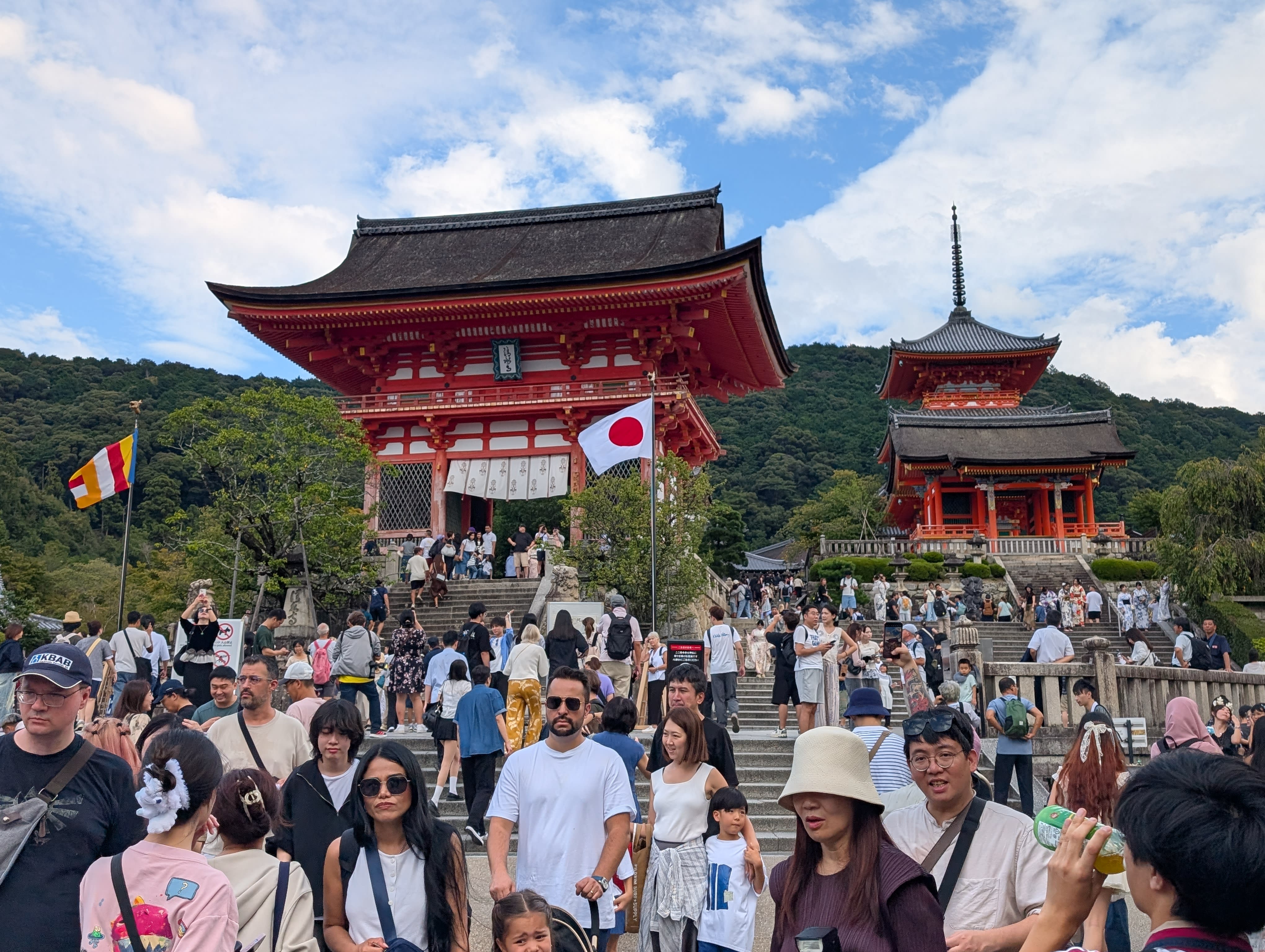
We went early the next morning and it made all the difference. Kiyomizu-dera — the wooden temple built on a cliff face, no nails, overlooking the city — is one of the most visited sites in Japan. At 9am on a weekday in late September, it was busy but manageable. The famous wooden stage juts out over the hillside and gives you a panoramic view of Kyoto that makes the city feel both ancient and infinite. Below, we drank from the Otowa Waterfall — three streams, each said to grant a different blessing. I drank from all three. I am not superstitious, but I am not stupid either.
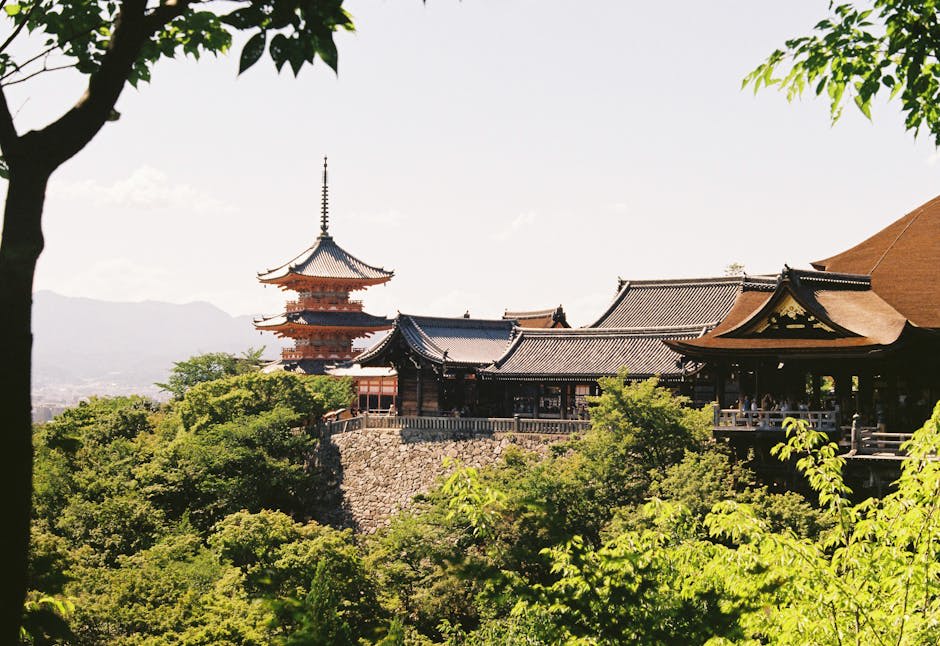
The walk back down through Sannenzaka was different in the morning light — softer, the shops open, the smell of matcha and fresh mochi drifting from doorways. We visited Kodai-ji Temple and its zen garden, which was exactly the kind of quiet, considered beauty that Kyoto does better than anywhere else.
The Tea Ceremony
That afternoon, we did a kimono tea ceremony in Gion, near Kiyomizu. I had been skeptical — it sounded like a tourist experience — but it was not. We changed into kimonos at the tea house, and something shifted immediately. The fabric changed how I moved. The obi changed how I stood. Lia, in a dark floral pattern with her hair pinned up, looked like she had stepped out of a different century.
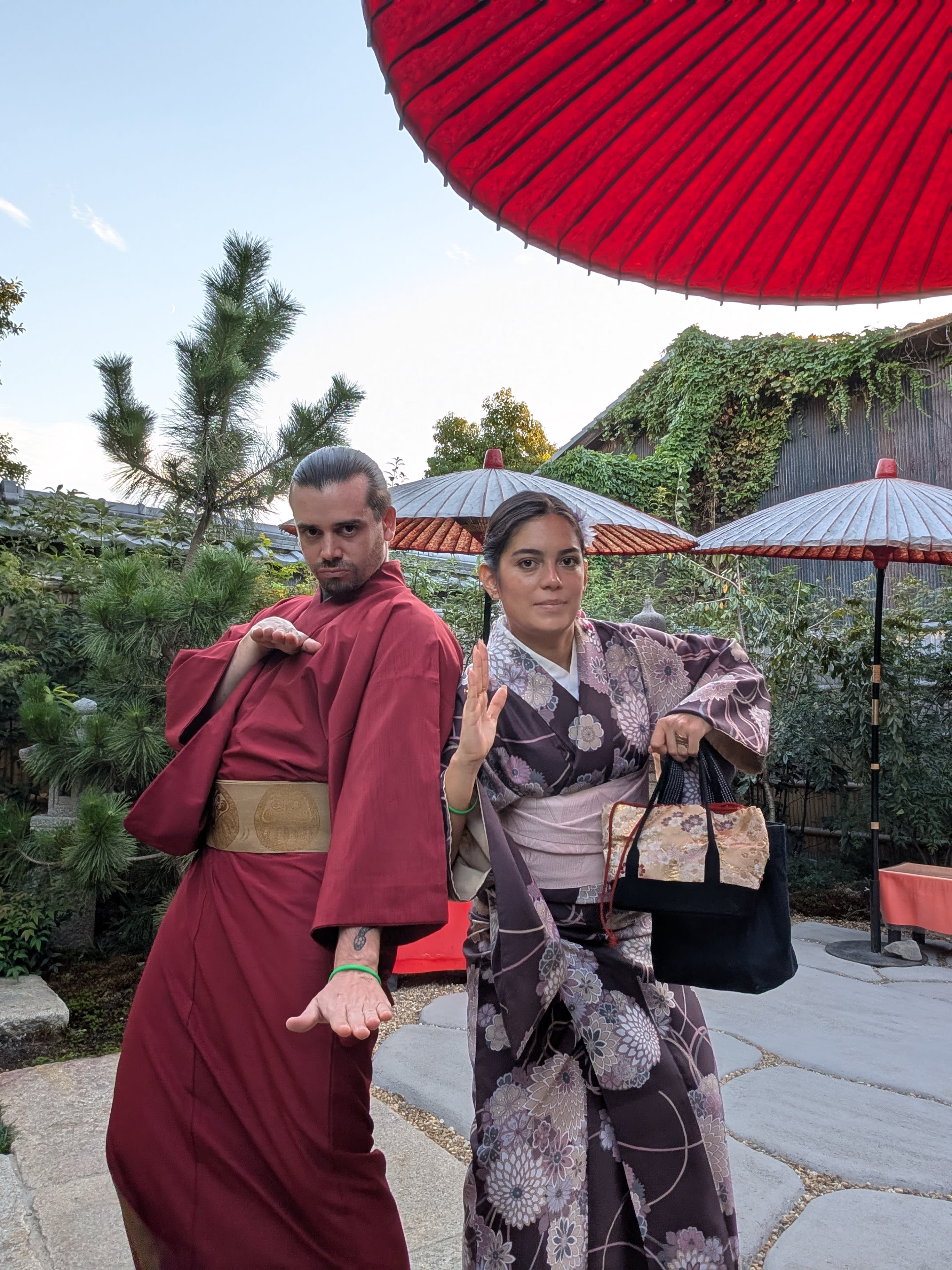
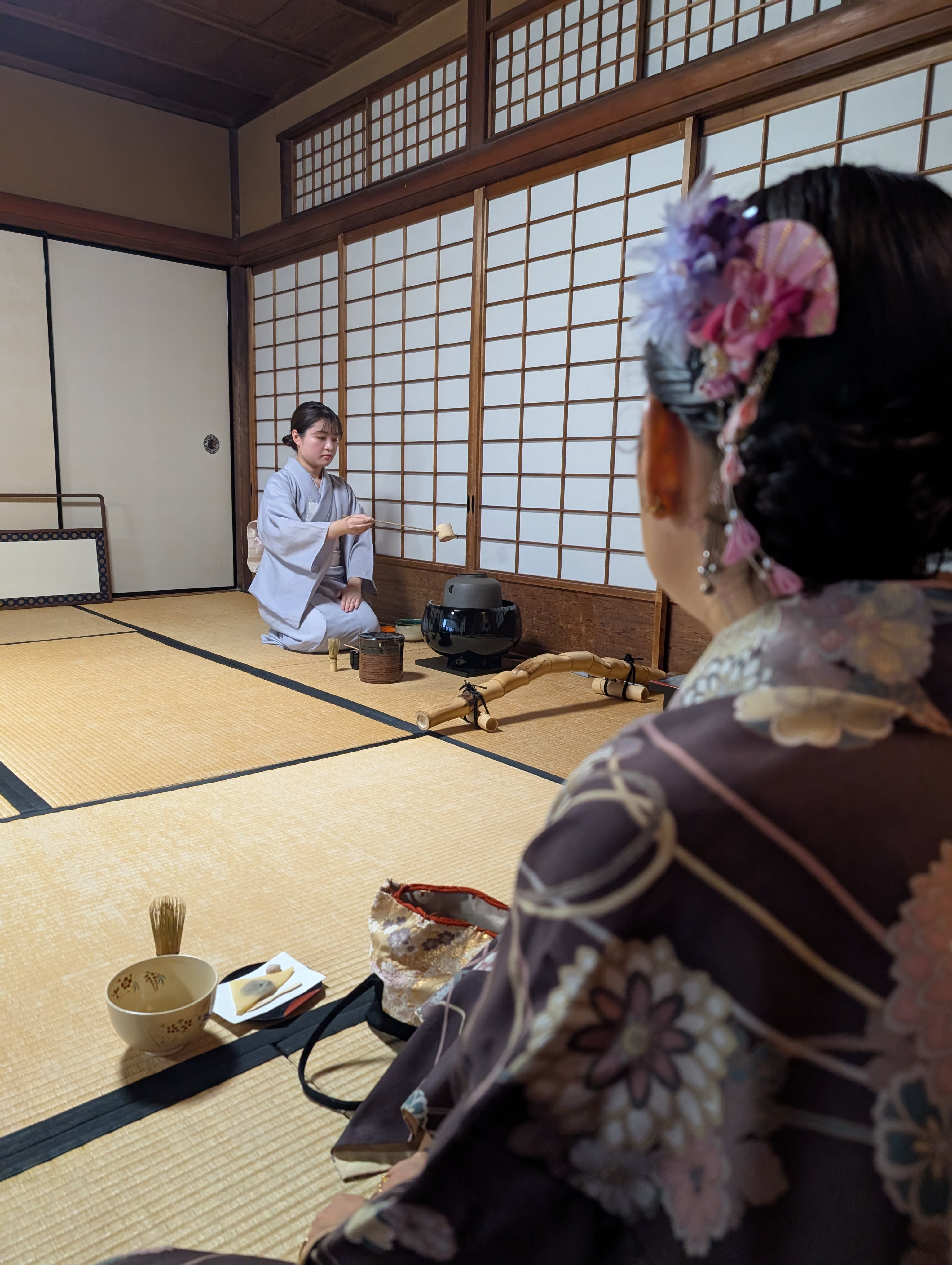
The ceremony itself was slow, precise, every gesture intentional. Our tea master knelt on the tatami in a pale blue kimono and whisked the matcha in a bowl that was probably older than my country. The whisk moved in circles, the foam appeared, and the room was silent except for the sound of bamboo on clay. Ninety minutes. No phones. The matcha was bitter and rich and served with a sweet that dissolved on the tongue.
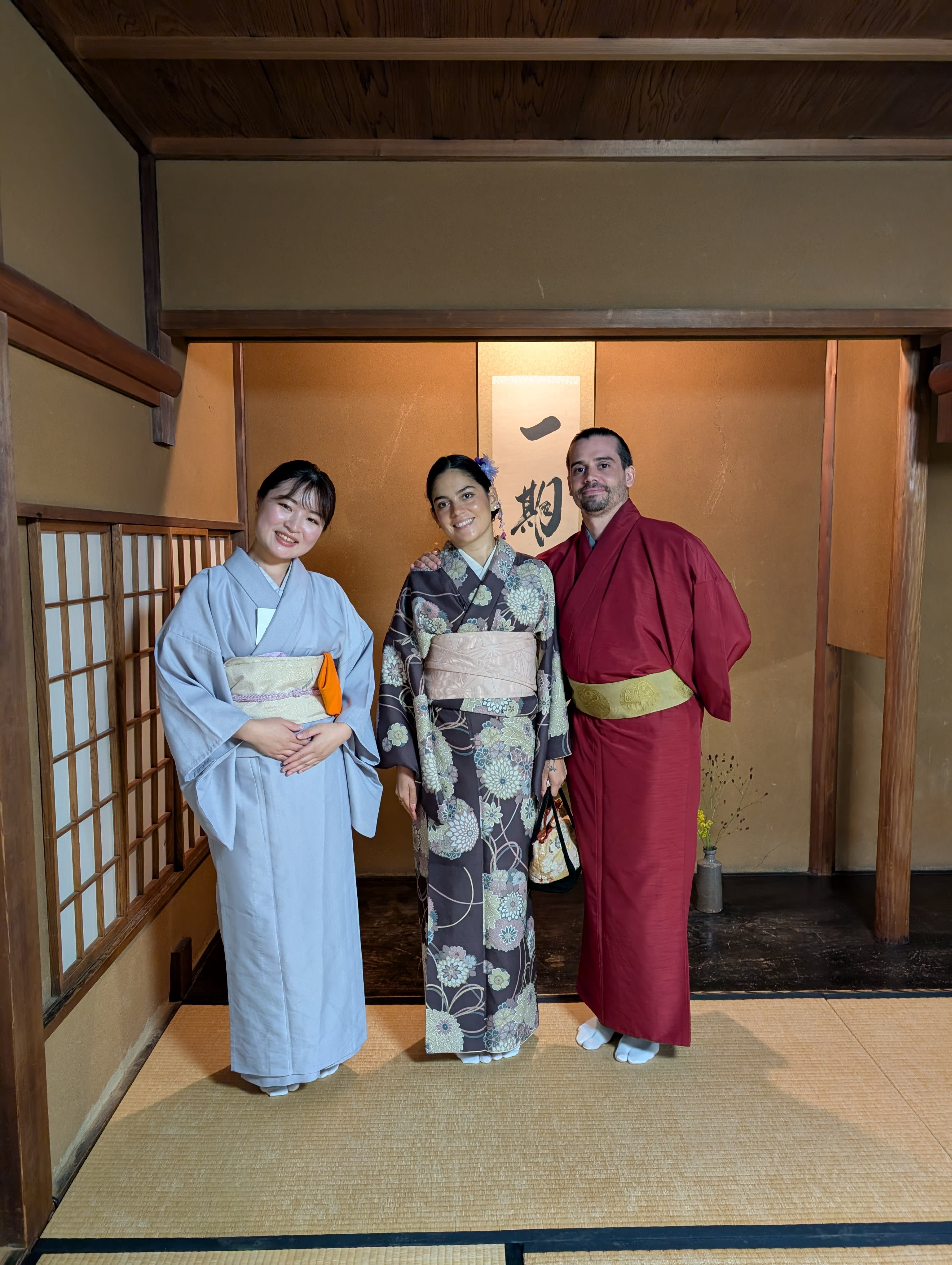
Afterward, she posed for a photograph with us. Three people in kimonos on tatami mats, a scroll on the wall behind us reading something I could not translate. Lia and I walked out into the evening streets of Gion in our kimonos, and for a few minutes Kyoto felt not like a city we were visiting but a world we had been admitted into.
Fushimi Inari
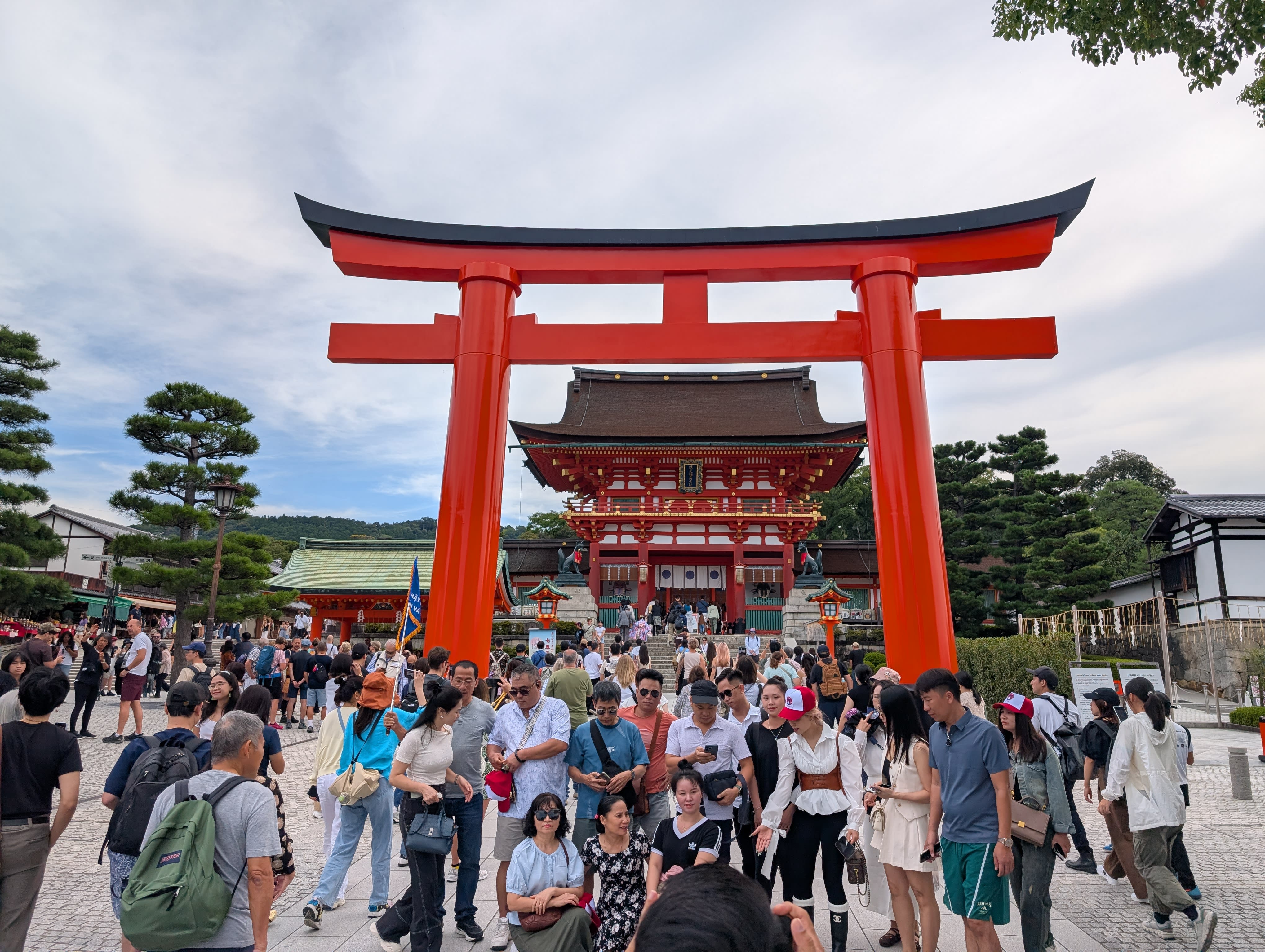
We took the JR Nara Line two stops south to Inari Station, arriving at eight in the morning, and walked straight into the famous tunnel of red torii gates at Fushimi Inari Taisha. The main entrance was already busy — the enormous red torii gate, the Rōmon gate behind it, the crowds milling with cameras — but the magic of Fushimi Inari is not at the entrance. It is higher up.
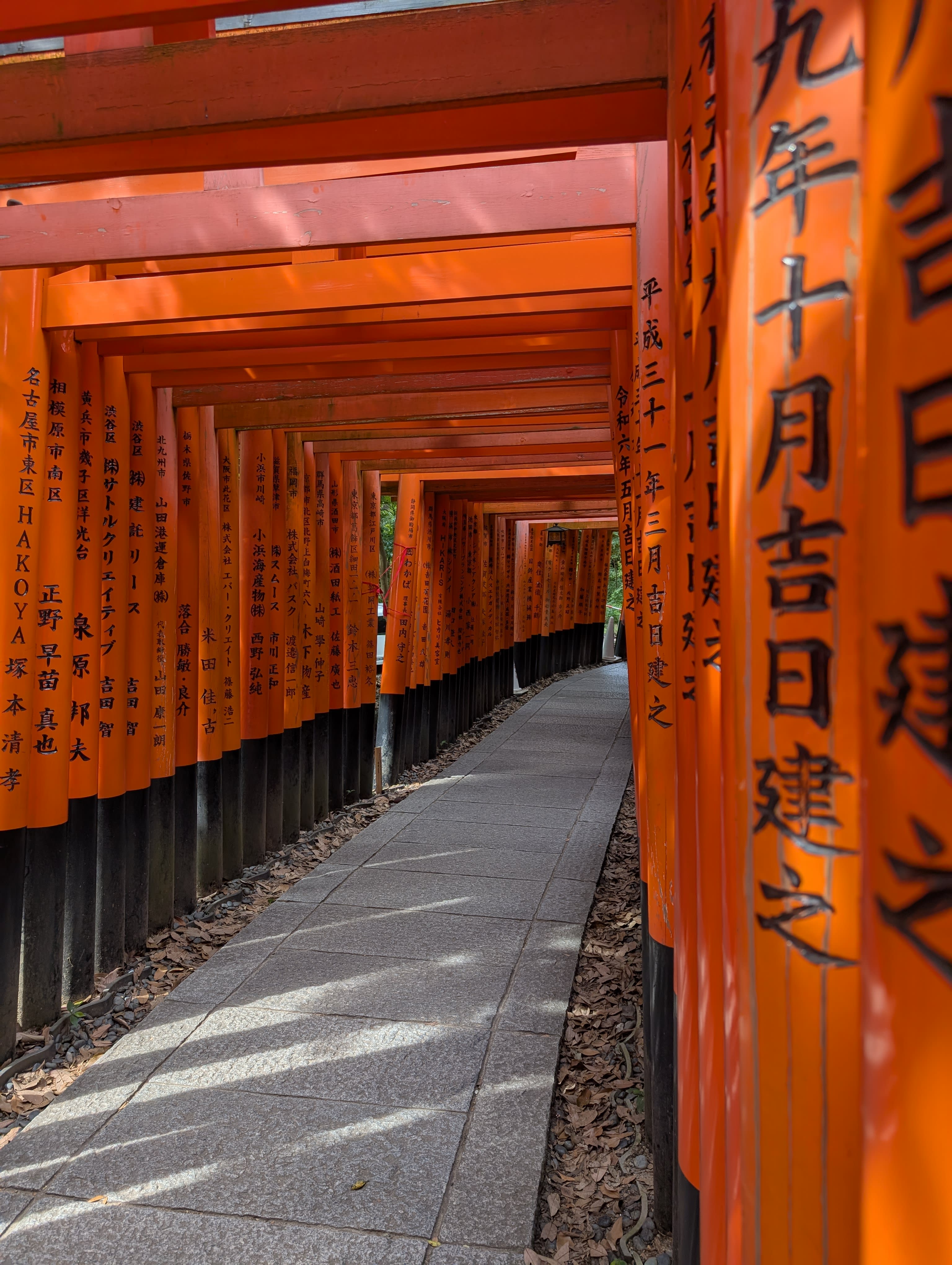
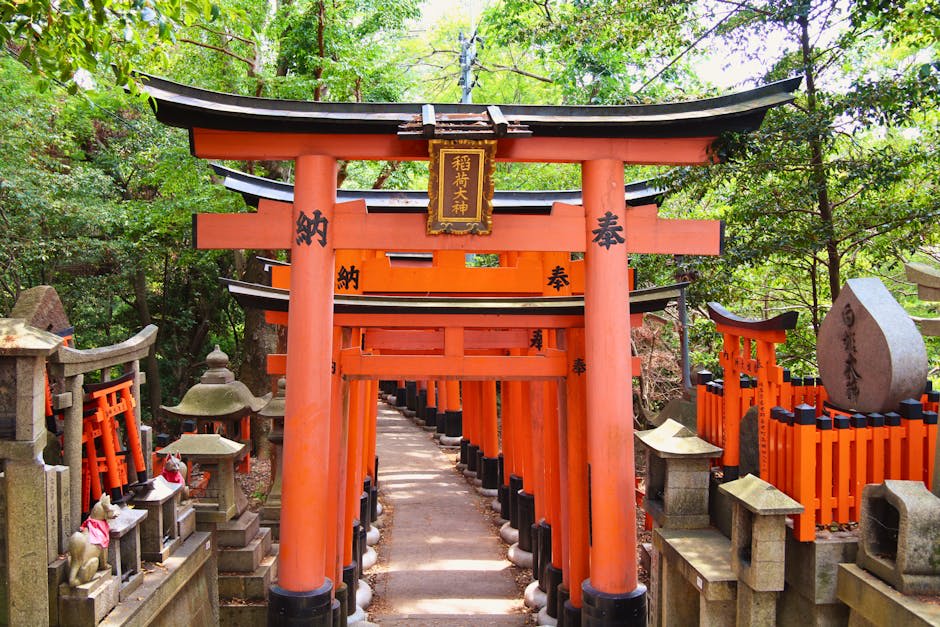
Inside the gate tunnels, everything changed. Gate after gate after gate — thousands of them, the light filtering through in orange streaks, each one inscribed with the name of the business or person who donated it. The kanji on the columns was beautiful even without understanding it. At that hour, the lower paths were beginning to fill, but the higher trails were nearly empty. We kept climbing.
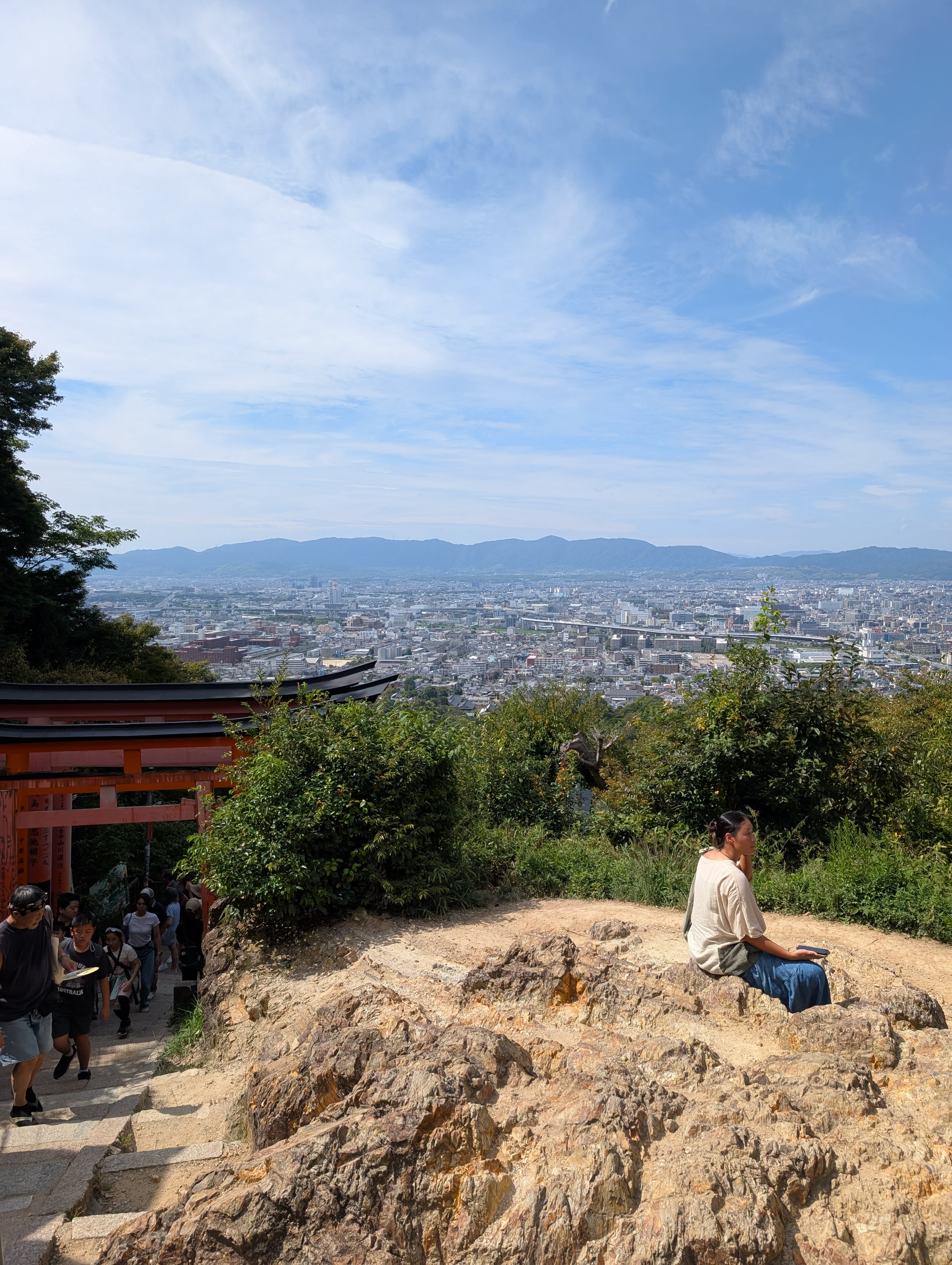
We hiked the full two-hour loop to the summit. Near the top, at a clearing with a small shrine and a red torii gate, Lia sat on a rock overlooking all of Kyoto — the city spread below, the mountains behind, the sky enormous. She sat there for ten minutes without saying anything. I took a photograph.
By the time we came back down, the crowds had arrived and it was a different place entirely. Go early. This is not a suggestion.
Afterward, we walked to the Fushimi Sake District — one of Japan’s great sake-producing areas, built along willow-lined canals. The Gekkeikan Okura Sake Museum gave us the history and a tasting, and we spent the afternoon strolling past the breweries in a state of mild, pleasant intoxication that felt entirely appropriate.
Kurama to Kibune — The Mountain Hike
This was my favourite day. We took the Eizan Railway from Demachi-Yanagi Station up into the mountains north of Kyoto to Kurama-dera, a temple built into the mountainside that felt like it existed outside of time. The halls are carved into the slope, the cedar trees are enormous, and the spiritual atmosphere is not performed — it is simply present.
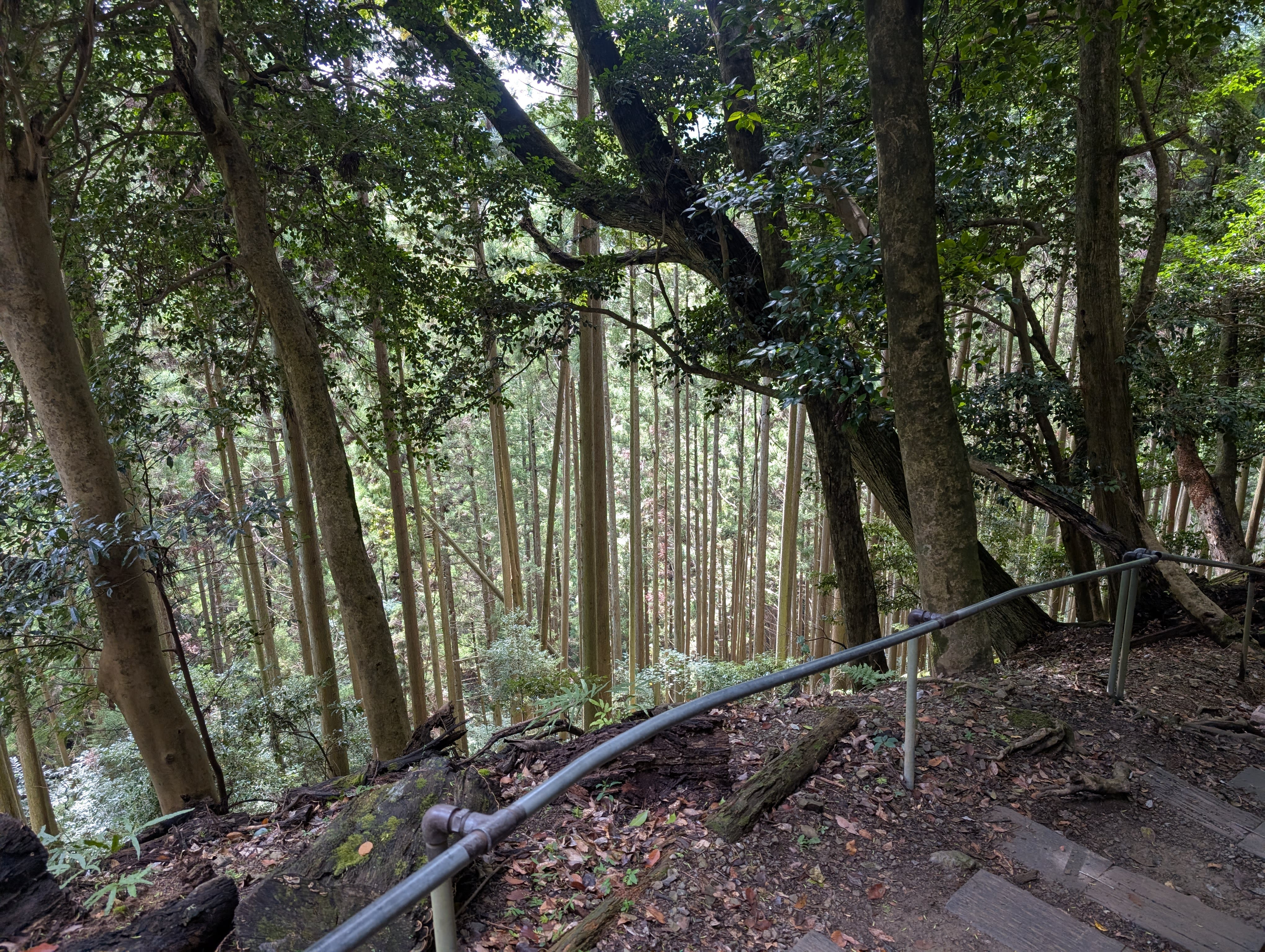
From Kurama, we hiked the mountain trail to Kibune — about ninety minutes through a forest of ancient cedars so tall the canopy filtered the light into something green and cathedral-like. The trail was steep in places, with wooden railings and stone steps that felt older than anything we had walked on in Tokyo. The silence was total except for birdsong and the occasional crack of a branch underfoot.
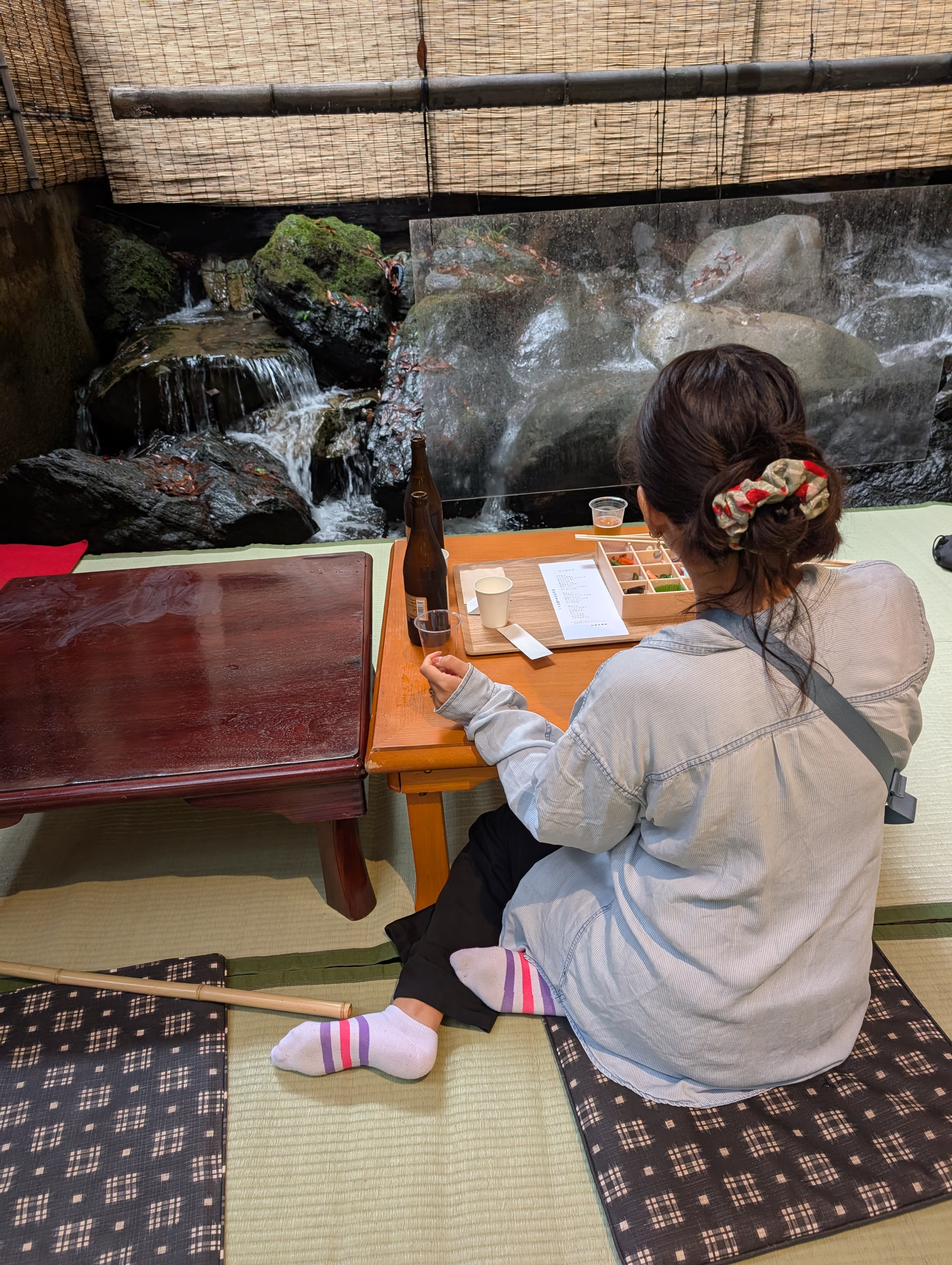
The trail ended at Kibune Shrine, dedicated to the god of water, and then we had the meal I will remember longest from all of Japan. A kawadoko restaurant — platforms built directly over the Kibune River, so you eat inches above flowing water in the cool mountain air. Lia sat on a tatami mat, her feet tucked beneath her, a bento box on the low table, a waterfall tumbling over rocks behind her. The food was delicate and precise. The river was loud and wild. The contrast was perfect.
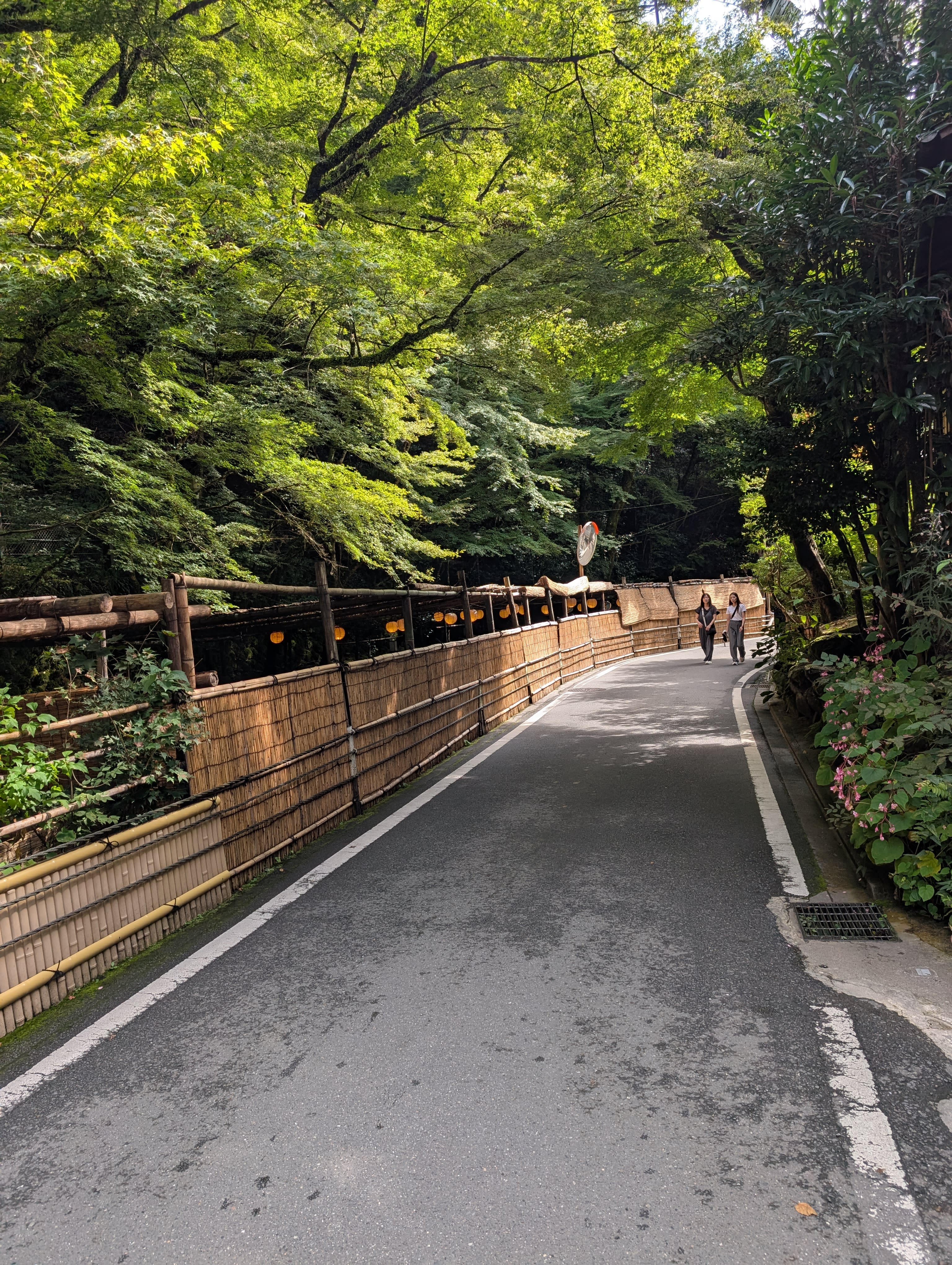
The walk back along the road to Kibune-guchi Station was beautiful in a quieter way — the green canopy arching over the lane, bamboo fences lining the path, the river audible but hidden. If you do one thing outside central Kyoto, do this.
Arashiyama
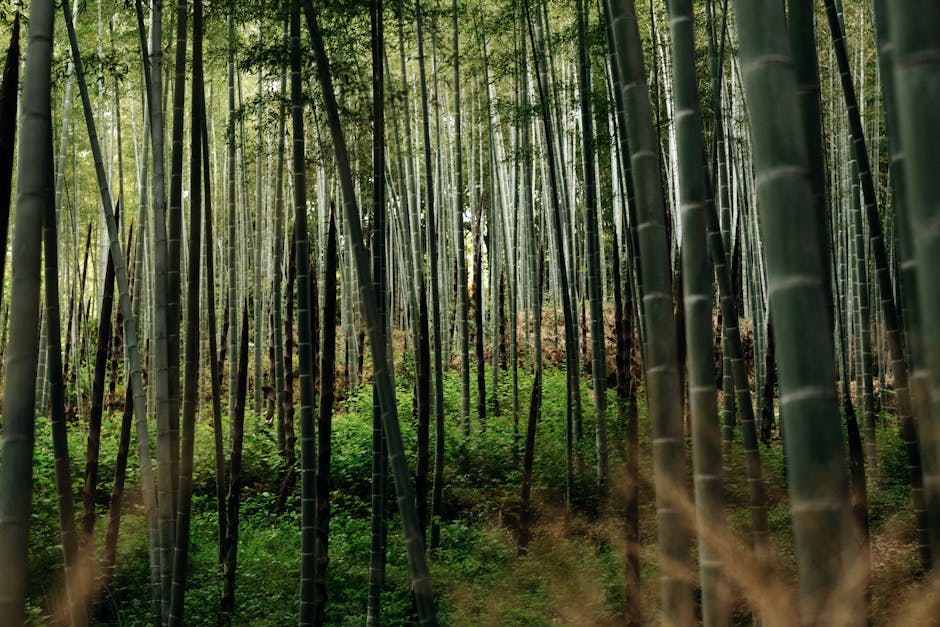
We went early again — Saga-Arashiyama Station by 8:30 — and walked straight into the Bamboo Grove before it became a crowd. The bamboo towers above you on both sides, the light is green and filtered, and the sound of the stalks moving in the wind is something between a whisper and a creak. Ten minutes of near-solitude before the groups arrived. Those ten minutes were worth the early alarm.
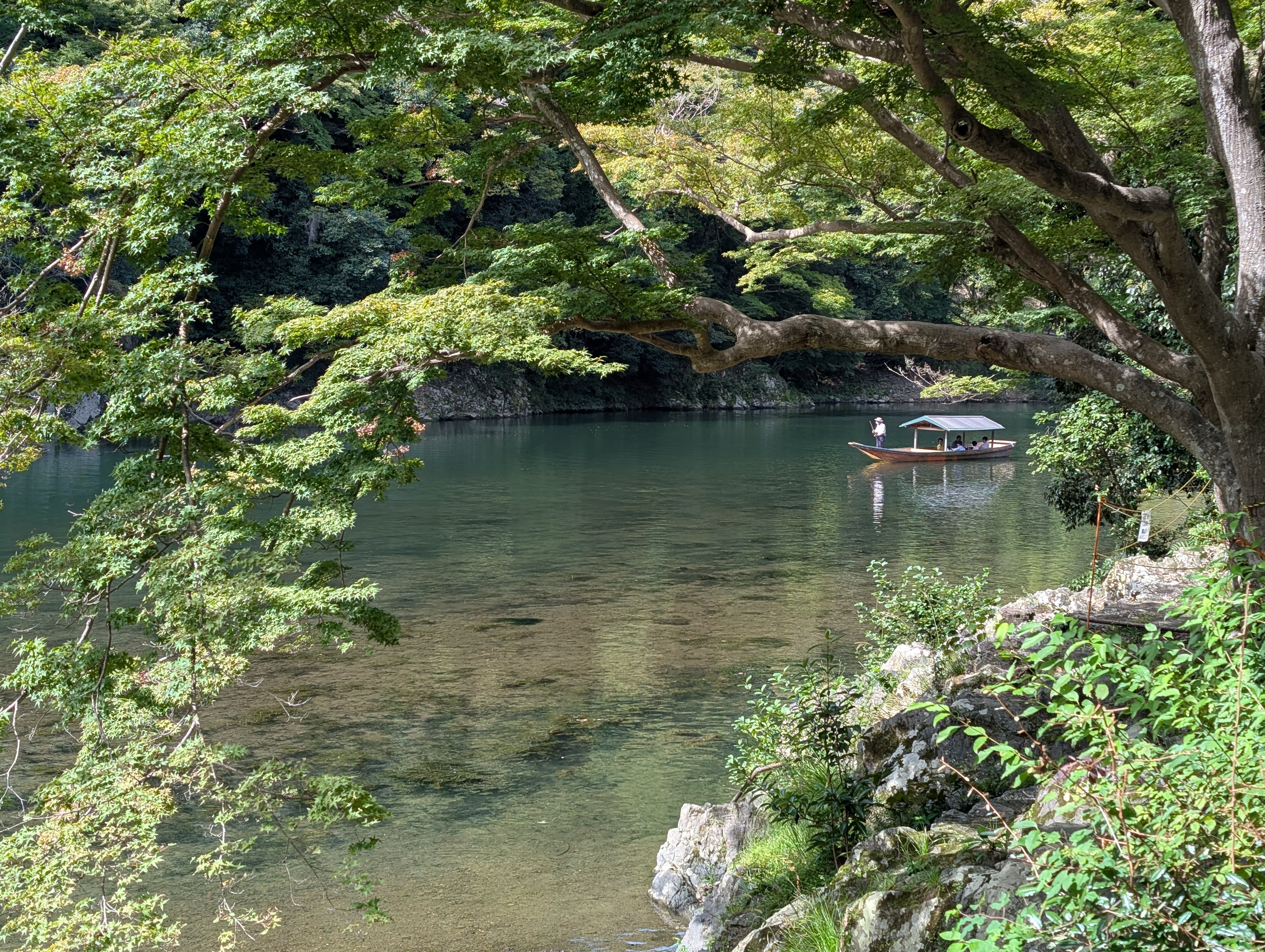
From the grove we entered Tenryu-ji, a UNESCO site whose landscape garden uses the surrounding mountains as borrowed scenery — a technique that makes the garden feel infinite. A traditional boat glided across the pond as we watched, slow and deliberate, the reflections of trees trembling on the water.
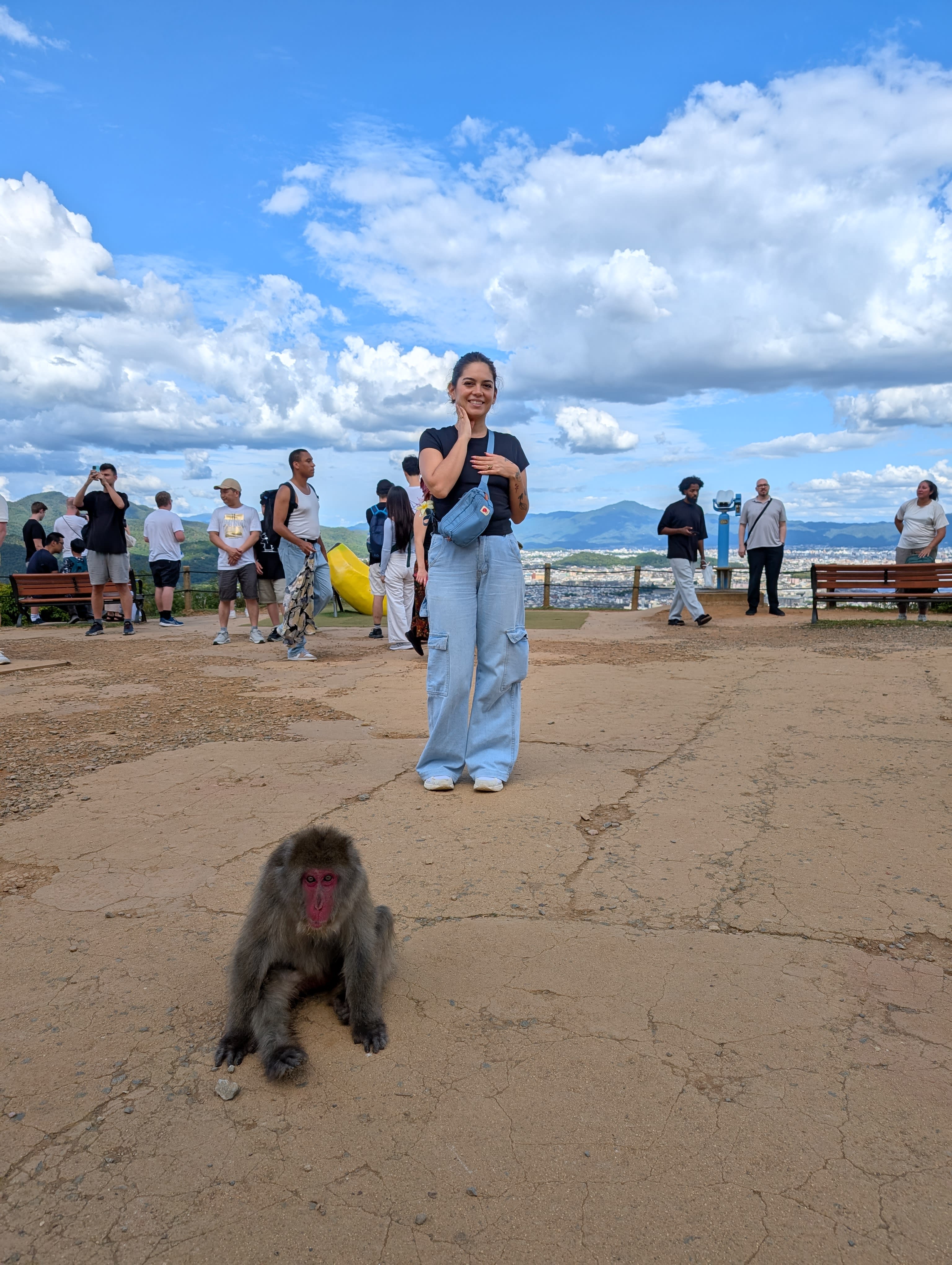
We crossed the Togetsukyo Bridge and spent the afternoon between the monkey park on the hill and the village below. The Iwatayama Monkey Park was a steep climb for a modest reward — except for the macaques themselves, who were wild, unbothered, and occasionally hilarious. One sat on a twisted branch like a philosopher contemplating the void. Another sat at Lia’s feet at the summit viewpoint, entirely indifferent to the panoramic view of Kyoto behind it.
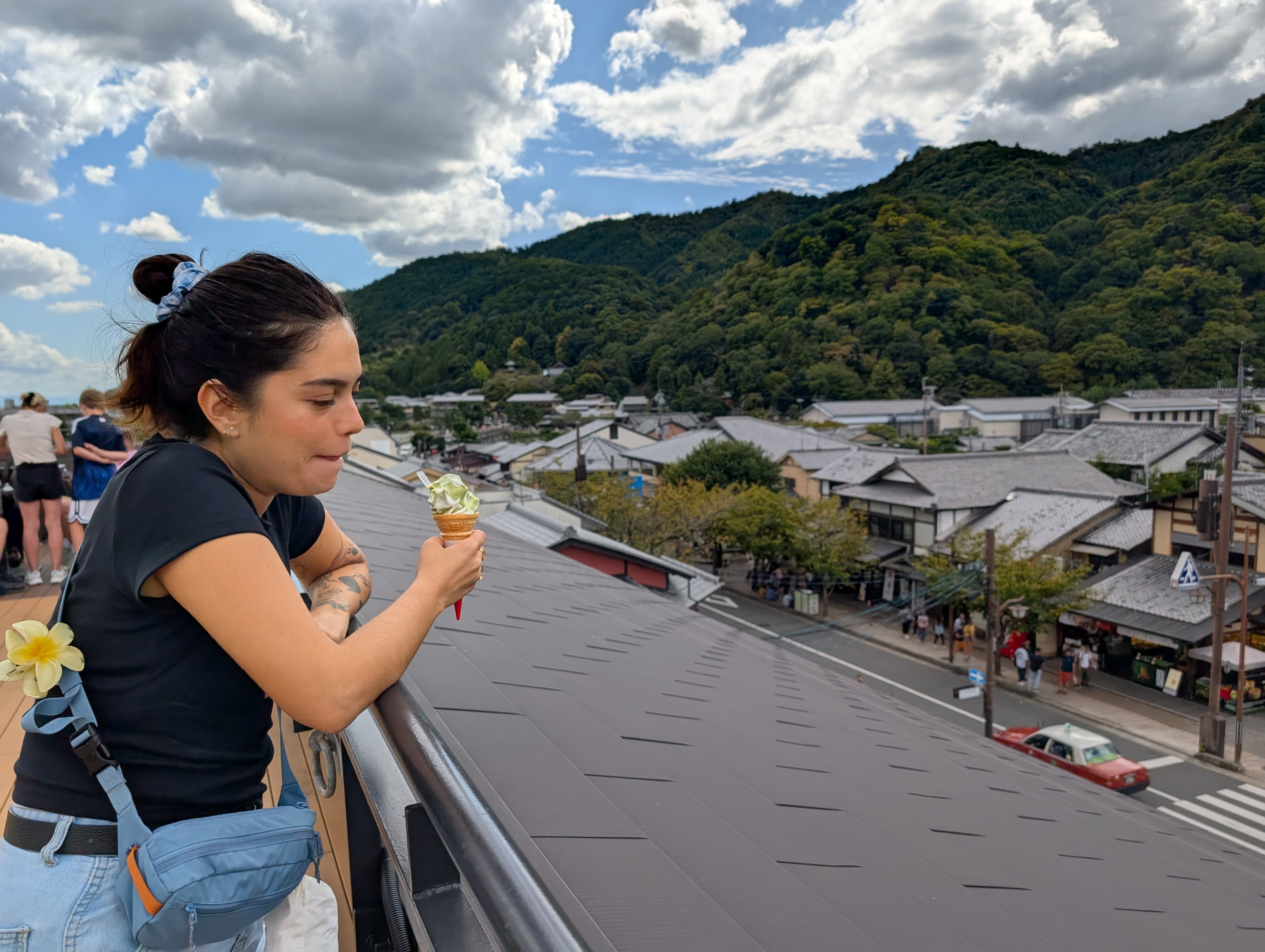
Lia ate matcha ice cream on the observation platform, looking out over the rooftops of Arashiyama and the forested hills beyond. The clouds were enormous. The mountains were green. The ice cream was dripping down her cone. This was the moment I stopped taking notes and started simply being in Kyoto.
The Departure
Our last night in Kyoto was dinner in Pontocho again, on a terrace overlooking the river, watching the light change. I did not want to leave. Kyoto does that — it gets under your skin so quietly you do not notice until you are packing your bag and the thought of boarding a train feels like a small grief.
The next morning, we took a taxi to Kyoto Station for the JR train to Osaka — thirty minutes and five hundred and eighty yen. Lia fell asleep in the taxi before we reached the station. Five days of temples, mountains, torii gates, matcha, sake, and stone-paved lanes had finally caught up with her.

I let her sleep. Kyoto had given us everything, and the least I could do was not wake her.
When to go: Late September was excellent — warm days, manageable crowds, the beginning of autumn colour. Late November is peak foliage and genuinely magical, but crowded. Late March to early April for cherry blossoms. June is rainy and quiet and the temples in the mist have a quality that no photograph captures. Go early in the morning, whatever the season. Kyoto belongs to the early risers.