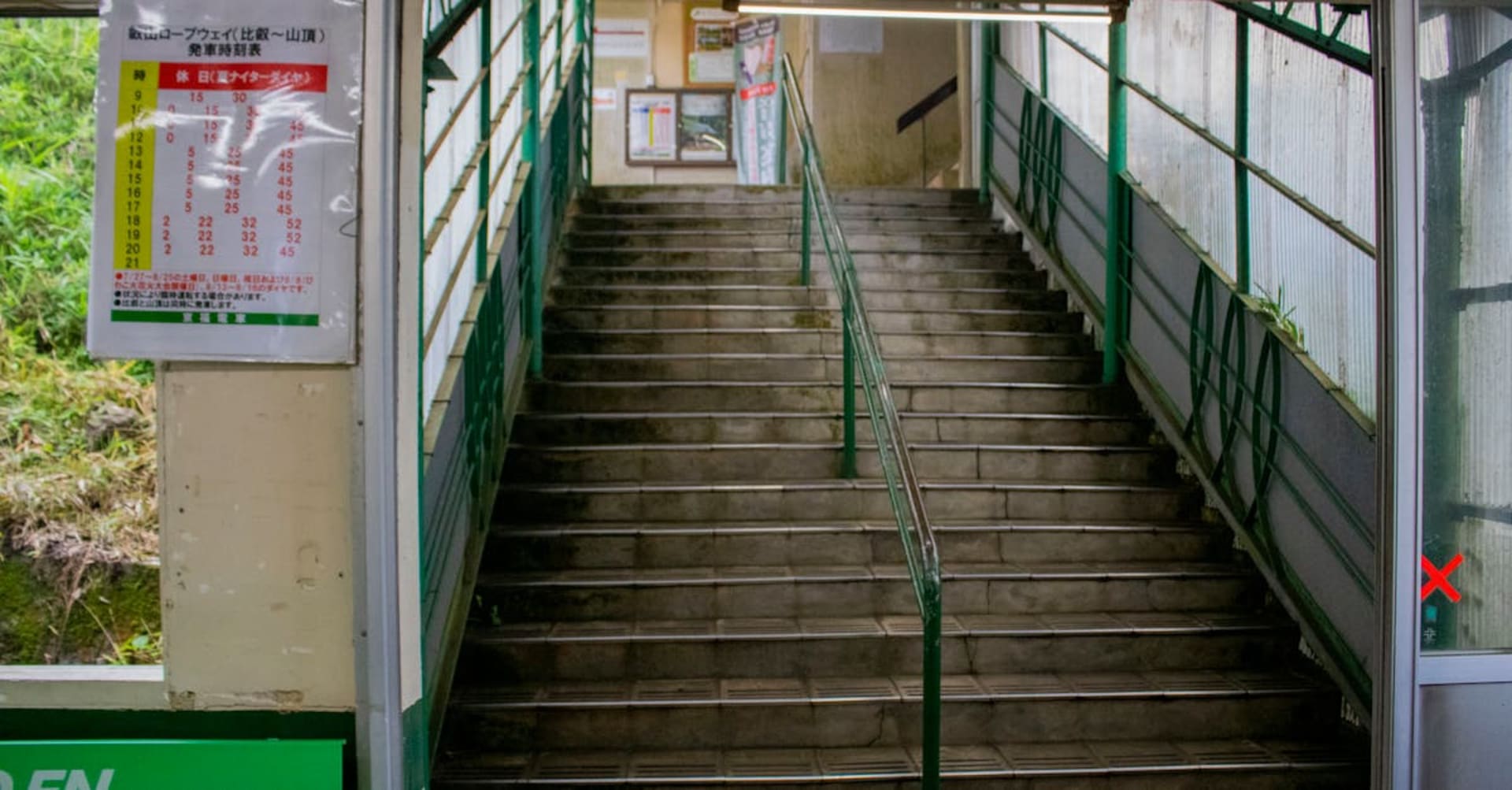
We did not walk the Kumano Kodo. I need to say this upfront, because what follows is an account of a place that rewarded us even though we only scratched its surface, and I want to be honest about the scratching. Lia and I took a day trip from Osaka into the Kii Peninsula — a bus to Hongu, a few hours of walking, and a night at an onsen town — and it was enough to understand that this place deserves a week, that I will come back, and that the Kii Peninsula contains something increasingly rare in Japan: genuine wilderness where the forest has been walking its own path for centuries and does not care whether you follow.
The peninsula hangs south of Osaka and Kyoto into the Pacific, and its interior is mountainous, densely forested with centuries-old cedar and cypress, and crossed by the Kumano Kodo — a network of pilgrimage trails that have been walked for over a thousand years. This is one of only two pilgrimage routes in the world designated as a UNESCO World Heritage Site (the other is the Camino de Santiago in Spain). The comparison is apt: both are ancient, both are walked for spiritual and physical reasons, and both reward the traveller who approaches them on foot and without hurry.
The Nakahechi Route — Walking Through Green Cathedrals
The Nakahechi route is the most accessible — a series of day hikes between mountain villages, each with accommodation ranging from rustic pilgrim lodges to ryokans with private onsen. We walked a section of the stretch from Takahara to Hongu, and even the few hours we managed were enough to understand why people devote days to this trail. The path climbs through cedar forest so dense the light arrives green and filtered, the trunks rising like columns in a cathedral that no one designed but everyone recognises. The air smells of wet earth and resin. The silence is not the absence of sound but the presence of something older than sound — the forest breathing, the streams running beneath the moss, the centuries of footsteps that have worn the stone smooth.
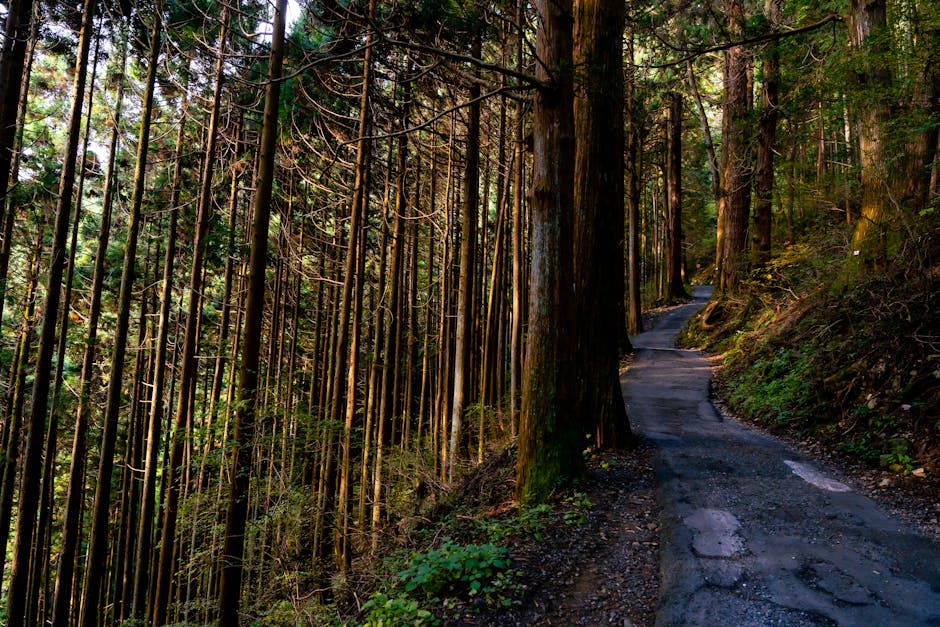
We stopped at a small teahouse along the trail — a wooden building staffed by an elderly couple who served us matcha and rice cakes made that morning. The man had been running the teahouse for forty years. His wife brought the tea on a tray with the deliberateness of someone performing a ceremony she has performed ten thousand times without it losing its meaning. We sat on the engawa — the wooden veranda — and looked out at the forest and drank our tea and ate the mochi and I thought about how the Kumano Kodo is not a hike. It is a pilgrimage, even for people who did not come here for spiritual reasons. The trail does something to you. It slows you down until the slowness becomes the point.
Kumano Hongu Taisha — The Convergence
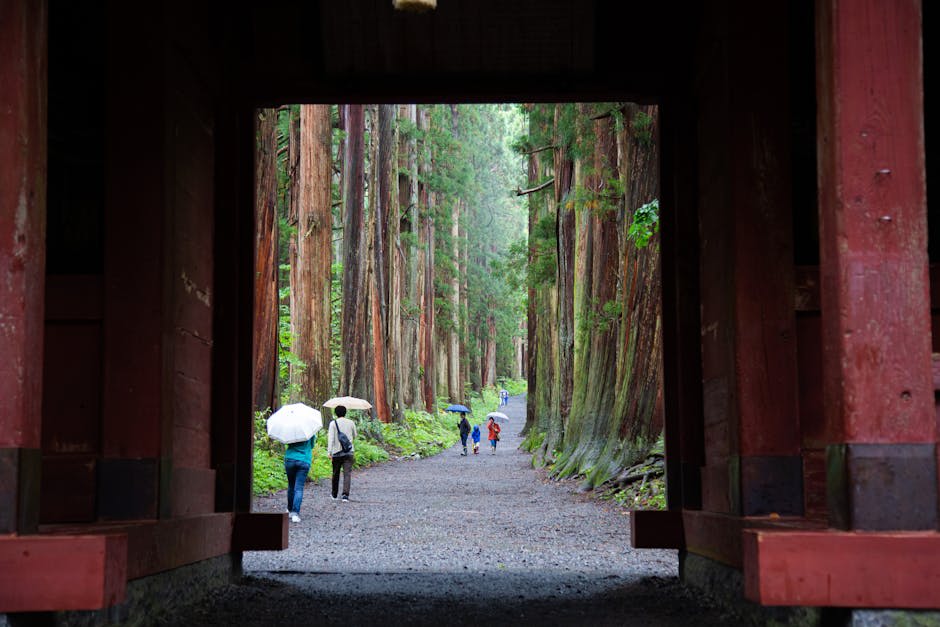
Kumano Hongu Taisha, one of the three grand shrines of the Kumano region, sits at the convergence of the trails. The approach is through forest, up stone steps flanked by cryptomeria, and the shrine appears gradually — first the roof, then the cypress-bark walls, then the courtyard with its gravel raked in patterns that suggest water without containing any. The original site — Oyunohara — was washed away by floods in 1889, and the torii gate that marks it is the largest in Japan, rising from a gravel riverbed surrounded by forest. We walked to Oyunohara in the late afternoon, and the scale of the gate — thirty-three metres tall, black steel against green trees — produced a silence in both of us that lasted several minutes. Arriving here on foot, after even a few hours of walking, carries a weight that arriving by car cannot replicate. Arriving after days on the trail must be transcendent.
The Onsen Towns — Where the Walk Ends and the Water Begins
The onsen towns — Yunomine, Kawayu, and Wataze — offer the best hot-spring bathing in the region, and after even a half-day of hiking, the water felt like a reward the mountains had been saving for us. We stayed in Yunomine, the oldest onsen in Japan — discovered 1,800 years ago — and bathed in Tsuboyu, a tiny UNESCO-listed bathing hut that you reserve for thirty-minute slots. The hut is barely large enough for two people. The water is naturally heated, slightly milky, and maintained at a temperature that hovers between comfort and spiritual revelation. I sat in the tub with the wooden walls around me and the steam rising and the sound of the Yunomine River outside the window, and I understood, viscerally, why the pilgrims who walked the Kumano Kodo for weeks considered this water sacred. It is not holy. It is better than holy. It is the exact thing your body needs after the exact thing you have done, and the alignment between effort and reward is so precise it feels intentional.
Kawayu has a river where hot spring water mixes with the river current — in winter, the locals dig a pool in the gravel and bathe outdoors, the steam rising into cold air, the mountains dark above. We did not make it to Kawayu. Next time.
What I Left Behind
The Kii Peninsula is the Japan that existed long before the tourists arrived — before the shinkansen, before the neon, before the conveyor-belt sushi and the robot restaurants and the things that make Japan feel like a science-fiction novel written by someone who also loves tradition. The peninsula is the tradition itself, unmediated, still functioning, still walked by people who believe that the act of walking to a shrine is as important as the act of praying at one. I believe them. The few hours we spent on the trail taught me more about Japan’s spiritual core than any temple in Kyoto, and the onsen at the end taught me that the body has its own form of prayer, and it involves very hot water and complete silence.
When to go: October to November for autumn colour and comfortable walking temperatures. April for cherry blossoms along the trails. Avoid July and August — the heat and humidity make hiking genuinely unpleasant. We went in late September and the weather was warm but manageable, the forest was green and dense, and the onsen water was exactly the right temperature for a body that had been climbing stone steps all afternoon.