
Kamikōchi
"The water was so clear it looked like the riverbed was floating in air. Lia knelt to touch it and pulled her hand back gasping — snowmelt, in July."
A pristine highland valley in the Northern Japan Alps where the clear Azusa river runs beneath the Hotaka peaks. No private cars, boardwalk trails through wetland and larch, and an alpine stillness that closes with the snow each winter.
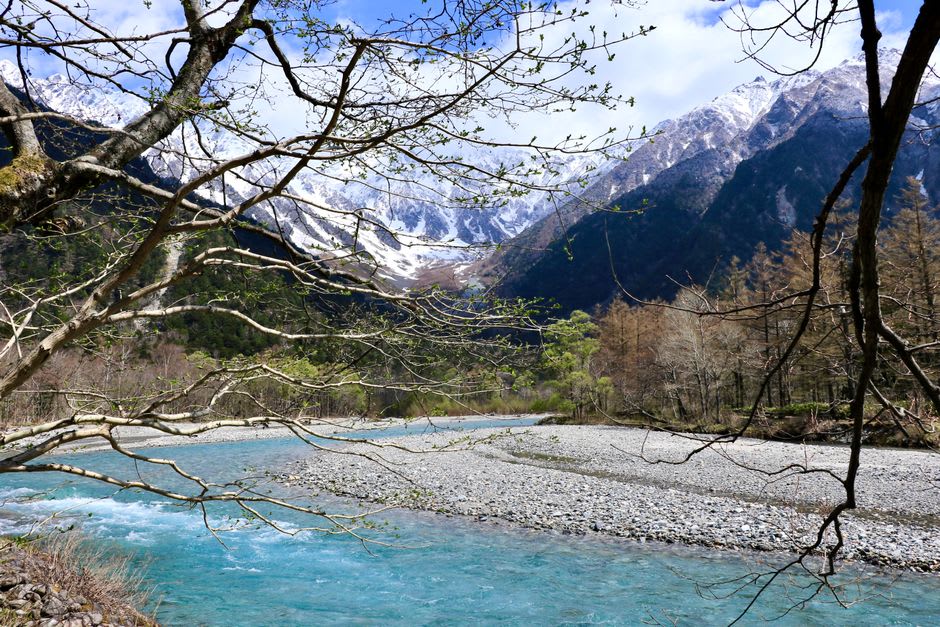
You cannot drive into Kamikōchi, and that single fact changes everything about it. Private cars are banned; you leave yours in a valley car park far below and come up the last stretch by bus through a long dark tunnel, and when you step out at the other end the noise of engines is simply gone. Lia and I arrived on a bright July morning, the air sharp and thin with altitude, and walked out onto the Kappa-bashi bridge to find the Azusa river running beneath us so clear it seemed to hold no water at all — just a floating bed of pale stones — and the Hotaka peaks standing over the whole valley, still streaked with snow. Neither of us said anything for a while. There wasn’t much to add.
The river and the bridge
Kappa-bashi is the heart of Kamikōchi, a wooden suspension bridge that swings gently over the Azusa, and it’s the point every walk in the valley seems to begin and end at. The river here is glacial and astonishingly clear, fed by snowmelt off the peaks, so cold that touching it hurts within seconds — Lia tried, and yelped, and we both laughed. From the middle of the bridge the view runs straight up the valley to the Hotaka range and, off to one side, the perfect volcanic cone of Yakedake, which still faintly steams. The light in the mornings is extraordinary, the peaks catching gold while the valley floor is still in blue shadow, and the water beneath goes from black to turquoise as the sun reaches it.
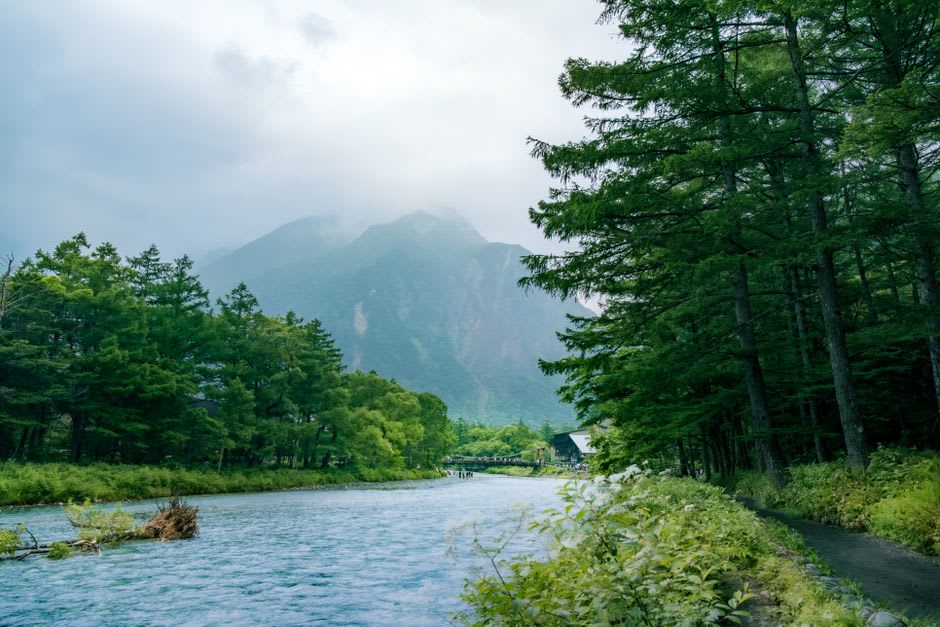
The valley is at around fifteen hundred metres, and you feel it — the air is cool even in high summer, the light hard and clean, the whole place carrying that particular alpine clarity that makes distances impossible to judge. It’s the most un-Japanese landscape I saw in Japan, and one of the most beautiful.
Boardwalks and still ponds
You don’t come to Kamikōchi to summit anything, unless you’re a serious mountaineer bound for the high Hotaka huts. The pleasure of it, for the rest of us, is the network of level trails and boardwalks that run along both banks of the Azusa, threading through wetland, birch and larch. Lia and I walked upstream to Myōjin, an easy hour or so through forest loud with birdsong, to a small shrine beside the mirror-still Myōjin Pond, its surface so calm it doubled the mountains perfectly. Downstream the other way lies Taishō Pond, formed when Yakedake erupted and dammed the river a century ago, its shallows full of the bleached skeletons of drowned trees standing up out of the water like something from a dream.
We saw monkeys — a troop of Japanese macaques picking through the grass beside the path, entirely indifferent to us — and the tracks, though we never saw the animal, of the region’s famous serow. Signs everywhere reminded us to take our rubbish out, to leave nothing, to stay on the boards. The valley is protected fiercely, and it shows in how untouched it feels.
An alpine season
The thing to understand about Kamikōchi is that it lives and dies by the seasons. The road up opens in mid-April and closes again in mid-November, and through the deep winter the valley is sealed off entirely, silent under snow, reachable only by those willing to ski or snowshoe in. We came in summer, when the meadows were green and the rivers full; autumn, they say, is the great season, when the larch turns and the peaks get their first snow and the whole valley blazes gold and white together. We stayed a night at one of the handful of lodges, ate a quiet dinner of river fish and mountain vegetables, and stepped outside after dark to a cold so clean and a sky so thick with stars that I stood out in it far longer than was sensible.
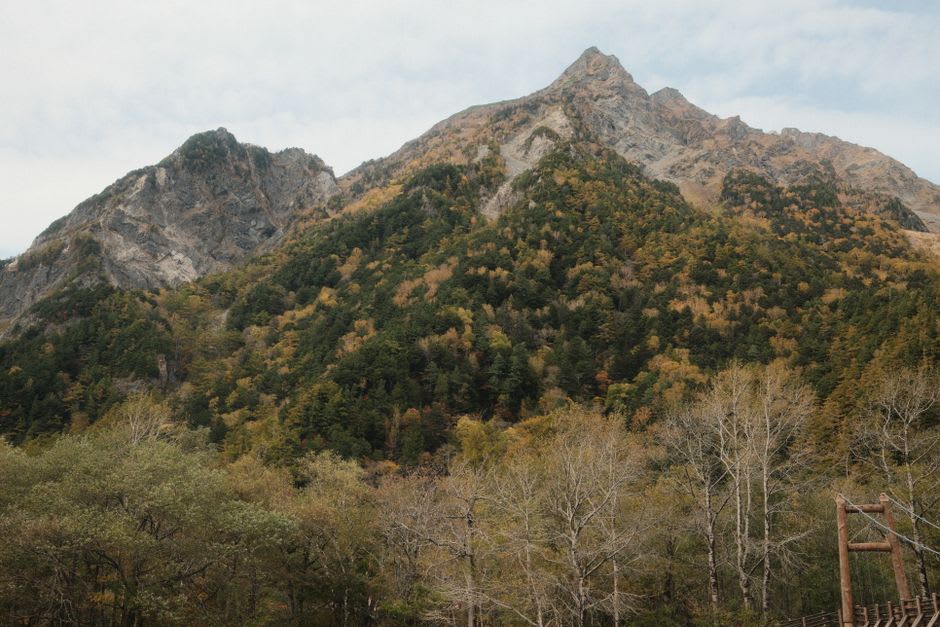
In the morning the mist lay along the river and burned off slowly as the sun climbed, and we walked the boardwalk one last time before catching the bus back down through the tunnel, out of the quiet and into the noise of the ordinary world.
Getting There
Kamikōchi is in Nagano prefecture, in the Northern Japan Alps, and reaching it takes deliberate effort — which is part of its protection. From Matsumoto, take the private railway to Shinshimashima and then a bus up the valley, or drive as far as the Sawando car park and change to the shuttle bus, since private cars go no further. The valley is open only from mid-April to mid-November; check the dates before you plan, as it closes completely for winter. Come in early summer for green meadows and full rivers, or late October for the larch turning gold beneath fresh snow on the peaks.
Keep exploring
More of Chūbu