Gokayama
"There was no coach park, no crowd, no queue — just a handful of thatched houses, a river, and an old woman raking her garden who nodded at us as we passed."
A remote mountain valley in Toyama and the quieter UNESCO sibling of Shirakawa-gō. Steep-thatched gasshō-zukuri farmhouses cluster along a river gorge, where washi paper is still made by hand and old folk songs are sung in the winter dark.
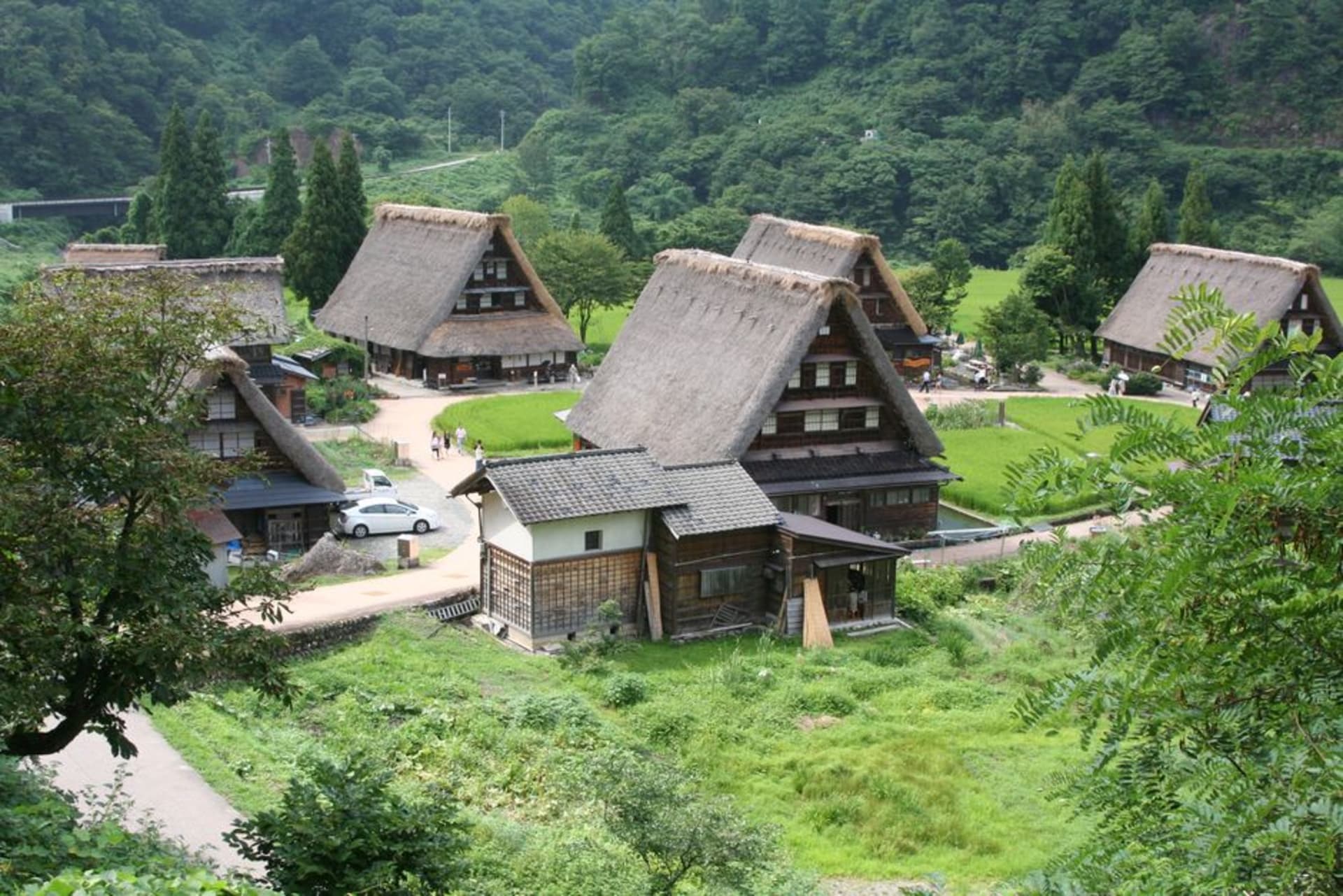
Everyone goes to Shirakawa-gō, and I understand why, but if you drive twenty minutes further up the gorge you come to Gokayama, and Gokayama is the one that stayed with me. Lia and I arrived in the late afternoon, having half-expected another crush of coaches, and found instead near-silence — a scatter of steep-roofed farmhouses along a fold of the Shō river, wood smoke somewhere, a dog barking twice and then stopping, and the mountains standing so close on every side that the light was already draining out of the valley though the sky above was still bright. The two hamlets that make up the site, Ainokura and Suganuma, share the UNESCO listing with their famous neighbour, but almost none of the crowd. We had them, that evening, very nearly to ourselves.
Ainokura and its steep roofs
The gasshō-zukuri houses are the whole point, and they are extraordinary. The name means “hands in prayer,” for the roofs are pitched at that sharp angle so the heavy winter snow slides off rather than crushing them, and they are thatched a metre thick with no nails in the frame, whole beams lashed with rope so the great structure can flex. Ainokura, the upper hamlet, holds a couple of dozen of them terraced up a hillside among small paddies, and Lia and I walked its single lane slowly, in and out of the smell of woodsmoke and cut grass. From a viewpoint on the slope above, the whole hamlet lay below us, roofs like a fleet of grey hulls run aground among the green, and I understood suddenly how these places had survived — too far up, too hard to reach, too poor to be worth changing.
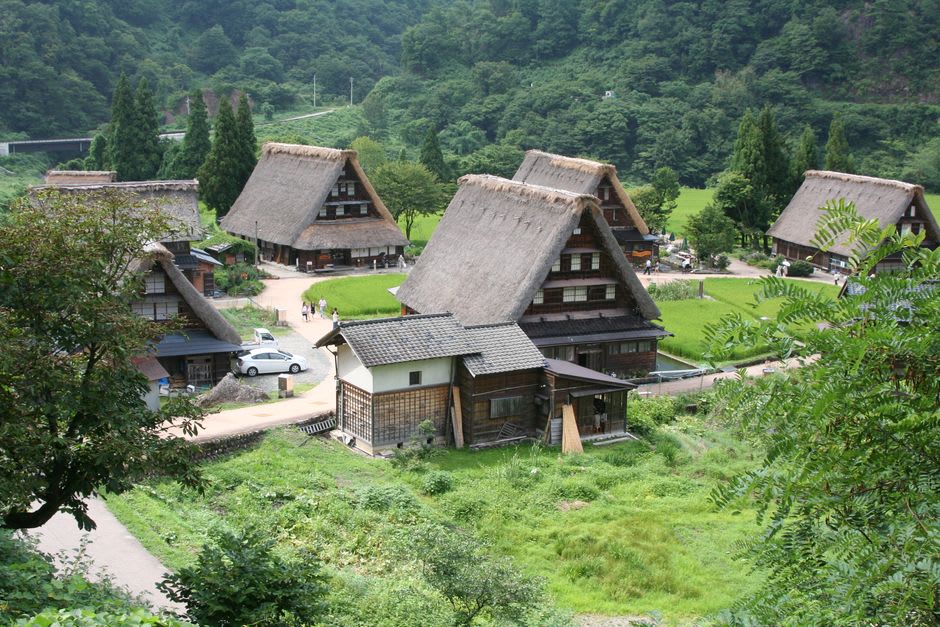
Some of the houses are museums now, some guesthouses, but many are simply lived in, and that is the difference from Shirakawa-gō — Gokayama is still a place where people are getting on with their lives rather than performing them.
Washi paper and folk song
The isolation that preserved the houses also preserved crafts that vanished elsewhere. Gokayama has made washi, handmade mulberry-fibre paper, for centuries, and at a small workshop in the valley Lia and I watched a maker dip a bamboo screen into a vat of pale slurry and shake it just so, back and forth, until a sheet formed as if from nothing. We each made one, badly, and were given them to keep, still damp, pressed between boards. The valley is famous too for its folk songs — the haunting Kokiriko, said to be among the oldest in Japan, danced with a clattering instrument of little wooden slats — and though we did not catch a performance, the old man at the paper workshop hummed a few bars of it for us, unprompted, and it raised the hair on my arms.
We stayed the night in one of the farmhouses, sleeping on futons under that great dark canopy of roof, and ate a dinner of river fish and mountain vegetables around an irori hearth sunk into the floor, the smoke curling up to cure the thatch above just as it has for three hundred years.
A valley through the seasons
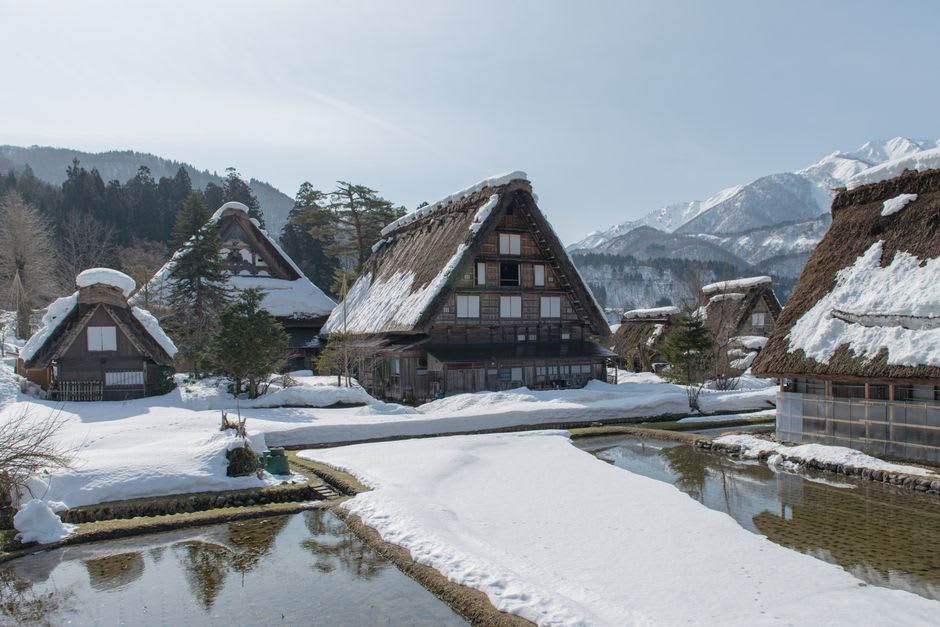
Gokayama changes hard with the year. We came in early summer, when the paddies were flooded and mirror-bright and the whole valley was a hundred shades of green; autumn brings the maples down the mountainsides in red and gold; but it is winter the place is truly built for, when metres of snow bury the valley and the steep roofs finally earn their pitch, and on certain evenings the hamlets are lit up and the black thatched shapes glow against the white. The buses thin out, the gorge closes in, and I imagine — we did not see it — that it feels then very much as it must have for centuries, cut off and self-sufficient and quietly alight in the dark.
Getting There
Gokayama lies in the mountains of southern Toyama prefecture, up the Shō river gorge from its better-known neighbour. The simplest approach is by bus: the World Heritage buses connect Takaoka and Shin-Takaoka stations with the hamlets of Ainokura and Suganuma, and other services run up from Shirakawa-gō and Kanazawa. A car makes the valley easier still. Come in summer for the flooded green paddies, in autumn for the maples, or in the snowbound winter for the lit-up hamlets — but check the timing of the seasonal illuminations, as they fall on only a few evenings.
Keep exploring
More of Chūbu