Verona
"Verona earned its reputation as the city of love long before Shakespeare arrived to confirm it."
Shakespeare's city of love has a Roman amphitheater where operas still echo in summer, and medieval streets that rival Florence for beauty.
Verona earned its reputation as the city of love long before Shakespeare arrived to confirm it.
I came expecting Juliet’s balcony and left thinking about the light — that particular amber that settles into the stone of Piazza Bra around six in the evening, when the Arena di Verona shifts from monument to furnace. Two thousand years of sun have soaked into those Roman arches and they give it back slowly, reluctantly, the way a place holds warmth after the people have gone.
The Arena and the Adige
The Arena is the center of gravity. You can’t walk the old city without orbiting it eventually. At night in July, when the opera season runs, the ancient stones fill with voices — Verdi, Puccini — and the sound travels across the Adige river toward the hills. Lia and I caught a rehearsal afternoon by accident, stumbling through the wrong gate, and stood in the empty tiers listening to a soprano test the acoustics alone. No audience, no set, just the circle of Roman stone and her voice climbing to nowhere. That was the surprise Verona kept for us.
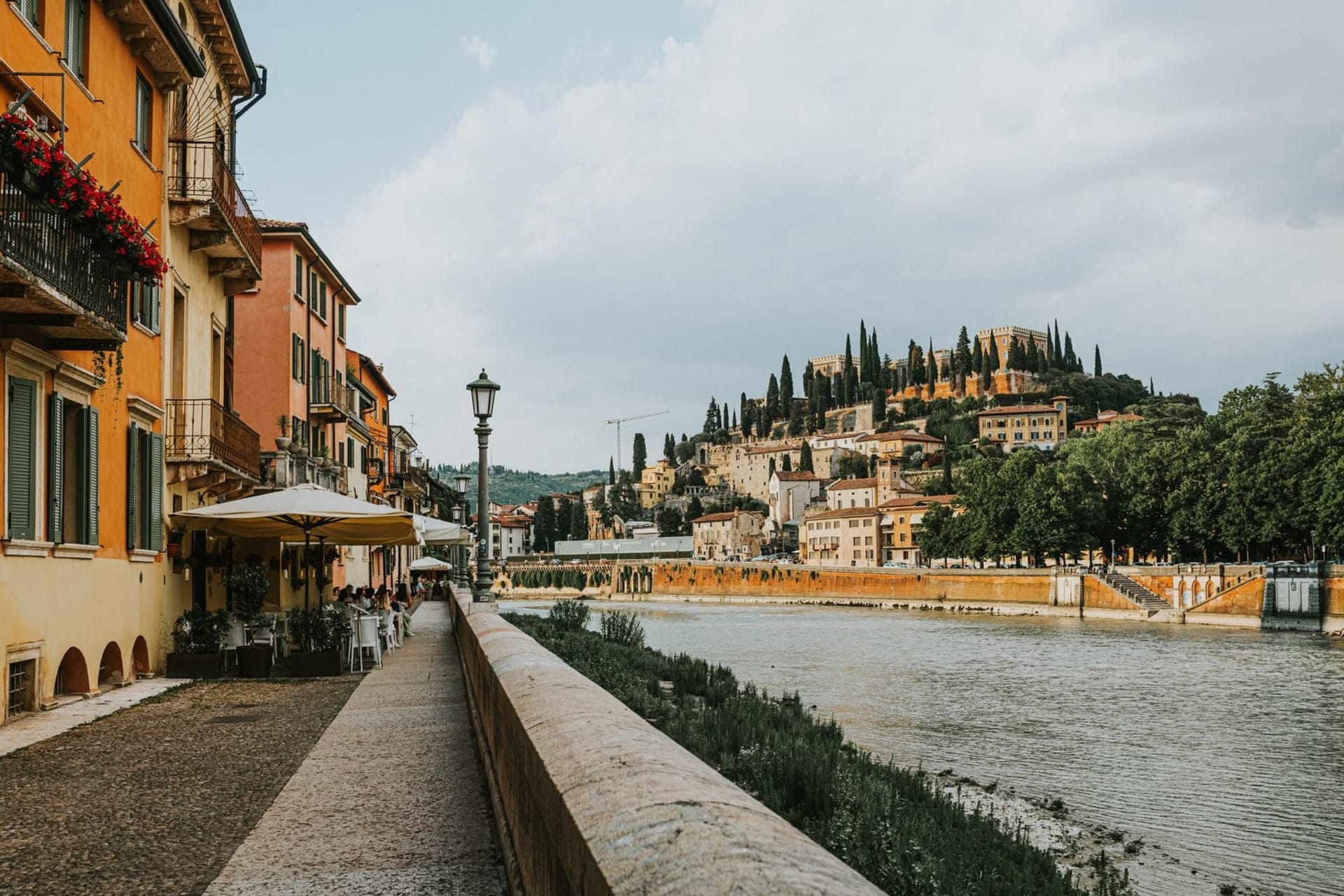
The Adige bends through the city like punctuation, and the bridges crossing it — Ponte Pietra especially, with its Roman and medieval arches mixed together after wartime reconstruction — reward the kind of slow walking that means going nowhere in particular. The north bank, past Castel San Pietro on its hill, has views that most visitors never bother with. We sat up there eating a paper cone of fried gnocchi from a truck near the stairs and watched the city arrange itself below.
Corso Sant’Anastasia and the Side Streets
Away from the Romeo-and-Juliet tourism machinery around Via Cappello, the older neighborhoods breathe more honestly. Corso Sant’Anastasia runs north from Piazza delle Erbe between palazzi that haven’t been dressed up for anyone. The church at the end — Sant’Anastasia itself — holds a fresco by Pisanello in the sacristy that stopped me cold. Saint George before the princess, a forest of hanged men in the background, the whole thing painted in 1436 with the casual authority of someone who understood that beauty and cruelty share the same room.
Lunch in Verona means risotto all’Amarone, slow-cooked in the local Valpolicella wine until it turns a deep brick red and tastes like the valley in November. The trattorie on the small streets east of Piazza delle Erbe serve it without ceremony, in ceramic bowls, with a carafe of house red that costs almost nothing.
When to go: Late April through early June hits the sweet spot — the opera season hasn’t begun yet so the piazzas breathe, temperatures stay mild, and the wisteria on the old walls along Lungadige San Giorgio is still in bloom.