
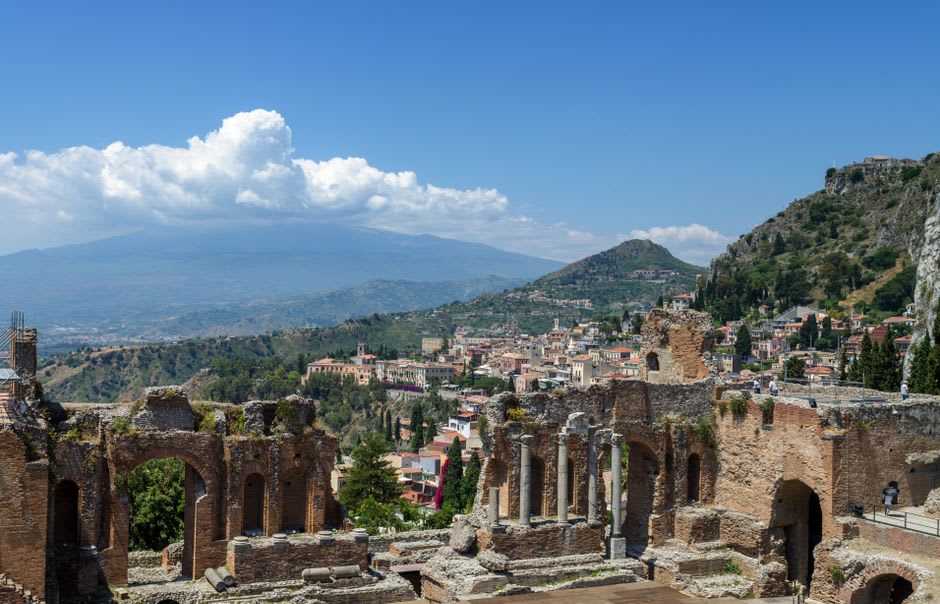
A Greek theater with Mount Etna smoking in the background — the single most absurd view I've found in Italy, and I've looked hard.
Taormina sits on a terrace of rock high above the Ionian Sea, on Sicily’s eastern coast, and it has been showing off for roughly twenty-five centuries. The Greeks founded it in the fourth century BC, the Romans expanded it, and by the nineteenth century it had become the essential stop on the Grand Tour — Goethe wrote about it, D.H. Lawrence lived here, and half of European aristocracy passed through at some point to gawk at the same view I gawked at. Some places lose their magic under that weight of reputation. Taormina, somehow, has not.
The Theater That Steals the Show
The Teatro Antico di Taormina is the reason everyone comes, and it deserves every bit of the attention. Built by the Greeks and later rebuilt by the Romans for gladiatorial games, the theater’s stone tiers curve around a stage whose backdrop is not a painted set but the real thing: the Ionian Sea below, the coastline curling south, and Mount Etna rising beyond it all, often with a thin plume of smoke drifting from the summit as if the whole scene were staged for maximum drama. I sat on the worn stone steps for the better part of an hour doing nothing but watching the light shift over the volcano, and it remains one of the only times a “view” has genuinely stopped me from talking.
Below the theater, the town itself is a tight knot of medieval streets centered on Corso Umberto, the pedestrian spine lined with Baroque churches, the fourteenth-century Palazzo Corvaja, and boutiques that have gotten expensive enough to remind you this is no secret. It gets crowded, particularly at midday when the cruise-ship crowds arrive from Messina. I learned to time my wandering for early morning, when the shutters are still half-closed and the only sound is the scrape of a broom on stone.
Isola Bella and the Coast Below
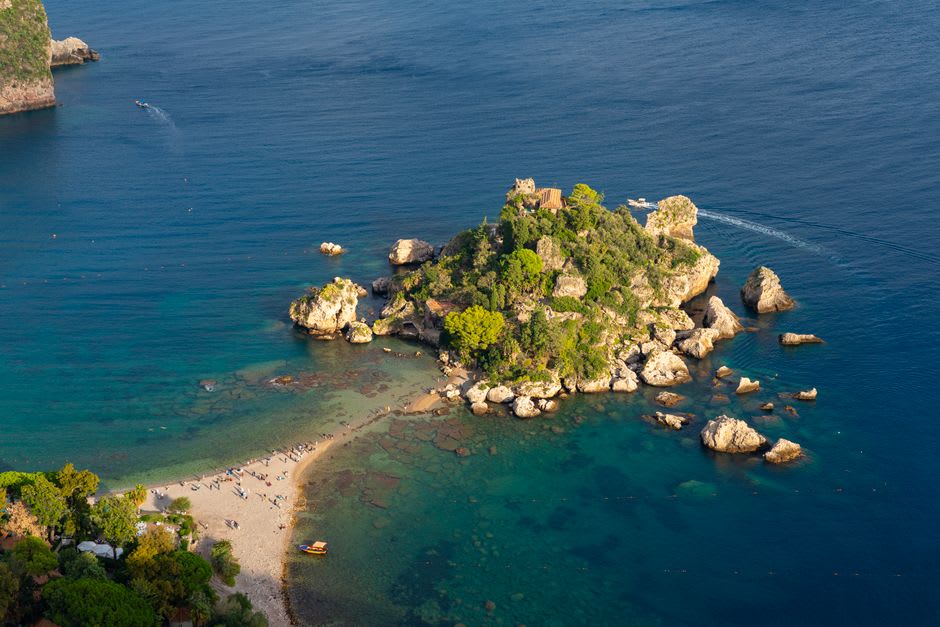
A cable car drops you from town down to Isola Bella, a small nature reserve island connected to the mainland by a slim sandbar that you can wade across when the water is calm. It’s a strange, almost aggressive contrast — one minute you’re among Roman ruins and elegant hotels, the next you’re barefoot on a pebble beach with the water doing that improbable Sicilian turquoise. I swam out past the sandbar and floated on my back looking up at the cliffs, at Taormina perched above like it had been carved there deliberately.
Etna itself is close enough to feel present at all times — a day trip up its black slopes is easy to arrange, and standing on lava fields still warm in places gives you a very different register of awe than the theater does: less romantic, more geological reminder that this whole coast exists at the pleasure of a volcano that erupts, on average, every few years.
When to go: May, June, and September offer warm sea temperatures without the full crush of August crowds, and Etna’s summit trails are most reliably open.