
Siena
"Florence perfected the Renaissance. Siena never forgave it, and never really left the Middle Ages."
A medieval rival to Florence that never surrendered its Gothic soul, built around a shell-shaped square where horses still race twice a year.
Siena has a chip on its shoulder about Florence, and once you know the history you understand why. For much of the 13th and 14th centuries, Siena was Florence’s genuine rival — richer, in some periods, and militarily its equal, having famously crushed the Florentines at the Battle of Montaperti in 1260. Then the Black Death arrived in 1348 and killed perhaps two-thirds of the population, and Siena never fully recovered its ambitions. What it kept, frozen almost perfectly in place, was its medieval city — brick-red, vertical, Gothic where Florence went classical, and in my opinion more atmospheric for it.
Everything in Siena bends toward the Piazza del Campo, one of the most extraordinary public squares in Europe: a scallop-shell-shaped bowl of pinkish brick, sloping gently down toward the town hall, ringed by cafés. I arrived in the early evening and just sat on the warm brick with a gelato, watching the whole town seemingly funnel through it — teenagers, tourists, a man practicing scales on a trumpet by the fountain. Twice a year, in July and August, this same square is packed with dirt and ten horses race around it bareback at terrifying speed in the Palio di Siena, a contest between the city’s seventeen historic contrade (neighborhoods) that dates back centuries and is taken with a seriousness that borders on religious.
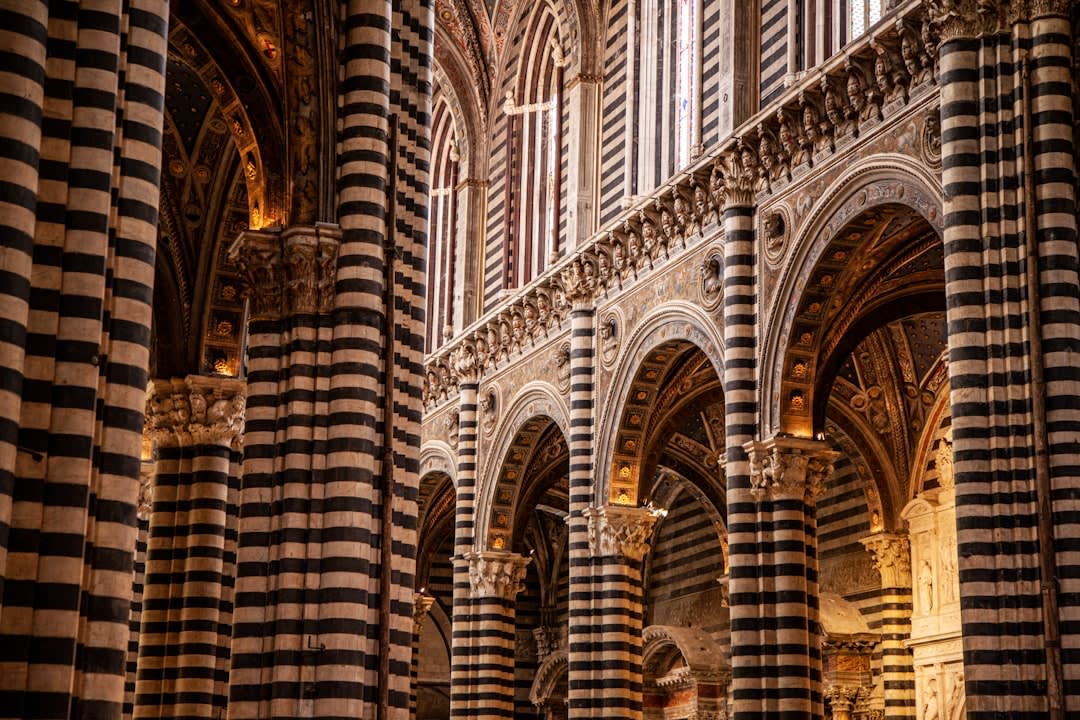
The Duomo’s Black-and-White Stripes
Siena’s cathedral is one of the great underrated buildings of Italy — a striped black-and-white marble facade, an interior floor inlaid with 56 marble panels depicting biblical and allegorical scenes (many kept covered except for a few weeks a year to preserve them), and a library, the Piccolomini Library, whose frescoed ceiling by Pinturicchio is so vividly colored it looks freshly painted rather than five centuries old. The Sienese originally intended to build an even more colossal cathedral — you can still see the abandoned skeleton of the unfinished nave extension, the Facciatone, a wall of ambition that the plague simply stopped in its tracks.
Climbing the Torre del Mangia
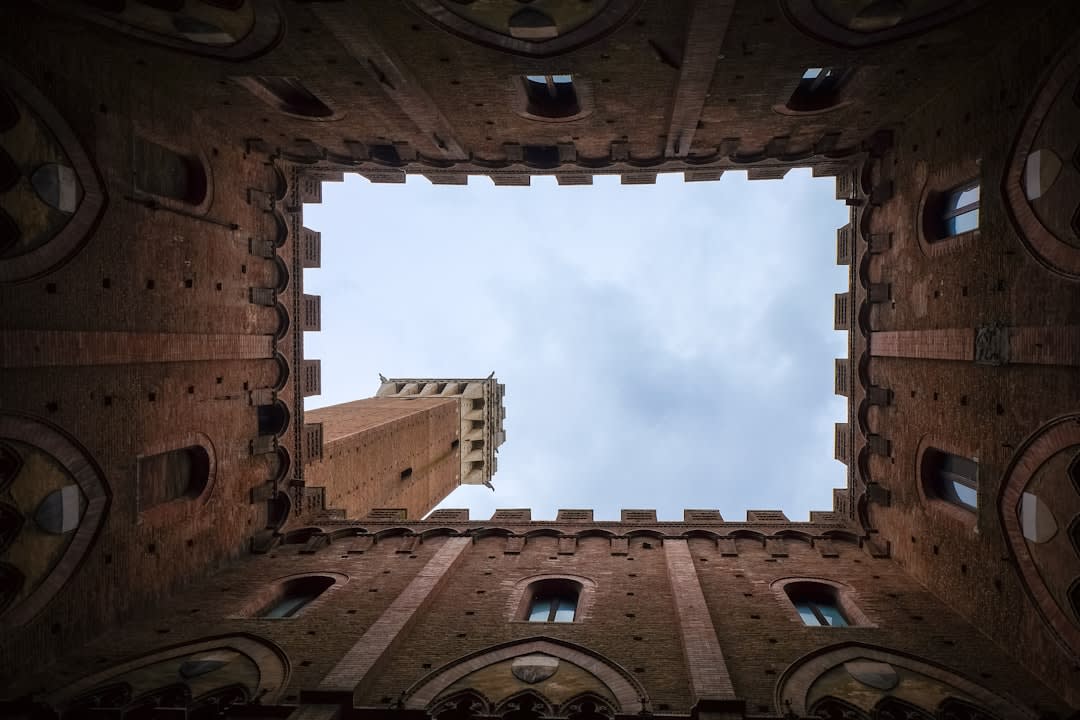
Beside the Campo rises the Torre del Mangia, a slender brick bell tower completed in 1348 — deliberately built one meter taller than Florence’s own town hall tower, because of course it was. Climbing the 400-odd narrow steps to the top left my legs shaking, but the view over the terracotta rooftops and the green Tuscan hills beyond the city walls made it worth every step. Siena’s countryside — the same hills that produce Chianti and Brunello di Montalcino not far south — rolls away from the city in a way that reminds you this is still, fundamentally, Tuscany.
When to go: Early June or late September to avoid peak crowds, or plan deliberately around July 2nd or August 16th if you want to witness the Palio — book accommodation months ahead, as the whole city fills for it.