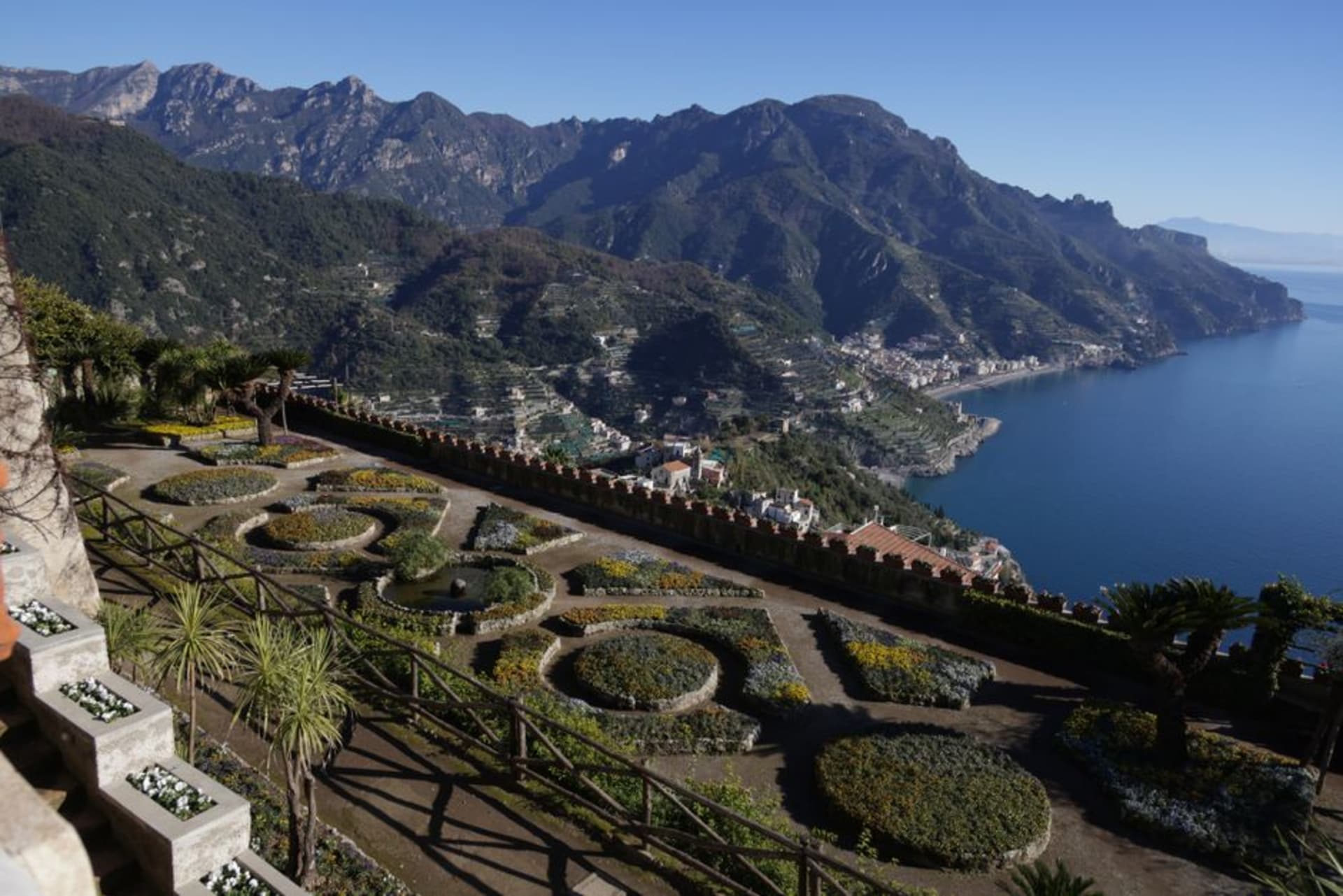
Ravello
"Wagner stood on that same terrace and said it was the garden Klingsor had dreamed of — I stood there and just said 'oh' out loud, alone, like an idiot, and meant it."
Ravello sits three hundred meters above the Amalfi coast's traffic and noise, which is precisely why composers and popes have been retreating here for a thousand years — I finally understood the appeal after one evening in the gardens.
Getting to Ravello means leaving the Amalfi coastal road entirely and switchbacking up through lemon terraces for twenty minutes until the sea traffic noise disappears and the air changes — thinner, quieter, scented with something I can only describe as stone and citrus. The town sits on a ridge above Amalfi and Atrani, and that elevation is the whole reason it exists as anything other than another fishing village: medieval nobility built their villas up here specifically to look down on the coast rather than compete with it. By the 13th century Ravello had its own bishopric and a merchant aristocracy wealthy enough to import craftsmen from Sicily and the Islamic world, which is why the town’s Moorish-influenced cloisters and mosaic pulpits look more Palermo than Naples.
Villa Rufolo and a Composer’s Discovery
Villa Rufolo, built in the 13th century by the Rufolo merchant family, has a cloister with interlaced Arab-Norman arches that Boccaccio used as a setting in the Decameron, and gardens that drop away toward the coast in terraces of cypress and flowering shrubs. Richard Wagner visited in 1880 while composing Parsifal and declared the garden to be, unprompted, the very image of Klingsor’s magic garden from his opera — the moment is commemorated now with the Ravello Festival, which stages a symphony orchestra on a cliffside platform overlooking the sea every summer, quite possibly the most theatrically located concert venue I’ve ever stood in. I wasn’t there for a performance, but the empty platform alone, jutting out over three hundred meters of open air with the coastline curling away in both directions, justified the climb up from Amalfi on its own.

The Terrace of Infinity
A ten-minute walk across town, Villa Cimbrone one-ups even Rufolo. The villa itself was substantially rebuilt in the early 1900s by an English aristocrat, Lord Grimthorpe, who assembled it from genuine medieval fragments and invented antiquity in equal measure — an eccentric, romantic project that somehow produced something more moving than a purely authentic building might have. Its gardens culminate at the Terrazza dell’Infinito, the Terrace of Infinity, a long balustrade lined with marble busts where the ground simply stops and the Tyrrhenian Sea takes over, no railing tall enough to interrupt the sense that you could keep walking straight into open sky. Greta Garbo reportedly hid out here with conductor Leopold Stokowski in the 1930s to escape the press, and standing at that balustrade at sunset, watching the light go orange over Salerno’s gulf, I understood completely why she picked this particular ledge to disappear to.

Ravello’s Duomo, dedicated to San Pantaleone, holds a vial that’s said to liquefy every July on the saint’s feast day, echoing the more famous miracle of San Gennaro in Naples — a small-town cousin of a bigger phenomenon, celebrated with no less sincerity here. I sat in the cathedral square afterward with a granita, watching the town go about an evening that felt entirely unhurried by anything happening on the coast far below.
When to go: Late spring or September for the Ravello Festival’s outdoor concerts and warm evenings without the full August crush that clogs the Amalfi road below.