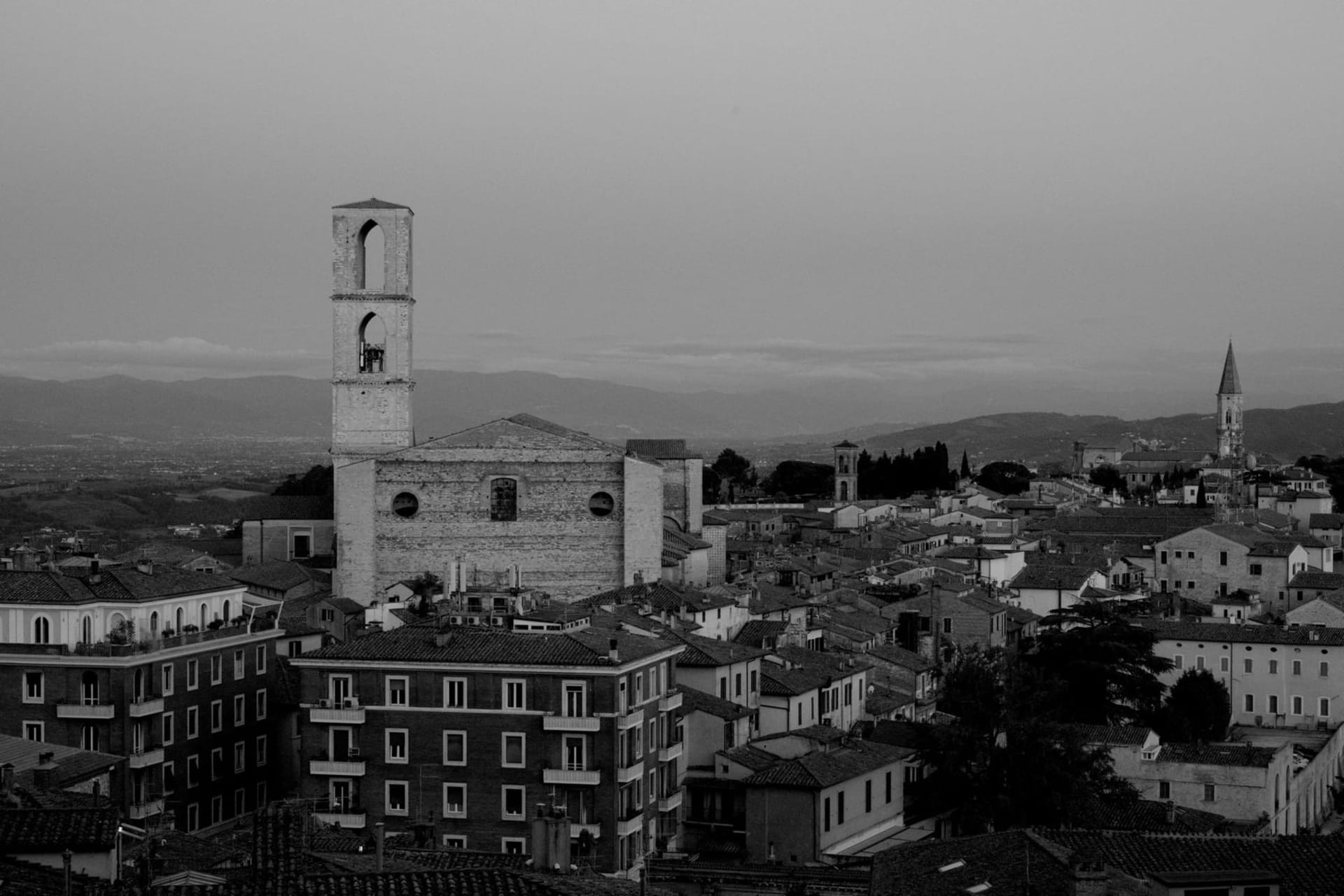
Perugia
"Perugia is an Etruscan city in an Italian skin wearing a student hat — and pulling off all three."
Umbria's hilltop capital combines Etruscan gates, a medieval aqueduct, the world's greatest chocolate festival, and a student population that keeps it electric.
I arrived in Perugia at the wrong hour, which turned out to be the right one. Late afternoon in October, the sun hitting the travertine facades of Corso Vannucci at an angle so flat and golden it felt theatrical — like a city that had rehearsed the scene. Lia stood at the edge of the street watching a group of university students argue passionately over something on a phone, and said: this doesn’t feel like a museum.
She was right. Perugia is one of those Italian hill towns that never fully surrendered to its own postcard version.
The Weight of Stone
The Arco Etrusco on Via Ulisse Rocchi stopped me cold. It is not a reconstruction or a preserved fragment behind glass — it is a gate that has been walked through continuously for twenty-three centuries. The lower courses of stone, enormous and dry-fitted, belong to the Etruscans. A Roman arch sits above them. A Renaissance loggia crowns the whole thing. Three civilizations stacked like geological strata, and students on bikes pass through it without looking up.
The Acqueduct of Perugia, repurposed as a pedestrian walkway, offers the strangest stroll in Umbria — a medieval engineering project turned promenade, threading between apartment windows and laundry lines above the lower city. From it, the view opens over a valley that has not changed its fundamental shape since before Rome existed.
Chocolate and the Piazza
Perugia is home to Eurochocolate, held each October, which transforms the centro storico into something genuinely deranged in the best possible way: sculptures carved from dark Perugina blocks, fog from nitrogen-cooled dispensers, the smell of cocoa over ancient stone. The Perugina factory itself sits just outside the city — a pilgrimage for anyone who grew up cracking open a Baci and reading the little love note inside.
But the surprise was not the chocolate. It was the Galleria Nazionale dell’Umbria, which I had expected to spend twenty minutes in and stayed for two hours. Perugino — the painter who would later teach Raphael — was born near here, and room after room holds his work, suffused with that peculiar Umbrian light: soft, holy, slightly melancholic. I stood in front of his polyptych altarpiece and felt the room go quiet around me.
Eating on the Corso
Dinner meant torta al testo — a flatbread cooked on a stone griddle, stuffed with prosciutto and stracchino — eaten standing at a counter on Via dei Priori, washed down with Sagrantino from Montefalco, which costs almost nothing in Perugia and tastes like the hills look.
When to go: October is the obvious choice — Eurochocolate runs mid-month and the light is extraordinary — but late April also works beautifully, before the tour buses arrive and while the Umbrian valleys are still green.