Montalcino
"Every road into town smells faintly of oak barrels, which is a smell I did not know I loved until I smelled it."
A fortress town that traded swords for barrels, where the whole economy runs on one grape and everyone seems fine with that.
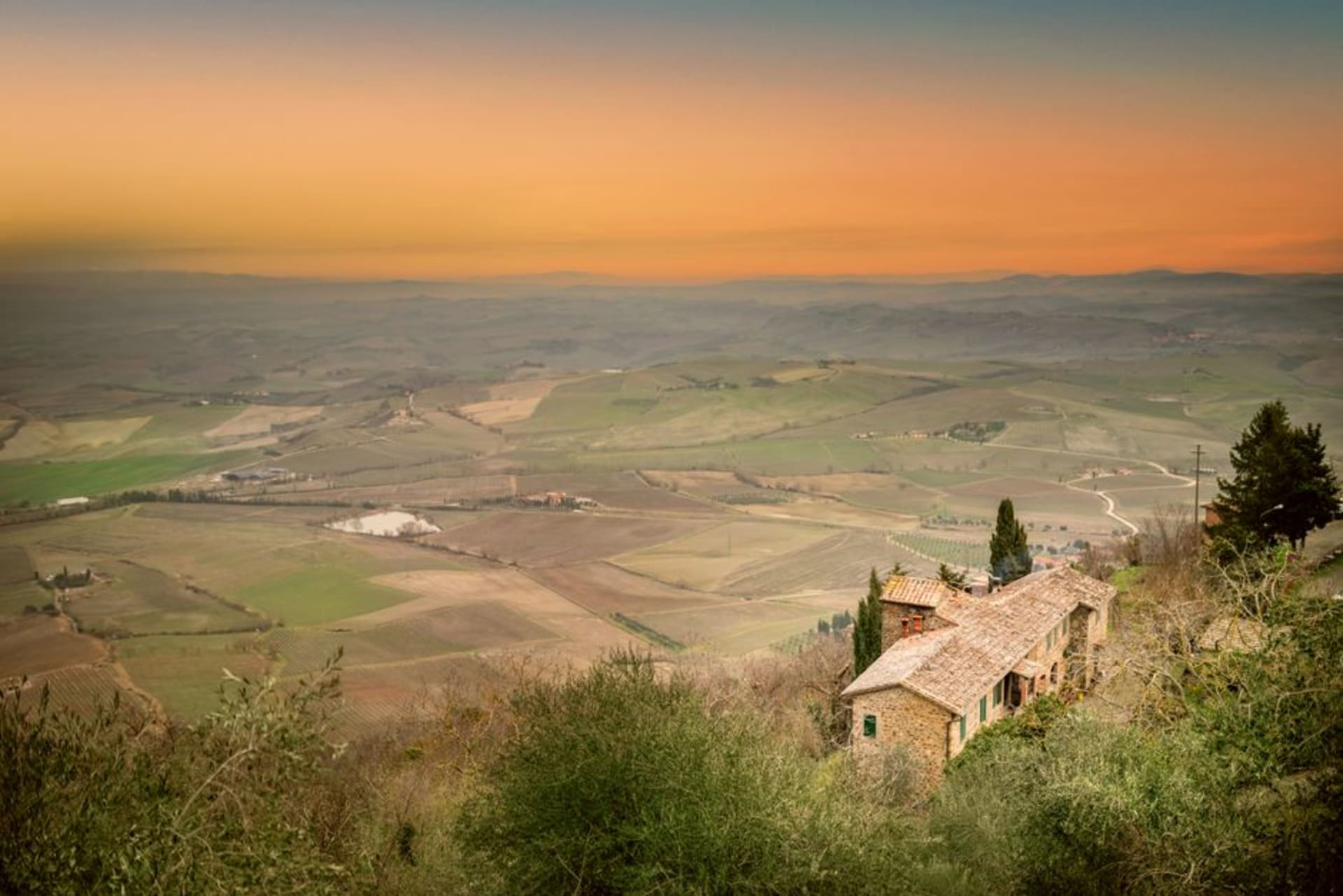
Montalcino is unapologetically a one-industry town, and that industry is Brunello di Montalcino, one of Italy’s most serious wines, made exclusively from a local clone of Sangiovese called Sangiovese Grosso. Driving up from the valley, the approach is a slow-motion advertisement for the place — terraced vineyards climbing the slopes in neat rows, the town itself perched at the top like a cork on a bottle, its skyline dominated by the crenellated silhouette of the Fortezza, a fourteenth-century fortress built by the Sienese as their last stand against Florence. Montalcino was, briefly and stubbornly, the seat of the Sienese republic-in-exile after Siena fell to Cosimo de’ Medici in 1555 — the town held out for four more years, which is the kind of detail that explains a certain defiant pride I noticed in the way locals talk about their wine versus everyone else’s.
Inside the Fortezza
You can walk the ramparts of the Fortezza for a small fee, and it is worth every cent — from the walls, the view stretches across the Val d’Orcia, one of the most photographed agricultural landscapes on earth, all cypress-lined roads and rolling wheat fields turned gold in late summer. Inside the fortress courtyard there’s an enoteca where you can taste Brunello by the glass without committing to a bottle at cellar prices, which is precisely what I did, sitting on a stone bench in the shadow of the walls with a glass of wine that had been aging in oak and then in bottle for the better part of five years before it ever reached me. Brunello’s rules are strict: minimum five years of aging before release, with at least two in oak, longer still for the Riserva. You taste that patience in the glass — it’s a wine built for waiting, not for a Tuesday.

Walking the Val d’Orcia’s Edge
Beyond the fortress, Montalcino’s streets are steep and quiet, built of the same warm travertine as the rest of the Sienese countryside, and the Palazzo dei Priori still flies the flags of the old contrade-like quarters that once organized the town’s civic and military life. I spent an afternoon just wandering out past the walls along the road toward the Abbey of Sant’Antimo, a Romanesque monastery a few kilometers south where Augustinian monks still chant Gregorian plainsong in a church built of pale travertine that seems to glow at certain hours. The abbey’s foundation legend claims Charlemagne himself established it in 781, though most of what stands today dates from the twelfth century — either way, standing inside listening to that chant echo off stone that old was one of the more unexpectedly moving hours I’ve spent in Tuscany.

When to go: Late September for harvest, when the town buzzes with activity and every trattoria is pouring the previous vintage; late October for Sagra del Tordo, a boisterous medieval-costume festival built around archery and roast thrush that has nothing to do with wine and everything to do with why I keep coming back to small Tuscan towns.