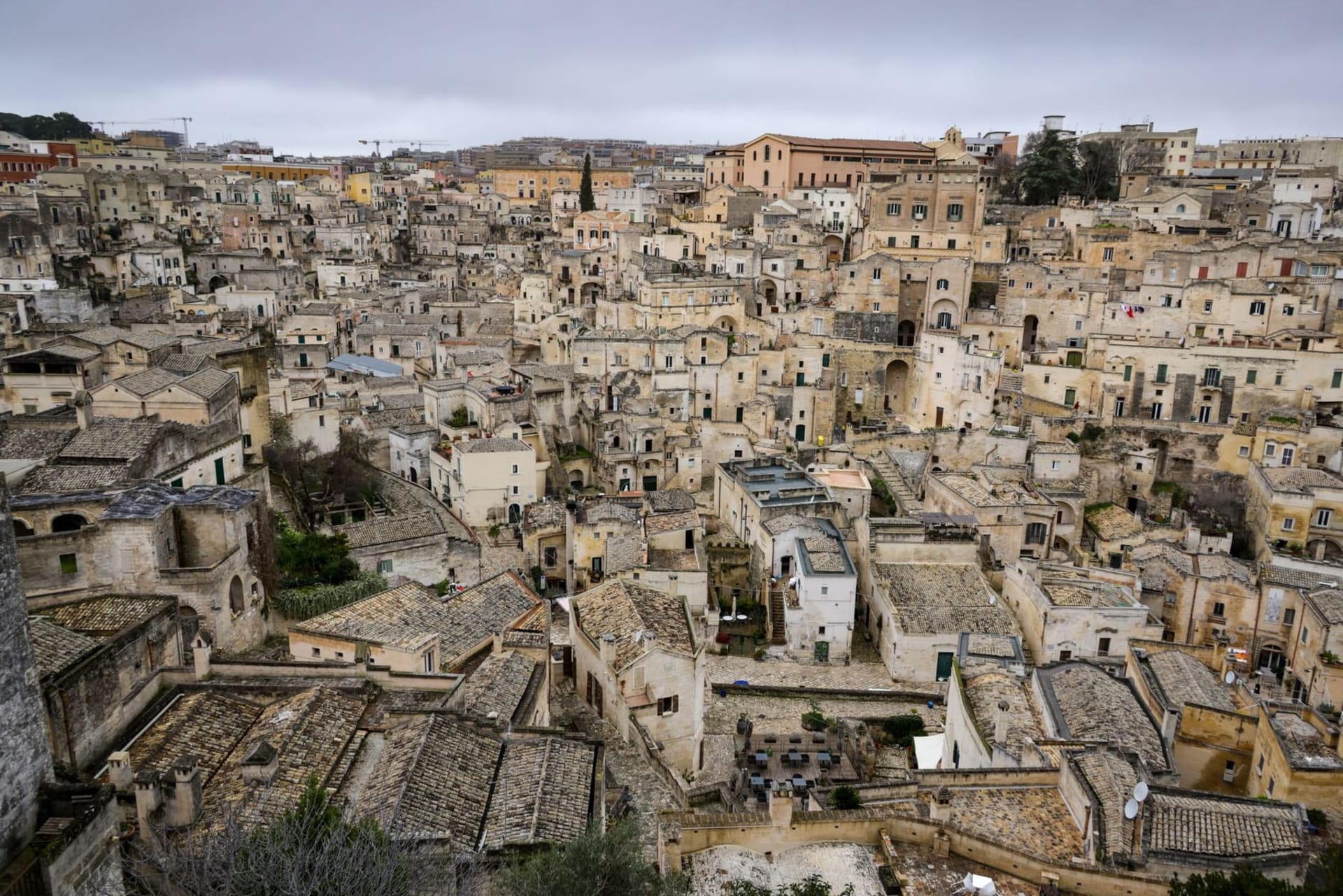
One of humanity's oldest continuously inhabited cities — cave dwellings carved into ravine walls that glitter with candlelight as a European Capital of Culture.
There are cities that announce themselves. Matera does not. It waits at the edge of a ravine — the Gravina — and then drops away beneath you, an entire civilization pressed into limestone, tier upon tier of cave doors and carved arches descending into something that should not exist and yet has existed for nine thousand years.
I stood at the belvedere above the Sasso Caveoso on our first evening and felt the particular vertigo that only arrives when time collapses. Not the comfortable historical distance of a museum. Something rawer than that.
The Stone That Breathes
The Sassi are divided into two districts — Sasso Caveoso and Sasso Barisano — separated by a ridge where the cathedral of Maria Santissima della Bruna keeps watch in Apulian Romanesque stone. Walking between them means losing yourself in a labyrinth of vicinati, the shared courtyards where cave families once lived with their livestock below and their beds above, warmth pooled between the bodies of animals and children and grandparents on the same earthen floor.
The tufa rock holds the temperature of the season before. In October, when we were there, the caves exhaled something that was half autumn, half the memory of summer. Lia pressed her palm flat against a wall in one of the restored cave houses on Via Bruno Buozzi and said it felt like the stone was breathing. I think she was right.
The smell is mineral and particular — cool dust cut with wild thyme that forces itself through the rock wherever it can, and woodsmoke from the restaurants carving their way into the same hillside their ancestors did.
An Unexpected Descent
The discovery I did not expect: there is a church underground. The Cripta del Peccato Originale, just outside the city in the Murgia plateau, is a cave chapel with Byzantine frescoes of startling, almost painful beauty — ochre and terracotta figures of archangels and a Madonna with a gravity in her painted eyes that no ceiling fresco in Florence has ever managed to land on me the same way.
We almost skipped it. We almost did not rent the car. The road is unmarked and the site is appointment-only and I am glad for every inconvenience that forced me to pay attention.
Eating Into the Stone
Dinner in Matera is inevitably in a cave. I would usually resist a cliché this deliberate, but the ristorante cut into the tufa at Baccanti on Via Sant’Angelo serves crapiata — the ancient local legume stew of chickpeas, lentils, and farro — with such plainness and confidence that it reads as a kind of argument. This food was here before argument. It will be here after.
The local bread, pane di Matera, is bronze-crusted, dense with hard wheat, and shaped like a croissant scaled up to absurdity. We ate an entire one between us at the market near Piazza Vittorio Veneto and had no regrets.
When to go: April through June offers warm light and manageable crowds before the summer peak; October is ideal — harvest season brings cooler evenings and the city’s gold-toned stone photographs best under an autumn sun.