Lucca
"Where every other Tuscan city tore down its walls for progress, Lucca planted trees on top and called it a park."
A walled city that never bothered demolishing its walls, so now you can cycle an entire ring road in the sky above the rooftops.
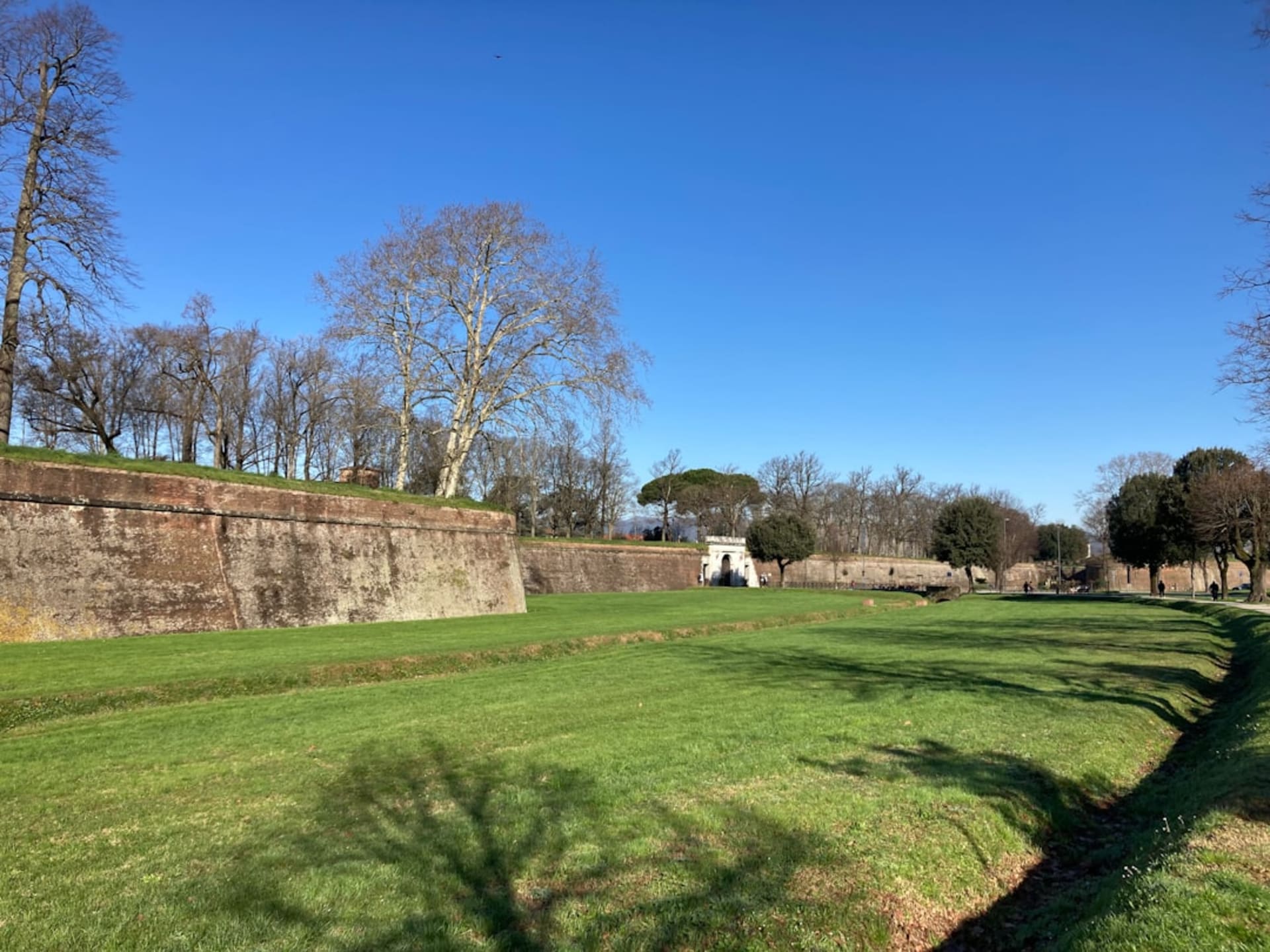
Most Italian cities eventually demolished their defensive walls — they got in the way of expansion, of traffic, of the modern city pushing outward. Lucca kept its Renaissance-era ramparts almost entirely intact, and rather than treating them as a relic, the city turned the top into a four-kilometer tree-lined promenade that locals use the way other cities use a park. I rented a bicycle my first morning and did the full loop, and it remains one of my favorite half hours in Tuscany: plane trees arching overhead, joggers and grandmothers with shopping bags sharing the same wide path, the old town dropping away on one side and the modern suburbs on the other, both equally none of your concern up there.
The walls themselves date largely from the sixteenth and seventeenth centuries, built thick and low specifically to absorb cannon fire rather than tower dramatically the way medieval walls did — which is why they survived. By the time anyone seriously proposed knocking them down in the nineteenth century, the citizens of Lucca pushed back and won, and the bastions were converted to gardens instead. It’s a small, specific act of civic stubbornness that shaped the entire character of the place: contained, unhurried, resistant to the tourist stampede that hits Florence an hour up the road.
The Amphitheater That Isn’t
Inside the walls, the strangest and best thing in Lucca is the Piazza dell’Anfiteatro — an oval square that isn’t shaped like a square at all because it’s built directly on the foundations of a Roman amphitheater. Medieval houses were constructed right into and on top of the old arena walls, so the elliptical outline survives even though the amphitheater itself vanished piece by piece over centuries, its stone quarried for churches and towers elsewhere in the city. Standing in the middle of that oval piazza, ringed by ochre and rust-colored buildings with cafe tables spilling out, you’re technically standing where gladiators once fought. Lucca is full of that kind of quiet layering — a Roman street grid still visible in the modern map, a Romanesque church (San Michele in Foro) with a facade so ornately arcaded it looks unfinished by design, its rooftop statue of the Archangel Michael visible from half the city.
Lucca is also, famously, Puccini’s hometown, and the composer’s presence lingers in small ways — a modest house-museum, a statue in a piazza, the sense that this quiet, walled town produced someone capable of writing operas as emotionally enormous as Tosca and Turandot. It felt fitting, somehow, that such outsized drama came from a place this contained and orderly.

When to go: Late spring or early autumn, when cycling the walls is comfortable and Lucca Summer Festival (July) hasn’t yet filled the piazzas with concert crowds — unless live music is exactly what you’re after, in which case July is the month.