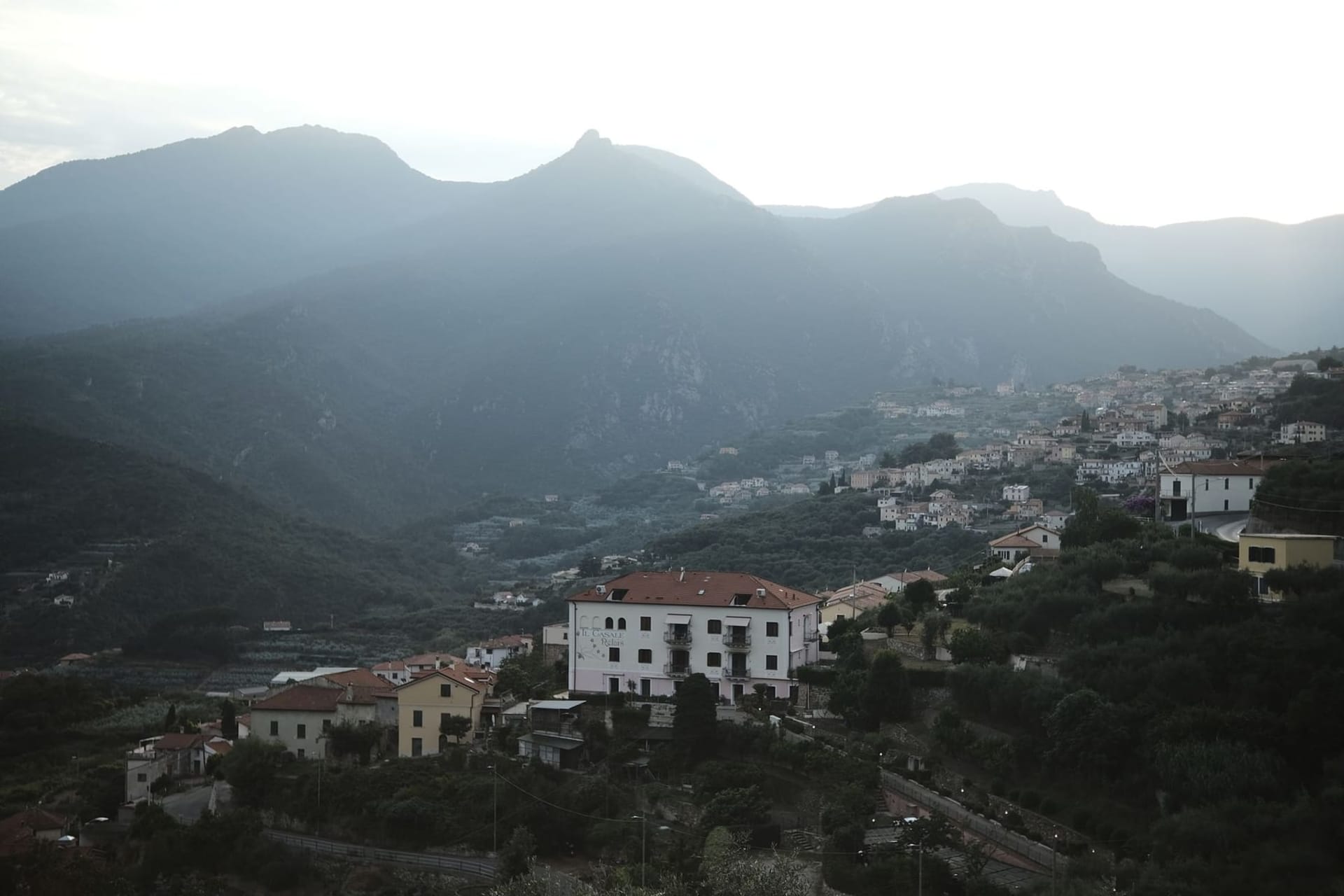
A village embedded in the Dolomiti Lucane spires of Basilicata, connected to its twin village only by a zip line.
There is a moment, somewhere on the switchbacks above Pietrapertosa, when the road gives up trying to be reasonable and the Dolomiti Lucane simply swallow you. The rock formations that rise from the valley of the Caperrino river are not gradual — they are sudden, almost aggressive, limestone needles that make you wonder how anyone ever thought to build a village up there at all. And then you round a bend and see Castelmezzano hanging off the face of one of those needles, its pale stone houses stitched into the cliff like something dreamed up rather than built.
Arriving at the Edge of the World
We came in late afternoon, Lia navigating from the passenger seat while I kept losing the road to the view. The village has fewer than eight hundred inhabitants and a single main street — Via Maggio — that threads between houses so close together the shutters nearly touch. The smell when we stepped out of the car was woodsmoke and wild thyme, undercut by something mineral and damp from the rock face above. We had a room above a small place run by a woman named Carmela, who handed us a bottle of Aglianico del Vulture without being asked and told us the kitchen closed at nine. This is the south. Things operate on their own terms.
The Norman castle at the top — what remains of it, which is mostly the idea of a castle — gives a view across to Pietrapertosa on the facing spire. The two villages are separated by a gorge and connected, absurdly and magnificently, by a zip line called Il Volo dell’Angelo. The Angel’s Flight. Lia had booked it months before I even agreed to come.
The Flight
I will not pretend I was not frightened. The harness clips in, the platform extends over nothing, and then you are released at ninety kilometers an hour between two medieval villages with the valley a hundred and twenty meters below your chest. What surprised me — genuinely, in a way I hadn’t anticipated — was the silence. At that speed I expected noise. Instead there was only wind and the strange, suspended quiet of being nowhere in particular, between two places, belonging to neither. I understood the name only when it was over.
What to Eat in the Valley
Dinner at a trattoria on Via Domenico Donatello: lagane e ceci, the thick pasta with chickpeas that is as old as the Roman road that once crossed this valley, dressed with olive oil from trees down near the coast. Then a lamb chop grilled over embers, served with a wedge of pecorino from the Agri valley that left a long, grassy finish. The bread came from a wood oven and arrived warm. We ate slowly and walked back through streets lit by a single lamp per corner.
When to go: Late May through early June, when the broom is in flower and the valley still has color before the summer heat bleaches it. September is equally good — the light turns amber earlier and the tourists have mostly gone.