Bologna
"Bologna decided long ago that knowledge and good food were not competing priorities."
La Grassa, La Rossa, La Dotta — fat, red, and learned — Italy's most intellectual and delicious city, with 40 kilometers of shaded porticos.
I arrived in Bologna on a Tuesday in October, stepping off a regional train from Florence into air that smelled of slow-cooked meat and coffee. The city introduced itself through its porticos — those long, brick-arched corridors that line nearly every street in the old center, forty kilometers of covered walkway that make the act of getting from one place to another feel vaguely ceremonial.
La Rossa
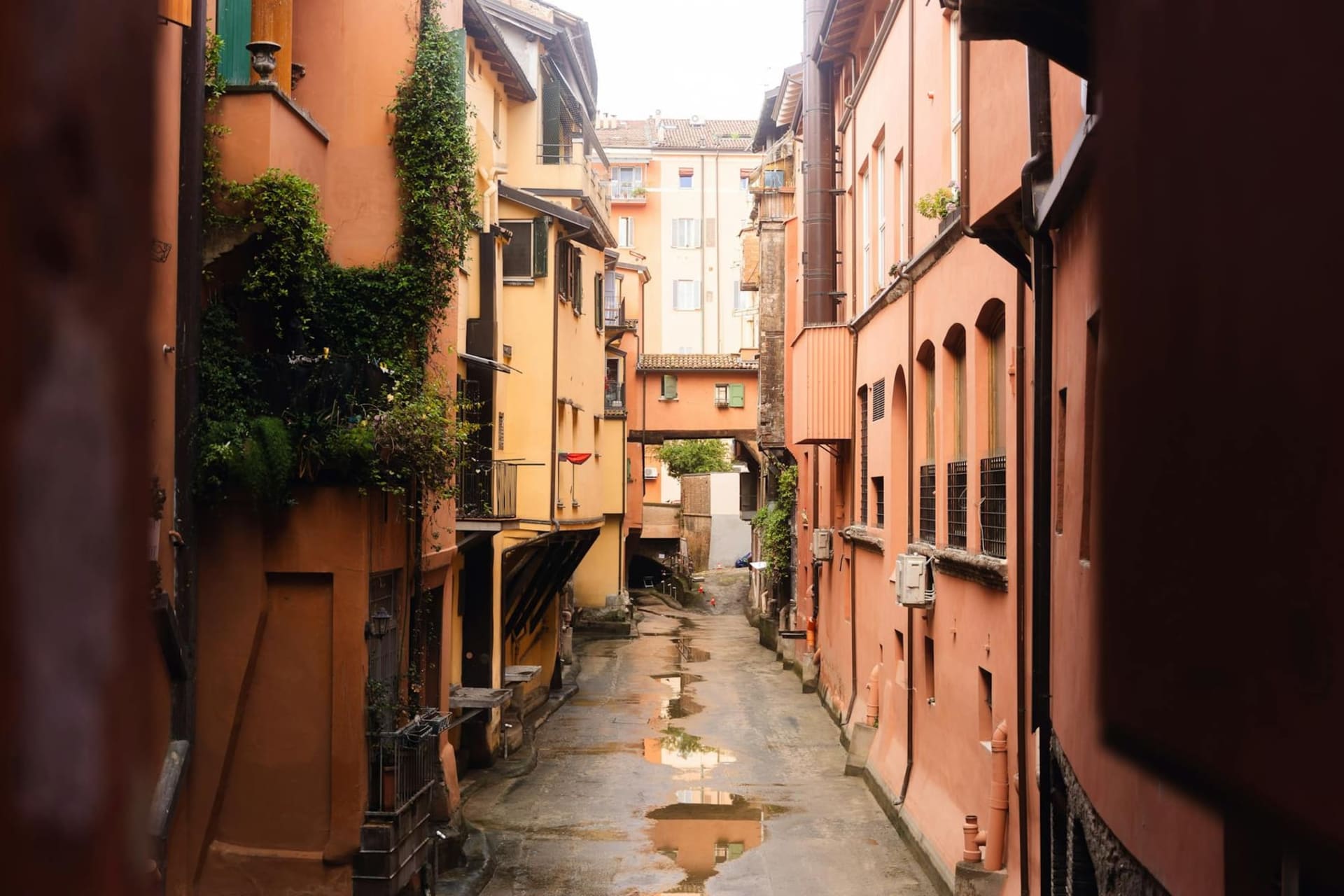
Bologna earns its name. The terracotta facades of the medieval towers and palaces cast the whole centro storico in a warm orange register, deepening to blood-red near sunset when the light falls sideways across Piazza Maggiore. The basilica of San Petronio anchors the square — unfinished, its marble facade cut off mid-wall as if the builders simply walked away one afternoon in the sixteenth century and never returned. Inside, a brass meridian line runs across the stone floor: a giant sundial commissioned in 1655, calibrated so precisely that the Inquisition apparently used it to verify the Gregorian calendar reform. I stood on it for a while and thought about the kind of city that turns a church floor into an astronomical instrument.
La Dotta
The university here is the oldest in the Western world — founded in 1088, though that date feels almost abstract until you walk past the anatomical theatre in the Archiginnasio, where marble tiers of seats surround a dissection table topped by a canopy carved with skinned human figures. Students have been arguing in the streets of the Quadrilatero market for nearly a thousand years. The market itself is something else: stalls heaped with mortadella, local cheeses, fresh pasta, cured meats in shades of rose and burgundy.
La Grassa
Lia had read that tagliatelle al ragù was invented here in 1972 by a member of the Italian Academy of Cuisine, who deposited a gold replica of the noodle — measured to exactly eight millimeters wide when cooked — with the Bologna Chamber of Commerce. I assumed this was the kind of story Italians invented to justify their habits. Then I ordered the pasta at a trattoria on Via del Pratello and understood that when something is this good, you make it official. The unexpected discovery came late that night: a bacaro tucked under the porticos near the Mercato di Mezzo, where a man in his seventies was serving mortadella on torn focaccia for two euros a piece and arguing with a student about Roman history. We stayed for an hour. The student lost.
When to go: April through June for mild weather and the outdoor market season in full swing. September and October bring the grape harvest from the surrounding Emilia-Romagna hills and cooler light that makes the red city glow.