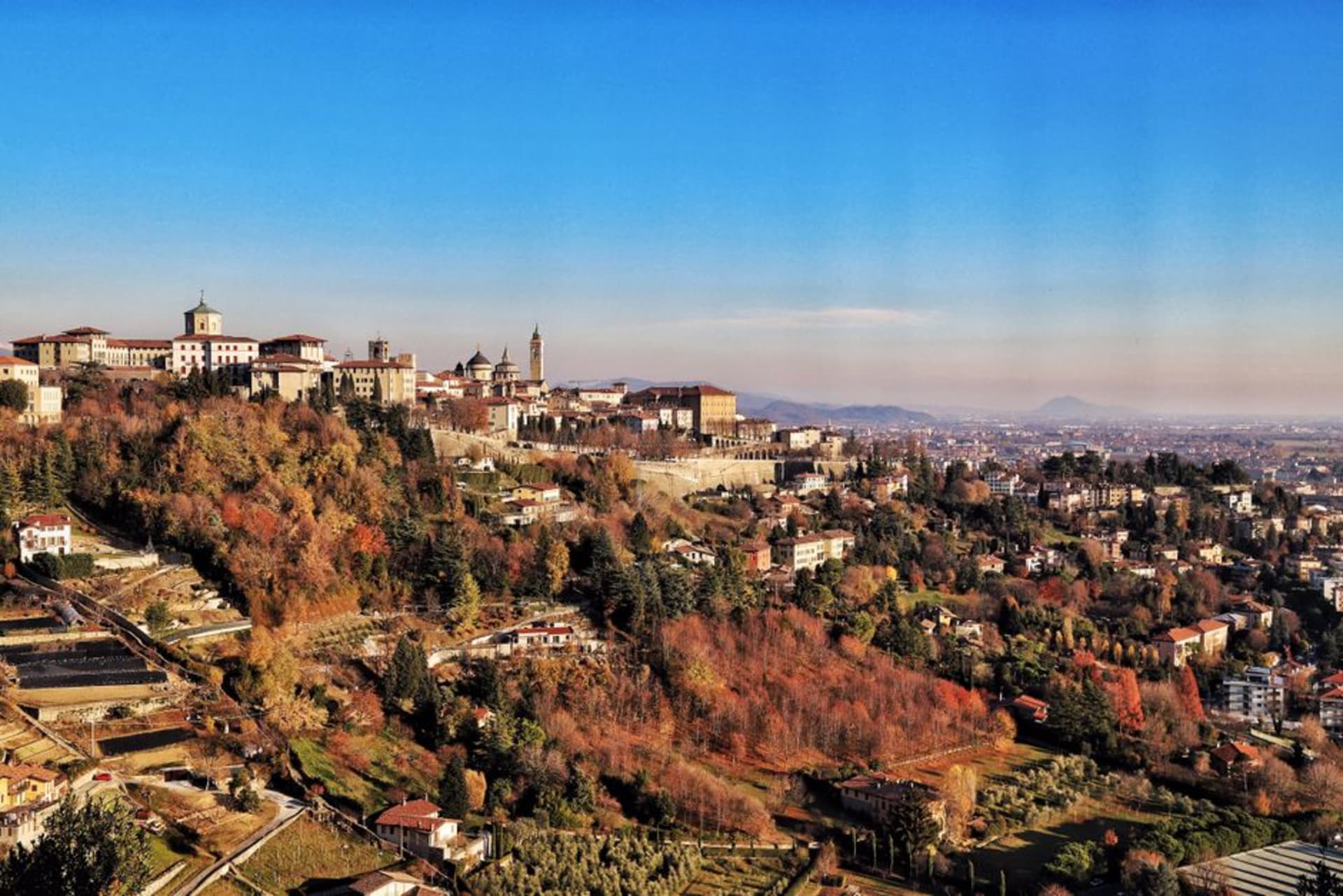
A city split cleanly in two — a Venetian fortress on the hill, a modern town below — and somehow more itself for the contradiction.
Bergamo announces its own structure before you’ve even bought a ticket for anything: there is Città Bassa, the lower city, flat and modern and functional, and there is Città Alta, the upper city, a walled hill town that the Venetians fortified in the sixteenth century when this was the westernmost outpost of their mainland empire. The two are connected by a funicular that’s been hauling people up the slope since 1887, and I’d argue the ride itself is one of the best cheap thrills in Lombardy — a few minutes of grinding ascent and you step out into a completely different century.
The Venetian Walls that ring Città Alta are, since 2017, a UNESCO World Heritage site, part of a chain of defensive fortifications the Republic of Venice built across its terraferma territories, and they’re in remarkable condition — you can walk long stretches of the ramparts, six kilometers of them, looking out over the Lombard plain toward Milan on a clear day and up toward the Alps on the other side. I did the full loop on a cool October morning, more or less alone except for a few locals walking dogs, and it’s one of those simple pleasures — a long walk with a view that keeps changing — that I return to Italy for again and again.
Piazza Vecchia and the Old Heart
At the center of Città Alta, Piazza Vecchia is one of the great unheralded squares in Italy — Le Corbusier reportedly called it the most beautiful in Europe, and while I’m always suspicious of that particular superlative, it’s a genuinely perfect composition: the white Palazzo Nuovo on one side, the medieval Palazzo della Ragione with its clock tower on the other, connected by a covered stairway. Push past the square into the Basilica di Santa Maria Maggiore and the adjoining Colleoni Chapel, a riot of colored marble built as a funerary monument for a Venetian mercenary captain — Bartolomeo Colleoni — who made his fortune as a condottiero and spent a chunk of it ensuring he’d be remembered lavishly. It works; the chapel is one of the finest examples of Lombard Renaissance architecture anywhere.

Donizetti’s City
Bergamo’s other claim to fame is Gaetano Donizetti, the prolific bel canto composer born here in 1797, and the city takes its musical heritage seriously — the Teatro Donizetti in the lower town hosts a festival in his honor each autumn, and his tomb sits inside the basilica in Città Alta, an oddly moving stop if you have any fondness for opera. Between the culture and the ramparts, it’s easy to lose a full day up here without trying, stopping for casoncelli — the local stuffed pasta, filled with meat and sausage and dressed simply in butter and sage — at a trattoria tucked into one of the side streets off the piazza.

Bergamo has also, in recent years, become a budget-airline gateway to Milan, which means plenty of travelers land here and rush straight onto a train without ever going up the hill. I understand the impulse to keep moving, but I’d tell anyone with even three or four spare hours between flights: take the funicular, walk the walls, eat the casoncelli, and then go.
When to go: September and October for the clearest views from the ramparts and the Donizetti festival season; late spring works well too, before the summer haze settles over the plain.