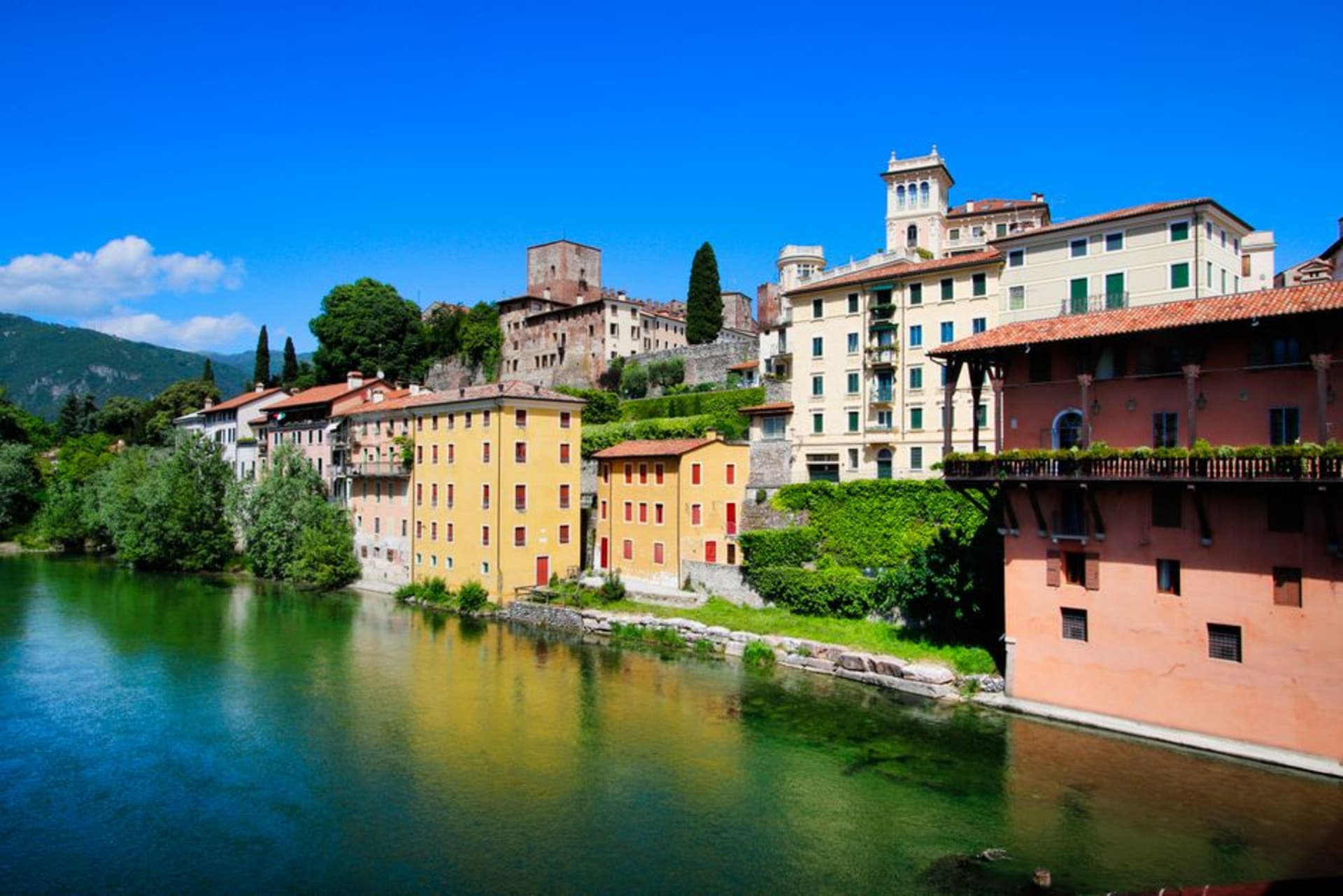
Bassano del Grappa
"A town that smells faintly of pomace brandy and looks like it was designed by a very sober Palladio anyway."
A wooden bridge, a river the color of jade, and a grappa distillery smell that follows you down every side street.
The first thing you notice in Bassano del Grappa is the bridge, and it deserves the attention. The Ponte degli Alpini — also called the Ponte Vecchio, though nobody confuses it with Florence’s — is a covered wooden structure spanning the Brenta River, originally designed by Andrea Palladio in 1569 after a flood destroyed the previous version. It’s been rebuilt in wood after wars and floods ever since, most recently after being blown up in World War I and again in World War II, and the Alpini — Italy’s mountain infantry corps — have rebuilt it each time as a point of regimental pride, which is why it carries their name. Standing on it, looking down at the glacial blue-green water of the Brenta rushing beneath, you’re looking at both an engineering relic and a genuine war memorial that just happens to be extremely photogenic.
The town’s full name gives away its other claim to fame. Bassano del Grappa didn’t originally have “del Grappa” attached — it was added in 1928, borrowing the name of the nearby Monte Grappa, partly to distinguish it from other Bassanos and partly, I suspect, because the association with the famous Italian spirit did the town no harm at all. Grappa, the pomace brandy distilled from the leftover skins, seeds, and stems of winemaking, has been produced here since at least the eighteenth century, and the Poli Museo della Grappa, right at the foot of the bridge, is free to enter and worth the twenty minutes even if you don’t plan on drinking anything stronger than coffee that day. I did plan on it, and the tasting room upstairs did not disappoint.
Walking the Old Town
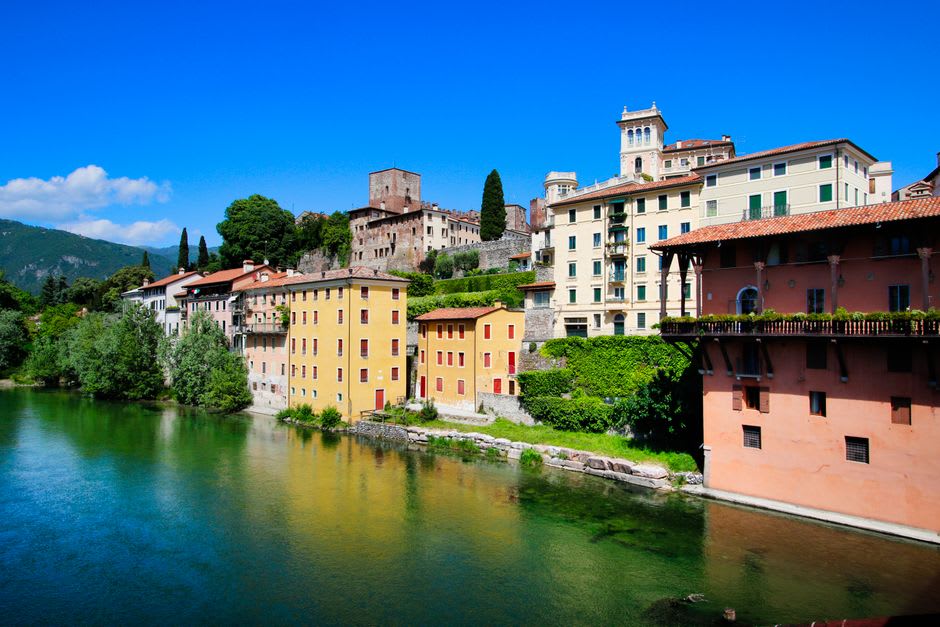
Past the bridge, the historic center climbs gently up toward Piazza Garibaldi and the Torre Civica, past townhouses with frescoed facades in the soft ochre and terracotta typical of the Veneto foothills. Bassano is also known for ceramics — its maiolica tradition dates back centuries, and small workshops still sell hand-painted plates and jugs in patterns that haven’t changed much since the Renaissance. I bought nothing because I was traveling with hand luggage, and I’ve regretted it mildly ever since.
Monte Grappa and the White Asparagus
The mountain that lends the town its second name looms above the plain to the north, and it carries a heavier history than the bridge does — Monte Grappa was the site of brutal fighting during World War I, and its summit holds a monumental ossuary honoring the tens of thousands of soldiers who died defending the line there. It’s a sobering half-day trip by car, a stark contrast to the postcard prettiness of the town below. Closer to ground level, Bassano is also proud of its white asparagus, grown in the sandy soil nearby and celebrated every spring with a dedicated festival — pale, tender spears served simply with hard-boiled egg and olive oil, a dish that shows up on every trattoria menu the moment the season starts.

When to go: April and May for white asparagus season and mild weather on the bridge; September for the grape harvest and the grappa distilleries in full swing.