Alberobello
"The trulli of Alberobello were designed to disappear and became impossible to forget."
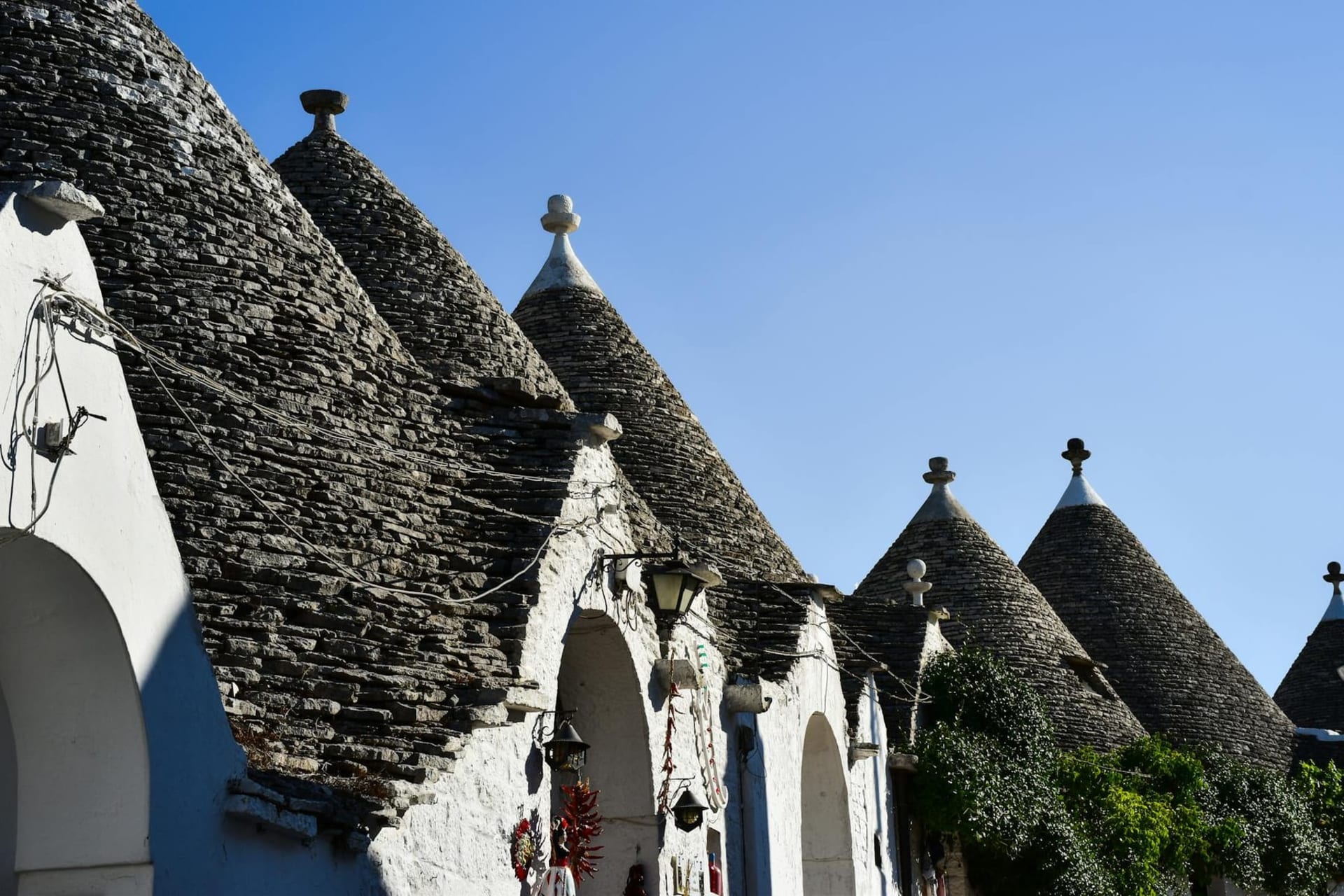
A UNESCO village of limestone trulli — conical dry-stone dwellings that look architectural but were built to be dismantled when tax collectors arrived.
There is something disorienting about arriving in Alberobello for the first time. The bus drops you at the edge of town and you walk maybe two minutes before the ordinary Italian streetscape ends and something else entirely begins — a hillside bristling with conical limestone rooftops, hundreds of them, the grey caps fitted stone by stone without a gram of mortar. The first thing I felt was not wonder, exactly. It was the mild vertigo of a landscape that shouldn’t exist.
Rione Monti and the Logic of Impermanence
The trulli are concentrated in two quarters: Rione Monti, with roughly a thousand cones packed along stepped lanes that descend toward the valley, and the smaller Aia Piccola across the road, where families still live and laundry hangs between the chimneys. I spent my first morning in Rione Monti, which is the tourist core — souvenir shops now occupy half the ground floors — but even there, around seven in the morning before the coaches arrived, the silence was startling. The stone absorbed sound. The light, a particular flat white you only get in the Puglian interior, fell across the walls without a single shadow to explain itself.
The dry-stone construction was deliberate tax evasion. Under Bourbon rule, permanent structures attracted a levy, so the trulli were built to be dismantled on short notice — the keystones pulled, the roofs collapsed, the inspector finding only a pile of rubble. That the same technique produced buildings that have stood for centuries, and that became a UNESCO World Heritage Site, is one of history’s neater ironies.
Lunch on Via Monte Nero and an Unexpected Cellar
Lia found the restaurant, as she usually does — a small trattoria on Via Monte Nero where a hand-lettered card in the window promised orecchiette al ragù bianco and a fixed lunch for twelve euros. We ate under a low vaulted ceiling that turned out, the owner explained, to be the interior of a trullo that had been swallowed by later construction. The ragù was lamb, barely seasoned, cooked long enough to dissolve. We ordered it twice.
The surprise came after lunch, when the owner gestured toward a trapdoor behind the kitchen. Below it was a cistern carved directly from the limestone bedrock — perfectly circular, cool as a cave, used for centuries to collect rainwater from the conical roof above. I had been photographing the outside of these structures all morning and had not thought once about what they held.
Trullo Sovrano and the Upper Town
The Trullo Sovrano, at the top of Piazza Sacramento, is the only two-storey trullo in existence, built by a wealthy priest family in the eighteenth century and now a small museum. The interior is darker than you expect and smells faintly of old plaster and dried herbs. From the square outside, late in the afternoon when the tour groups had gone, the whole of Rione Monti spread below in a wash of grey and white.
When to go: April through early June offers the best light and manageable crowds. July and August are hot and packed — the lanes in Rione Monti become impassable by midday. September is a quieter second choice, with the warmth still in the stone walls well into the evening.