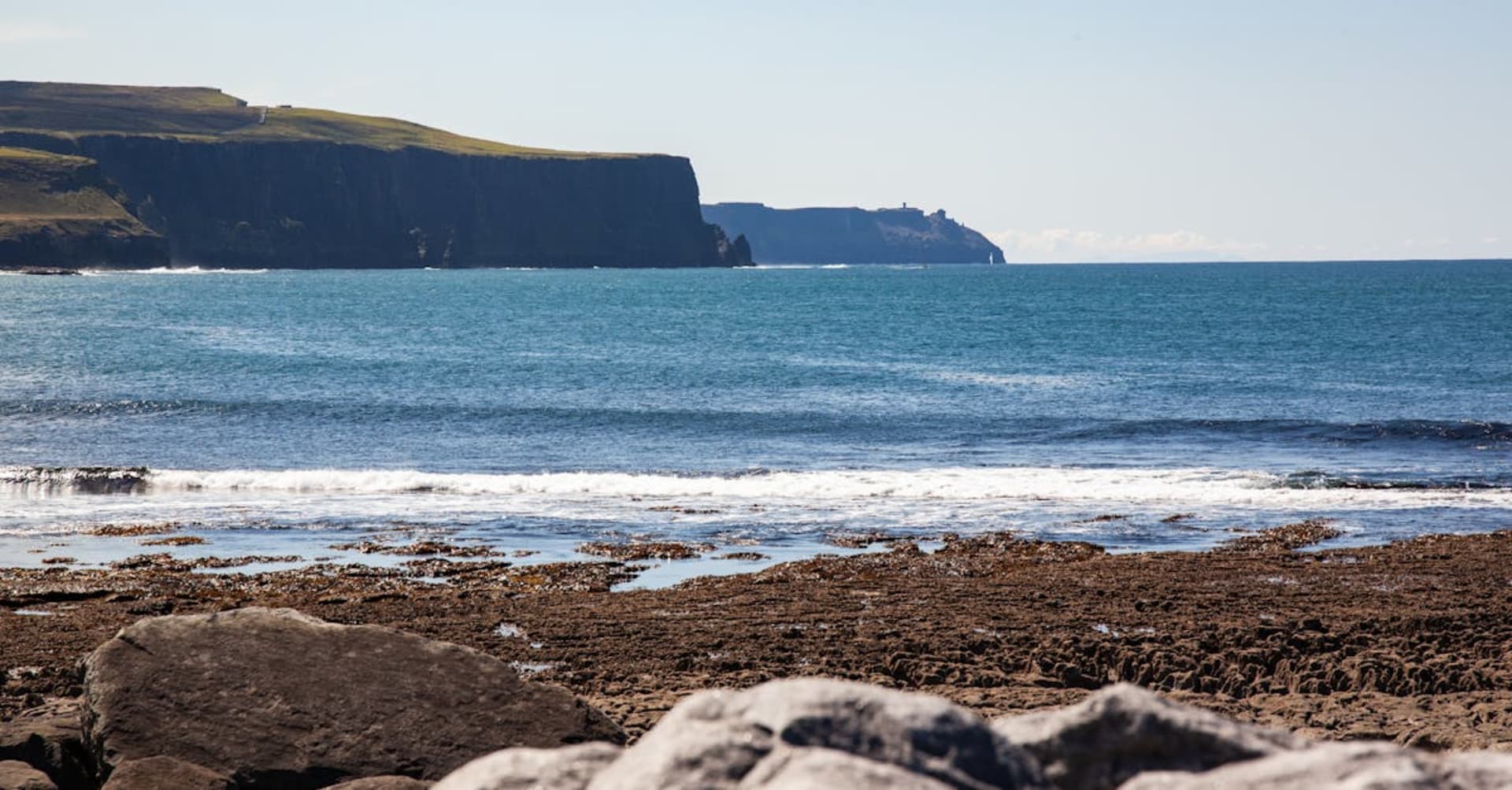
The Cliffs of Moher need no introduction and suffer none from receiving one. They rise two hundred meters from the Atlantic along eight kilometers of County Clare coastline, and standing at their edge — wind pulling at your jacket, seabirds wheeling below you, the Aran Islands visible on the horizon — you understand viscerally why the Celts believed the western sea led to the otherworld. The scale is difficult to comprehend until you see a boat below and realize how small it looks against the striped limestone face. I have stood at the edge of many cliffs in my travels, from Etretat in Normandy to the Algarve coast, but the Cliffs of Moher possess a drama that is entirely their own.
Walking the Edge
The cliff path extends well beyond the visitor center in both directions, and walking south toward Hag’s Head offers progressively quieter stretches where you might have the view to yourself. I walked south for an hour on a Tuesday morning and saw no one except a farmer checking his fence line, the two of us exchanging a nod that felt like a shared secret. Puffins nest on the cliff faces from April through July, and the layers of rock — 320 million years of compressed seabed — tell a geological story visible in the banding.

The Burren
The Burren, just inland, offers a complementary landscape that feels like visiting another planet: a karst limestone plateau where wildflowers grow from the cracks and megalithic tombs dot the grey terrain. The Poulnabrone dolmen — a portal tomb dating to 3800 BC — stands in a field of bare limestone like a stone table set for gods who have not returned. The combination of the Cliffs and the Burren makes County Clare one of the most geologically rich regions in Europe. I spent a morning on the Burren looking for the rare orchids that bloom here in May and June, growing from limestone that a geologist told me was formed from the shells of creatures that lived in a tropical sea three hundred million years ago.

When to go: May through September for the clearest skies and puffin season. Early morning or late afternoon to avoid peak crowds. Wind is constant — dress accordingly and hold onto anything you value.