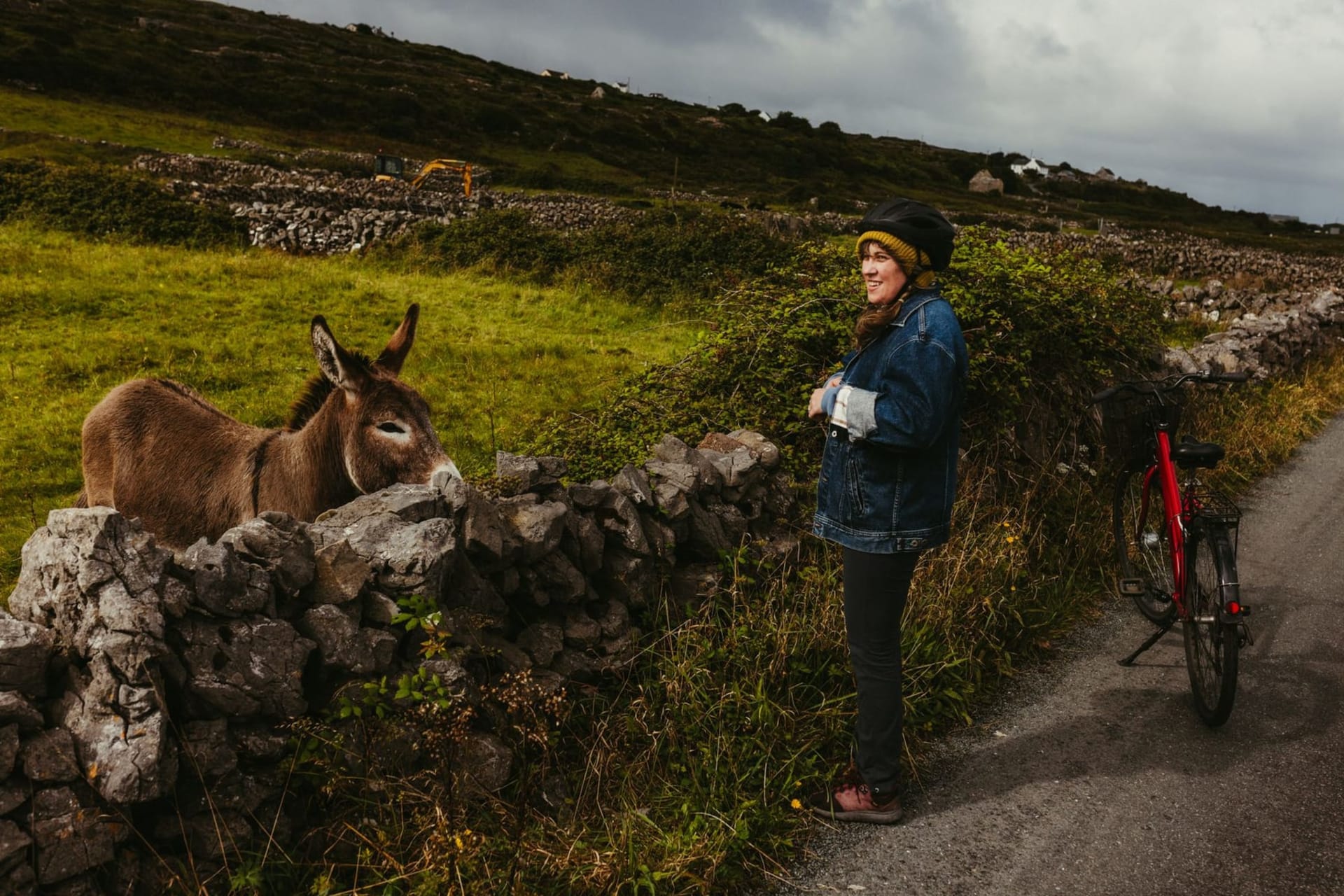
The middle Aran Island in Galway Bay, quieter than Inis Mór, where stone walls outnumber people and J.M. Synge spent his summers.
The ferry from Rossaveal doesn’t so much arrive at Inishmaan as surrender to it. The island offers no harbour glamour — just a concrete pier, a few men in caps, and the immediate sense that the Atlantic has always had the final word here. Lia squeezed my arm as we stepped onto the stone. “It’s like the island is looking at us,” she said. She was right. There are only around 150 people living on this wedge of limestone, and somehow all of them seem present in the air even when none of them are visible.
The Walls as Architecture
What photographs cannot prepare you for is the scale of the wall system. The stone walls of Inishmaan — built over centuries to clear the land and fix salt-blown soil — rise shoulder-height and run in every direction with an insistence that turns the island into a kind of outdoor labyrinth. On Bothar na gCreag, the track that loops above the south cliffs, the walls press so close on either side that walking it feels devotional, almost monastic. The rock is pale grey with streaks of rust, and in the late afternoon it holds the last of the Atlantic light like a slow ember.
Synge used to walk these same paths every summer between 1898 and 1902. The cottage where he stayed — Teach Synge — still stands at the top of the village lane, a low white building behind a wooden gate. You can look through the window at the table and the chair. I stood there longer than I expected to, thinking about the notebook he always carried.
The Surprise at the Fort
I hadn’t looked closely at the map before we climbed to Dún Chonchúir, the oval stone fort that sits on the island’s ridge like a crown. What I didn’t know — what stopped me completely when I reached the inner wall — is that you can see every coast of Ireland on a clear day from that height: the Connemara mountains to the northeast, the Cliffs of Moher as a dark pencil line to the south, and beneath you the two other Aran Islands laid flat on the water like stepping stones someone had given up placing. I had read nothing about this view. It arrived as pure gift.
Eating and Staying
Dinners on Inishmaan are a simple thing. The guesthouse run by the Faherty family, Inis Meáin Restaurant and Suites, serves food that tastes pulled directly from the island — crab claws, salt-meadow lamb, chowder so thick a spoon stands in it. The dining room is candlelit even in June because the windows face the Atlantic and the Atlantic is always winning.
When to go: May and early June offer the best balance — the days are long, the worst of the tourist traffic stays on Inis Mór, and the wildflowers in the limestone cracks are still in full colour. Avoid August if you want the island to feel like it belongs to itself.