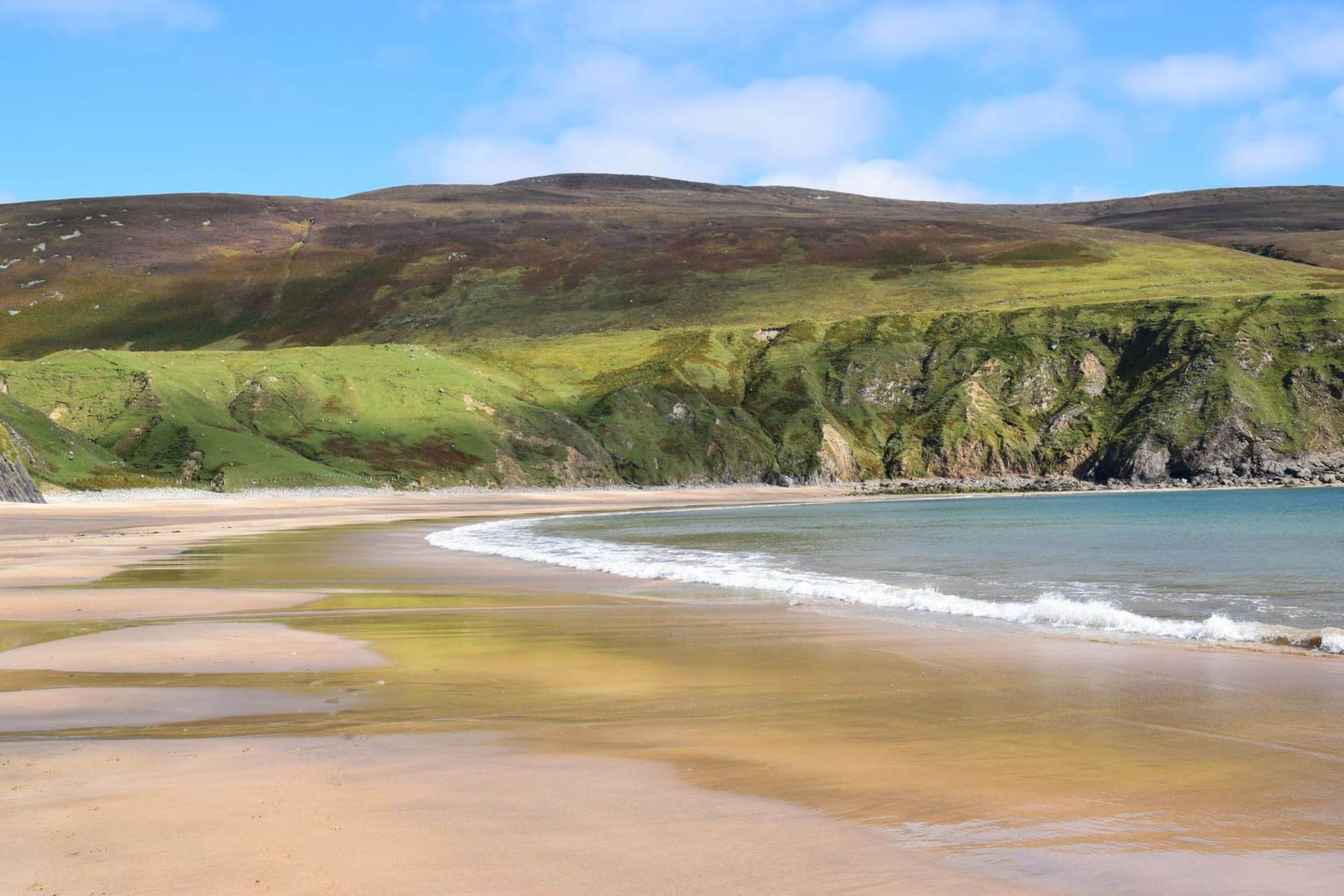
A remote coastal valley in Donegal where Irish is still spoken and a folk village museum preserves four centuries of thatched life.
The road that drops into Glencolmcille from the Glengesh Pass feels like a decision the land is making for you. One moment the plateau is open and wind-bitten, the next the valley unspools below — a narrow green finger pressed between dark hills, ending where the Atlantic waits in a bay the colour of unpolished pewter. I had driven three hours from Donegal town along roads that grew progressively narrower and more insistent, and by the time I coasted into the village of Cashel, past the small church and the hand-painted sign for An Chistin, I understood that this was a place that had survived by being inconvenient to reach.
A Valley That Refused to Empty
Glencolmcille should not still exist as itself. In the 1950s it was emptying — young people leaving for Dublin, for London, for anywhere that paid. Father James McDyer looked at this and did something unusual for a rural Irish priest: he organised. He founded the Glencolmcille Folk Village cooperative in 1967, built a craft industry, created work. The thatched cottages of the folk village — four of them, each reconstructed to represent a different century from 1720 onward — are still run by his cooperative today. I walked through them on a Tuesday morning when I was the only visitor, moving through stone rooms furnished with rush-seat chairs, iron pots, a cradle, a small window that held the whole valley. The smell of turf smoke had settled into the walls so deeply it seemed to come from the stone itself.
Irish — Gaelic, an Ghaeilge — is the first language of the valley. The road signs give only Irish place names. In the shop on the main road, the woman at the till greeted me in Irish before switching to English when she read my confusion. Lia, whose ear is better than mine for these sounds, caught words all afternoon.
The Atlantic Rim
The cliffs above Glencolmcille are among the most serious in Donegal, and Donegal is not a county that uses that word lightly. The Glen Head promontory rises past a Napoleonic watchtower and continues to an edge that the Atlantic has been arguing with for centuries. Below, the sea moves in colours I do not have names for — not quite green, not quite grey, lit from underneath on clear days as if the water itself is phosphorescent. I arrived at the top with my coat pressed flat against my chest by the wind and stayed far longer than was sensible.
What surprised me — what I had not expected from this corner of Ireland — was the Neolithic standing stone on the headland path, leaning at a slight angle as if listening to the sea below. No interpretation panel, no fence, no car park nearby. Just a stone put here by someone four thousand years ago, still here, still leaning.
Turas and Turf Smoke
The parish saint is Colm Cille, the same monk who left Ireland for Iona and changed the course of European Christianity. Each midsummer, locals walk the turas — a 4.8-kilometre pilgrimage circuit through fifteen early Christian sites — beginning before dawn. I walked part of it alone in the late afternoon, following stone crosses embedded in the hillside, water in the low channels reflecting a sky that could not decide between storm and clearing. The air smelled of grass and rain and something else, something mineral, that I have only encountered on Atlantic edges.
When to go: June through August brings the longest light and the best chance of clear days on the headlands — though the valley holds a particular grey beauty in September, when the tourists thin and the turf smoke returns to every chimney.