
Manzhouli
"There is a matryoshka doll here the size of a four-storey building. It is the most honest thing in town."
I had been told about the giant matryoshka dolls, but being told about them is categorically different from standing in front of them. Manzhouli’s Nesting Doll Square sits in the center of the main pedestrian street, a row of painted wooden dolls scaled up to architectural proportions — the largest one rises to perhaps four storeys, bright red and gold and cream, surrounded by smaller versions of itself in descending order like a Russian fairy tale that got loose from its book. The rest of the street carries the same logic: Cyrillic script on shopfronts, onion-domed buildings housing Chinese pharmacies, a restaurant where the menu is in three languages and the borscht contains lamb because this is still Inner Mongolia. I ate the borscht. It was excellent.
Manzhouli sits at the junction of China, Russia, and Mongolia — the actual borders of all three countries meet within a few kilometers — and the town has absorbed a century of that geographic peculiarity into something that looks like normal life to the people who live it. The Russian presence dates to the railroad: the Trans-Siberian line used to pass through here before it was rerouted, and the Russians who stayed became a small permanent community whose descendants still run bakeries selling black bread and pierogi alongside the ubiquitous milk tea shops.
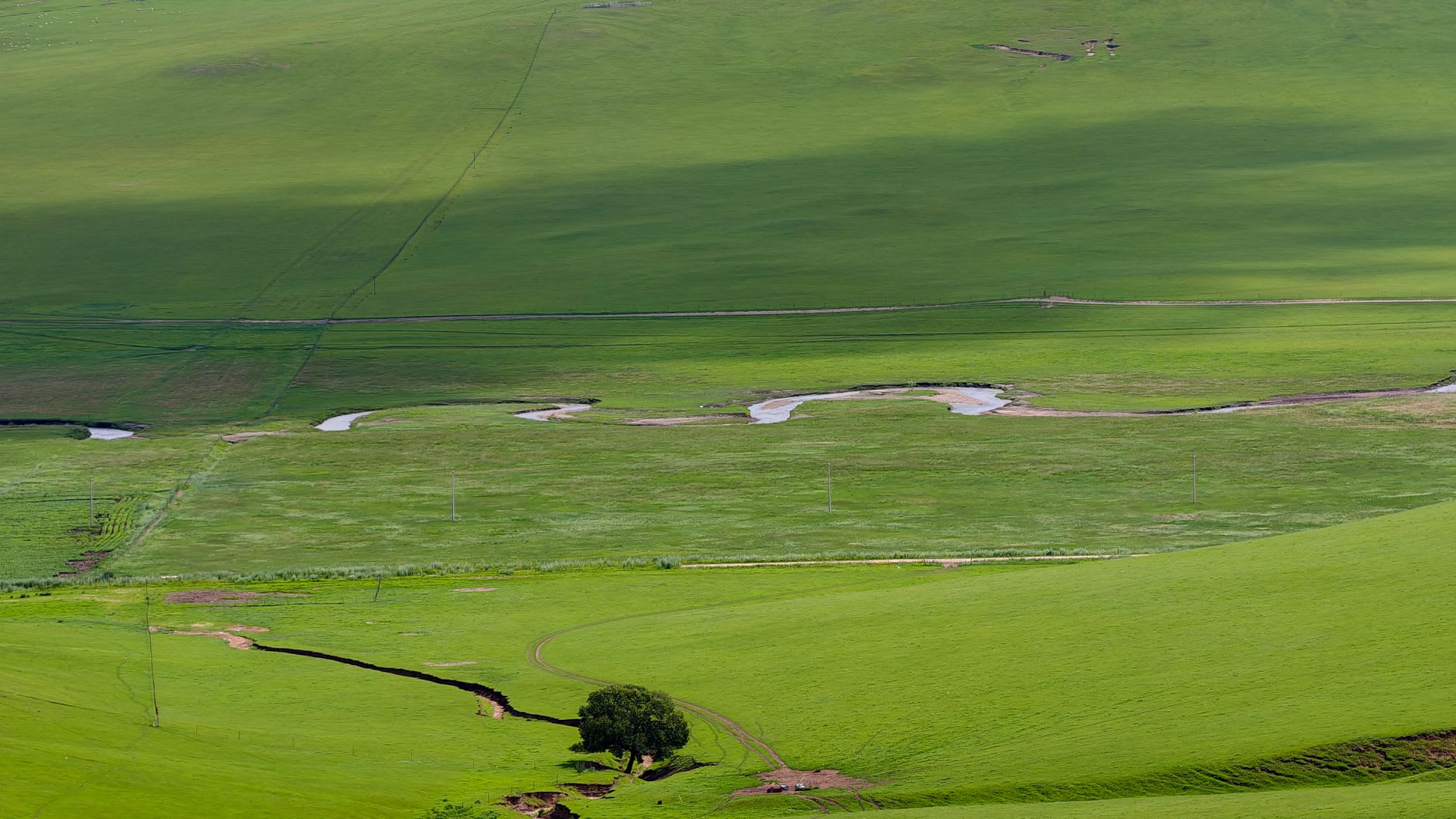
The International Trading Zone near the Russian gate is where the commercial logic of the border becomes visible. Chinese traders haul goods across in volumes that make the crossing feel like a supply chain with a flag in the middle: electronics going north, timber and dairy products going south, an endless flow of trucks queued at the customs checkpoint. Walking along the border fence at the north edge of town, you can see the Russian settlement of Zabaikalsk across a flat field, its water tower and low buildings catching the same flat light, and the proximity makes the geopolitical abstraction of a border feel suddenly literal, suddenly absurd.
The lakes outside town are where Manzhouli shows a different face. Hulun Lake — one of the largest freshwater lakes in China — lies twenty kilometers east, and on calm mornings the reeds along its shore hold cranes and bitterns in numbers that serious birdwatchers have been coming for since the 1980s. In the evening the light off the water is extraordinary, amber and flat, and the lakeside restaurants serve freshwater fish in ways that owe nothing to either Chinese or Russian tradition but something to both simultaneously.
There is a quality to Manzhouli that I have not found elsewhere in Inner Mongolia, a kind of cheerful commercial absurdity combined with genuine cultural overlay. It is not performing its hybridity for tourists. The Russian bakeries exist because people buy black bread. The oversized dolls exist because someone in the 1990s made a decision that turned out to be prescient. It is a town that stumbled into its identity and found it fit.
When to go: July and August are peak season, warm enough for the lakeside and busy with cross-border commerce and domestic Chinese tourists. September is calmer and the steppe light in the evenings has a quality that rewards slow walking. The Russian border trade slows in winter but Manzhouli in December has a particular charm — snow on the onion domes, the bakeries doing serious business with their hot pies, the border fence white and quiet.