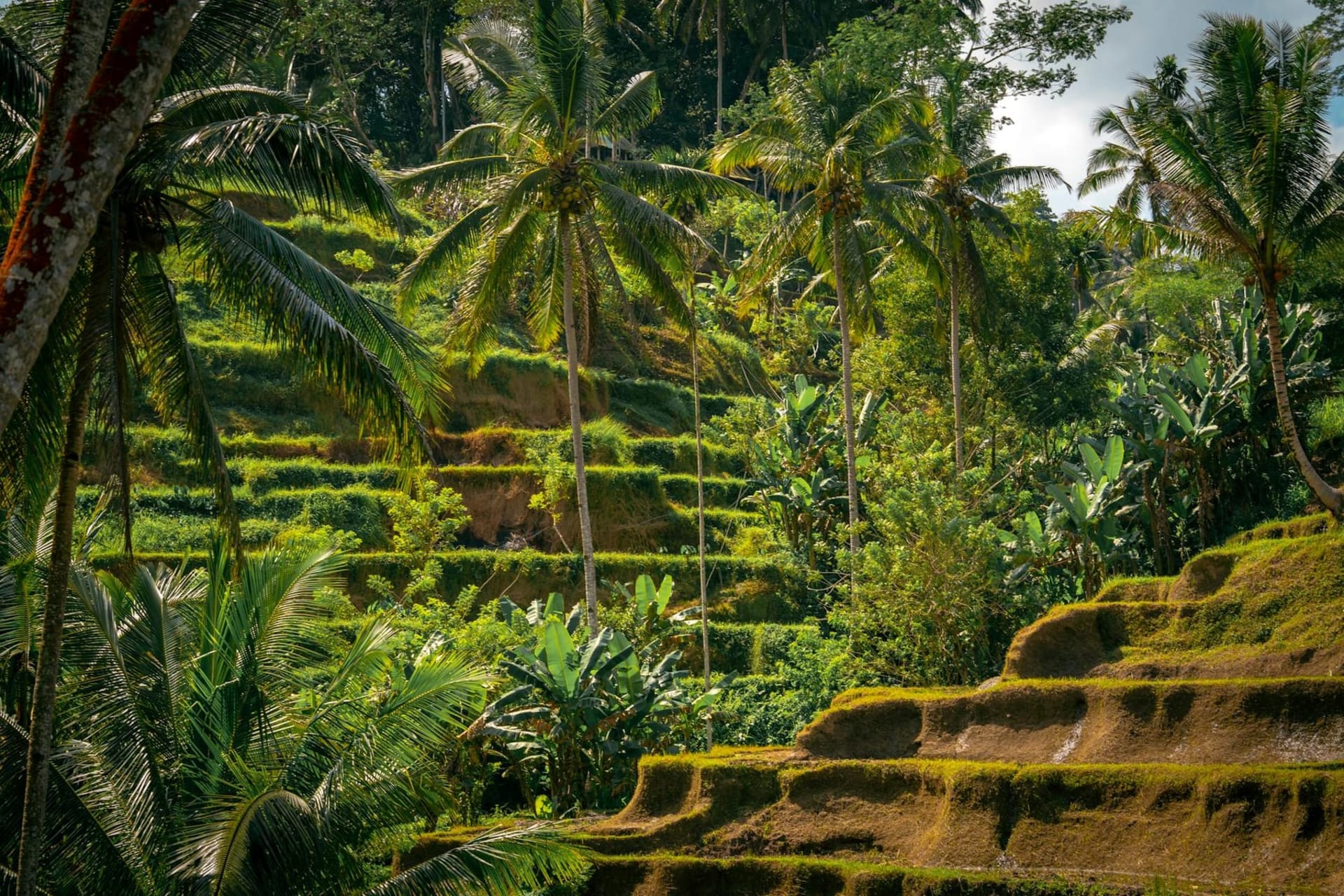
Ubud Rice Terraces
"The Tegallalang terraces make you realise that farming can be an act of profound aesthetic intention."
Tegallalang's stepped rice paddies and the subak irrigation system that has shaped Bali for millennia.
We arrived at Tegallalang before seven, when the light was still thin and the warung stalls along Jalan Raya Tegallalang were just rolling up their shutters. I had been warned — by guidebooks, by other travelers in the guesthouses of Ubud — that the terraces were overrun, commercialised, a Instagram backdrop posing as a landscape. I almost didn’t come.
I was wrong to hesitate.
The Geometry of Water
What you can’t fully understand until you stand at the valley rim is how deeply architectural the terraces are. Each step is a wall, a floor, a channel — a decision made by a farmer generations ago and ratified by every season since. The subak system, the cooperative irrigation network that has governed Balinese rice cultivation since the ninth century, works by gravity and consensus. Water flows down from the temple at Pura Ulun Danu Batur on the volcanic caldera above, distributed across the terraces through a web of stone channels, bamboo pipes and hand-cut ditches. Nobody owns the water. Everyone tends the system.
I walked the narrow bunds between the paddies for an hour, mud cool on my sandals, the smell of wet soil and something green and faintly fermenting in the air. The rice was at different stages in different plots — bright acid yellow where it had just been planted, deep emerald further down, gold on the hillside where a plot was days from harvest. The effect was a painting that had not decided to stop being painted.
What Surprised Me at the Bottom
Lia found it first. Midway down the valley, past a small shrine draped in black-and-white poleng cloth, there is a spring. Most visitors don’t descend that far — the best photographs are from the ridge, and the path down is slippery in places. But at the bottom, shaded by a fig tree of implausible girth, the water surfaces directly from the rock and flows into a small pool where offerings of marigold and rice float in circles. A man was bathing there, unhurried, as if the terraces above and the tourists at the rim were both equally distant from what mattered. We stood quietly at the edge for a while. It was the most still I felt in Bali.
Morning Over Everything Else
The terraces at Tegallalang face roughly east. By nine o’clock the valley fills with direct sun and the green goes flat. Before that, in the diffuse light, every paddy surface holds a faint reflection of sky. The whole valley breathes. Come early, stay through the first hour of real light, and leave before the tour buses fill Jalan Raya Tegallalang with diesel fumes.
When to go: Bali’s dry season runs from April to October, with June and July offering the most reliable mornings. Avoid arriving mid-morning during peak season — the terraces are at their most luminous, and least crowded, in the first hour after sunrise.