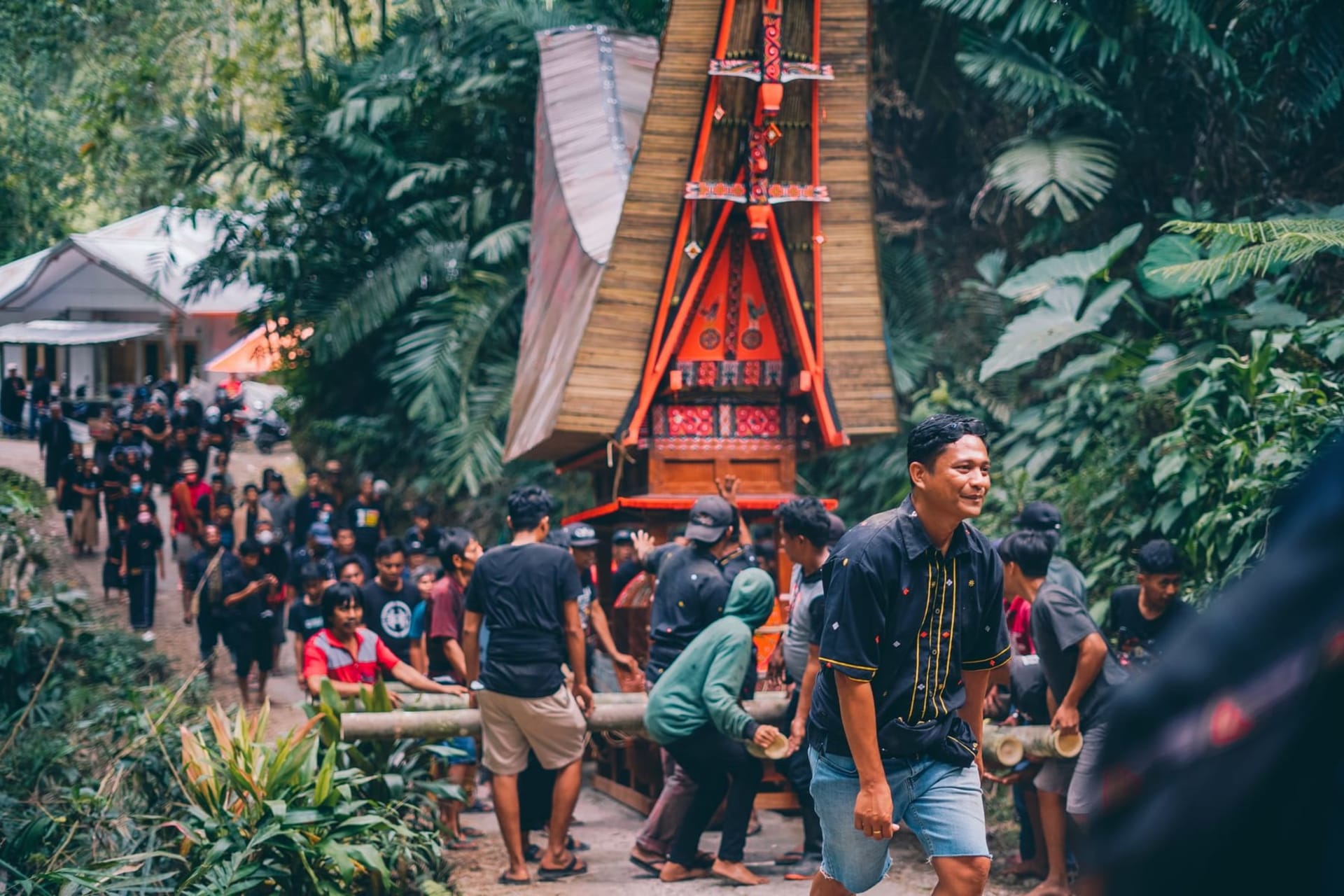
A highland culture in Sulawesi where funerals last weeks, the dead are buried in cliff rock, and buffalo are the currency of grief.
The road into Tana Toraja climbs for hours through Sulawesi’s green spine, passing banana groves and roadside stalls stacked with dried fish, before the landscape opens into something older and stranger. The air cools. The rooftops begin to curve — saddle-shaped, swept skyward at each end like the hull of a boat that never touched water. These are the tongkonan, the ancestral houses that mark you as having arrived somewhere that operates by its own calendar, one where the dead wait patiently to be sent off properly.
The Logic of a Long Goodbye
I had read about Torajan funerals before coming, but nothing prepares you for the scale of them in practice. In the village of Ke’te’ Kesu’, near the market town of Rantepao, I walked into a funeral that had already been going for four days and would continue for three more. The family had rented a field. There were bamboo grandstands, vendors selling palm wine and fried snacks, children running between the legs of buffalo tethered in lines. The deceased — a grandmother, someone explained — had been kept in the family home for months, treated as merely ill, spoken to, offered food, while the family saved the money and organized the livestock that her farewell required.
Buffalo are not simply animals here. They are currency, status, proof of love. The number slaughtered at your funeral tells everyone how well your family honored you. I watched a procession move through Rantepao’s main street — Jalan Ahmad Yani — the coffin wrapped in red cloth, dozens of men and women in black, a marching brass band playing something mournful and completely incongruous. Lia grabbed my arm and said nothing. There was nothing useful to say.
Cliff Tombs and Watching Eyes
Above the village of Lemo, the limestone cliff has been carved with neat rectangular holes, each sealed with a wooden door, arranged in rows twenty meters off the ground. On narrow balconies in front of them stand the tau-tau — painted wooden effigies, one per tomb, carved to resemble the person inside. They look out over the valley with an unsettling steadiness. The oldest figures have weathered to gray, their features softened by decades of mountain rain. The newest ones are shockingly lifelike.
What surprised me was the smell. I had expected something funereal. Instead the air around Lemo carried wood smoke, wet fern, and something faintly sweet I could never identify. The dead here do not feel buried. They feel installed, watching, still part of the landscape they came from.
Eating and Staying
In Rantepao, I ate pa’piong — pork and vegetables cooked inside bamboo tubes over an open fire — at a warung near the central market, Pasar Bolu. The fat had rendered slowly into the bamboo smoke and the result was the best thing I ate in Indonesia. I ordered it twice. The morning markets start before six; arrive early for the livestock section if you can handle it, which I could not, but Lia could, apparently.
When to go: The dry season runs from June through September and coincides with the peak of funeral season — families plan the large ceremonies for when roads are passable and guests can travel. Arrive with no fixed schedule. The best things here do not announce themselves in advance.