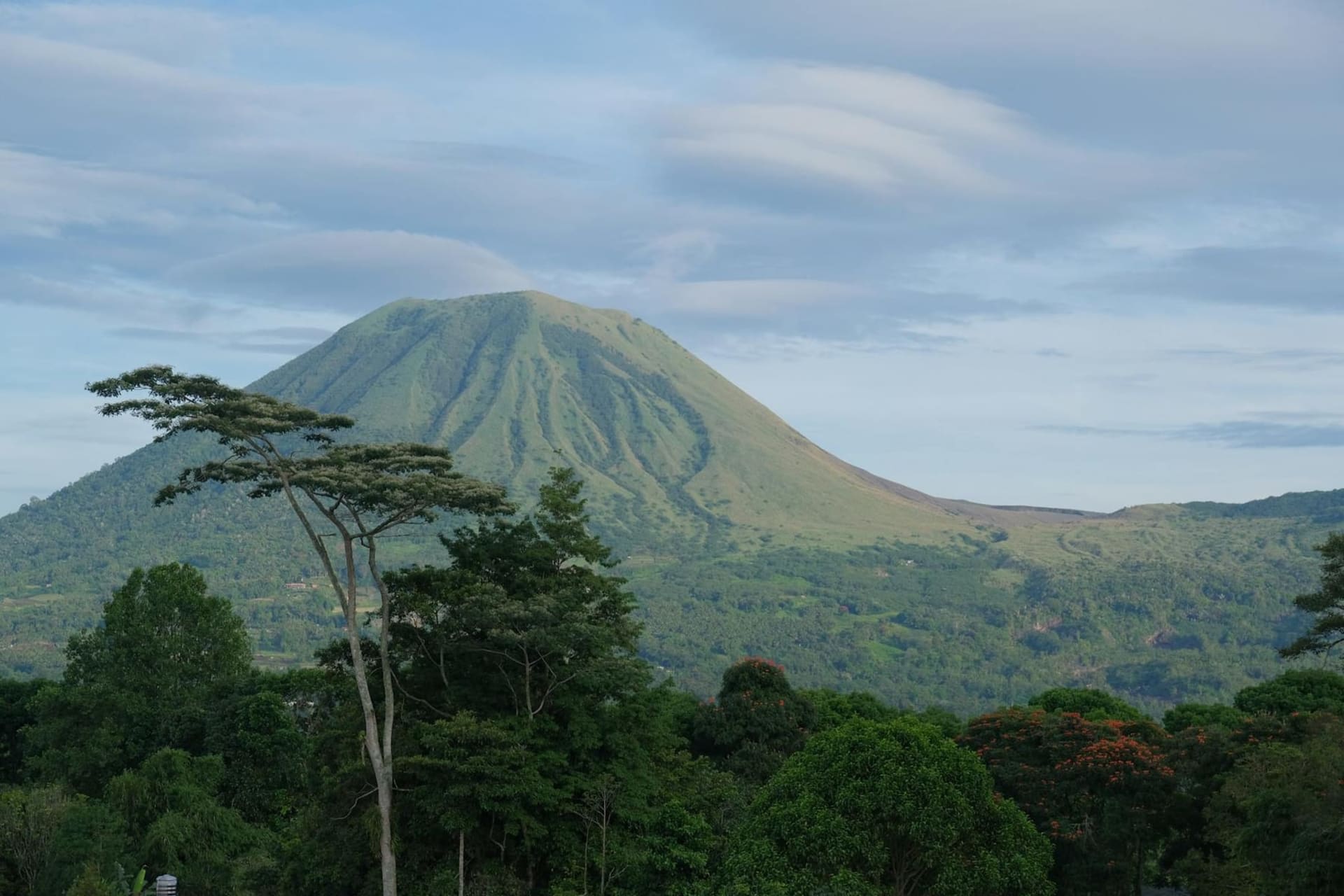
A cool highland town on Flores with traditional Ngada villages of thatched ancestor shrines still used for daily ritual.
I arrived in Bajawa on a bus that had taken three hours to cover sixty kilometers, the road coiling through volcanic ridges so steep the driver crossed himself at every switchback. The air outside was something I hadn’t expected from Indonesia — thin, cool, faintly smoky from cooking fires. After weeks of coast and lowland heat, my lungs noticed the difference immediately.
The Ngada Villages
The villages that ring Bajawa — Bena, Luba, Núa — sit on highland slopes with views of Gunung Inerie’s near-perfect cone cutting the sky to the south. In Bena, the most intact of them, twin rows of clan houses face a ceremonial yard where the ngadhu and bhaga stand: the ngadhu a thatched parasol-shrine mounted on a carved post, the bhaga a miniature house, each pair representing a founding ancestor. I had read about them before coming. Reading had not prepared me for the fact that a woman walked past one of them carrying laundry, a child ran between two others chasing a rooster, and a man was sharpening a machete on the stone base of a shrine that was, by some accounts, centuries old.
That is the thing about Bena: it is not a heritage site cordoned off for visitors. People live here, eat here, bury their dead and celebrate births in this same yard. The ikat cloth drying on a line strung between two clan-house eaves was woven here last week, not archived in a museum in Jakarta.
Mornings on Jalan Ahmad Yani
Bajawa town itself is small enough to walk end to end in twenty minutes. I spent most mornings on Jalan Ahmad Yani, the main street, drinking kopi flores at a warung with plastic chairs where the owner kept a radio tuned to something that sounded like gamelan crossed with country music. The coffee is local — Bajawa sits inside a coffee-growing belt and the robusta here has a dark, almost earthy bitterness that I started craving by the second day.
Lia found the market on our own first morning: a covered structure two blocks east where women sold sweet potato, cassava leaves, and pale yellow corn alongside bundles of the fragrant pandan that seemed to find its way into every dish we ate. We had mie goreng for breakfast two days running from a stall near the market entrance, the noodles fried with shallots and a local chili that was small, dark red, and serious.
The Surprise of Wogo
The unexpected discovery came not in Bena but in Wogo, an older village site we reached on foot from the main road after a local man pointed us up a steep unmarked path. Wogo is partially abandoned — some houses collapsed, others still standing — but the shrines remain, and on the afternoon we arrived, a small group of elders were making an offering at one of the ngadhu, placing betel nut and leaves at the base with a formality that required nothing from us except stillness. We stood at the edge of the yard for a long time after they left, the cone of Inerie behind us going pink in the late light.
When to go: The dry season from June to August brings the clearest skies and the best views of Gunung Inerie. The highlands stay cool year-round, but avoid the wettest months of January and February when the mountain roads become genuinely difficult.