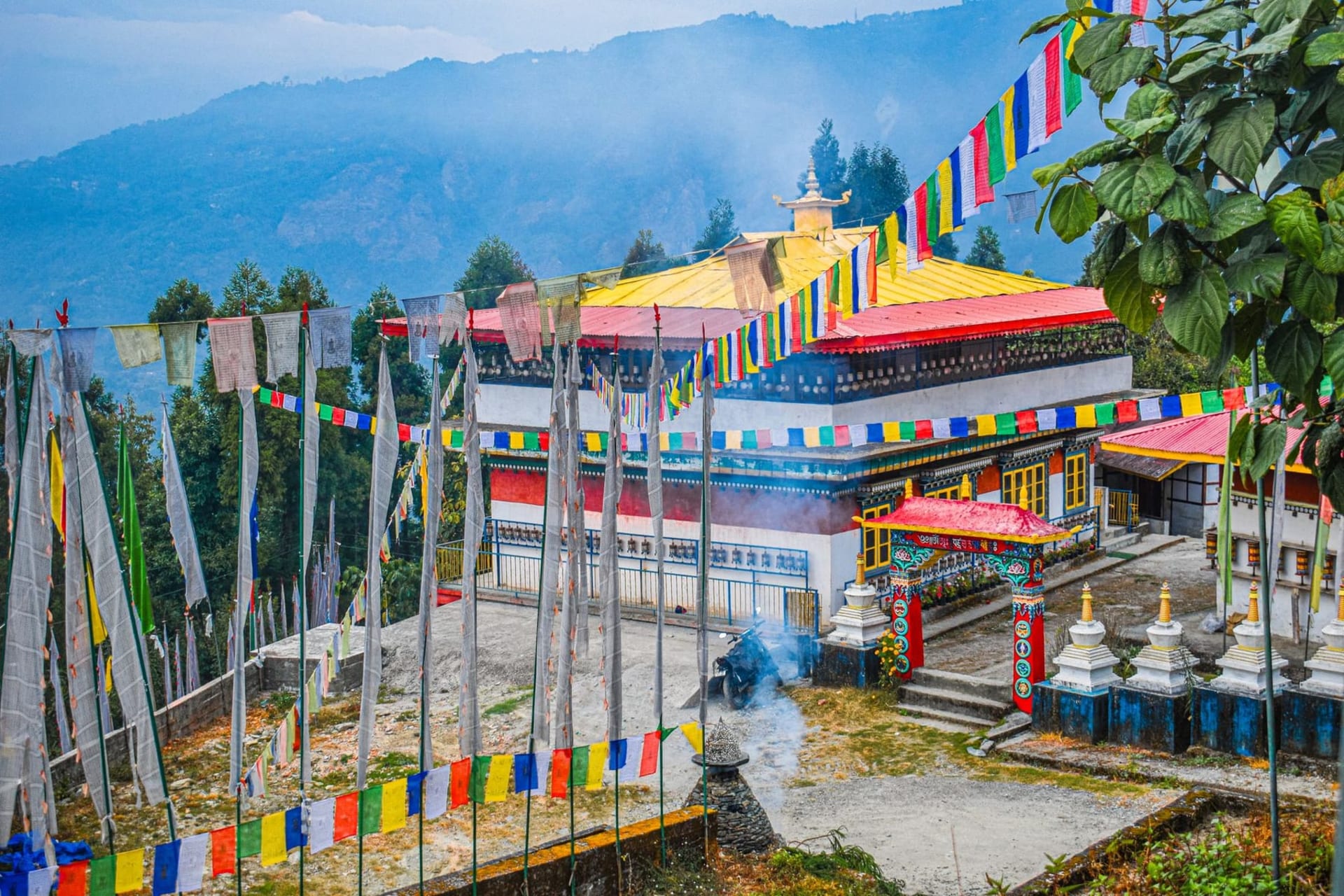
Sikkim
"Sikkim is the India that few people picture and everyone who visits refuses to stop describing."
Himalayan kingdom with Buddhist monasteries, cardamom forests, and views of the world's third-highest peak.
Nobody told me the air in Sikkim smells like cardamom. Not as a spice, not as a souvenir — as weather. Walking the road out of Yuksom toward the edge of a cardamom plantation, I kept thinking something was being cooked nearby, until Lia pointed out that the forest floor itself was the kitchen. The pods clustered in the undergrowth below waist-high banana-leaf canopies, and the whole hillside released this warm, faintly medicinal sweetness every time the mist shifted.
That’s how Sikkim works. It surprises you before you’ve asked it a question.
Above Gangtok
I had expected Gangtok to feel like a hill-station town caught between ambitions — and in some ways it does, with MG Marg’s pedestrian drag selling Darjeeling tea and phone cases in equal measure. But the mornings there are something else. From the guesthouse above Enchey Monastery, I watched the clouds thin at first light and Kangchenjunga materialize: the third-highest mountain on earth, fully visible, unrushed, filling the northeastern sky like a fact you keep forgetting. It’s one of those views that makes you feel the world is mostly hidden from you most of the time.
The monastery itself was quiet when I climbed up before breakfast. A monk was sweeping the courtyard in long, patient strokes. Prayer flags older than anything nearby snapped in the cold. The butter-lamp smell drifted out through a heavy wooden door.
Into the West
The road to Pelling winds through terraced fields and prayer-wheel pavilions where locals spin the cylinders as they pass, almost without breaking stride. At Pemayangtse Monastery, one of the oldest in Sikkim — founded in the early eighteenth century by the monk Lhatsun Chempo — I found a multi-story wooden model of Zangdog Palri, the celestial paradise of Guru Rinpoche, built entirely by one monk over years. No photograph I took of it captured anything useful. It’s the kind of object that only makes sense in person, in that particular dim light, surrounded by that particular silence.
The unexpected thing was the drive back. We stopped because a landslide had narrowed the road to one lane and a herd of yaks was crossing from a higher pasture. The herder, a teenager in a Sikkim FC jersey, waved at us from the other side with the complete indifference of someone whose yaks have always had the right of way. They probably do.
When to go: October through mid-December offers the clearest skies and the best chance of an unobstructed Kangchenjunga view; March and April bring rhododendron bloom across the hillsides, though morning clouds can linger into midday.