Jaisalmer
"Jaisalmer is a fort that never surrendered to modernity — people still sleep inside walls built to keep enemies out."
A living golden sandstone fort rising from the Thar Desert, where families still live inside its medieval walls.
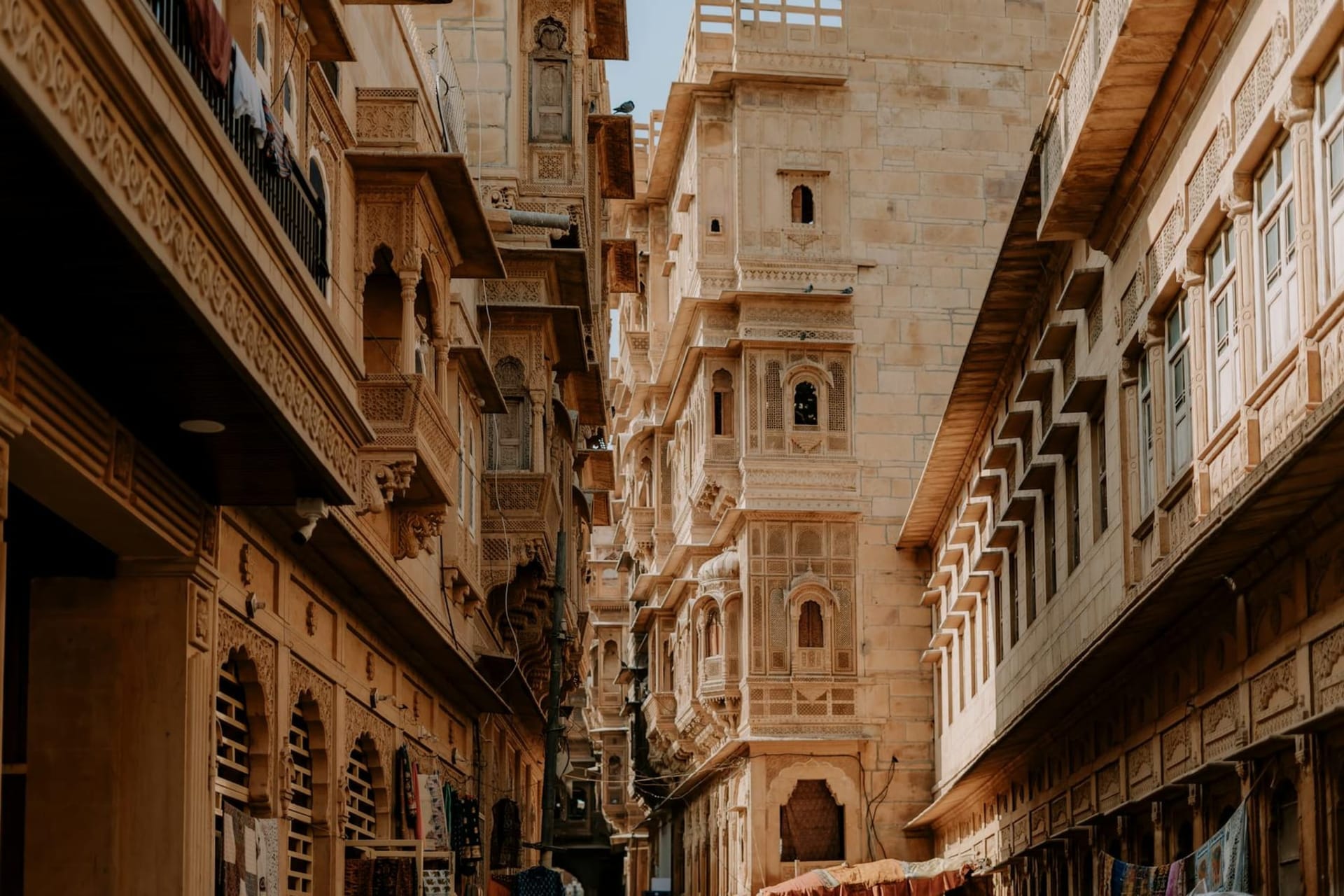
There is a particular quality of light in Jaisalmer that I have not found anywhere else — a saturated gold that seems to come not just from the sun but from the stone itself. The city is built from local yellow sandstone, and by late afternoon the whole place glows as though it has spent centuries quietly absorbing heat and is now, slowly, giving it back.
Inside the Living Fort
Most forts in India are monuments. Jaisalmer Fort is a neighborhood. About three thousand people still live within its walls, and when I walked up through Suraj Pol — the main gate — I did not enter a museum. I entered someone’s Tuesday. Women hung laundry from carved jharokha windows. A man sorted dried lentils on a step next to a sculpture that was eight hundred years old. The lanes inside are barely wide enough for two people to pass, and they smell of cooking oil, incense, and the particular dry warmth of old stone.
Lia and I spent an afternoon getting deliberately lost in the lanes that coil behind the Jain temples near Chandrapol. The temples themselves are extraordinary — their ceilings carved into cascading marble flowers so intricate they seem more like frozen foam than stonework. But the real discovery was a tiny chai stall wedged between two havelis where an elderly man made tea by throwing everything into a single blackened pot and letting it argue together over a gas flame. He handed it to us in small clay cups that we were apparently meant to smash on the ground when finished, which felt both wasteful and completely right.
The Desert Beyond the Walls
Jaisalmer’s reputation leans heavily on its camel rides and Sam Sand Dunes, and I understand the appeal — the Thar at sunset is genuinely moving, all coral and violet shadow. But the more interesting experience, for me, was simply standing on the fort’s northern rampart at six in the morning. The desert begins immediately outside the walls. There is no buffer of suburbs or industrial outskirts. The city ends, and then there is sand, and the silence of something very large and very indifferent.
I had expected the fort to feel theatrical, a set piece for tourists. What surprised me was how ordinary it was — how much it simply functioned as a town, complete with a small school, a post office, and a man who repaired motorbikes in a space no bigger than a wardrobe. The medieval and the mundane sit together here without ceremony.
Eating in the Old City
Dal baati churma — the Rajasthani staple of lentils, baked wheat balls, and sweetened crumbled bread — is best eaten in the lanes below the fort rather than in the rooftop restaurants aimed at travelers. The ones aimed at travelers have the views. The ones in the lanes have the food.
When to go: October through February, when temperatures are tolerable and the desert light is at its clearest. Avoid May and June — the heat becomes genuinely dangerous, and the fort’s stone radiates it back at you from every direction.